
☰ Explore Services & Menu
Pest Control +
Termite Services +
Commercial +
Wildlife & Bird Control +
Service Areas +
Pricing & Booking +
About Us +
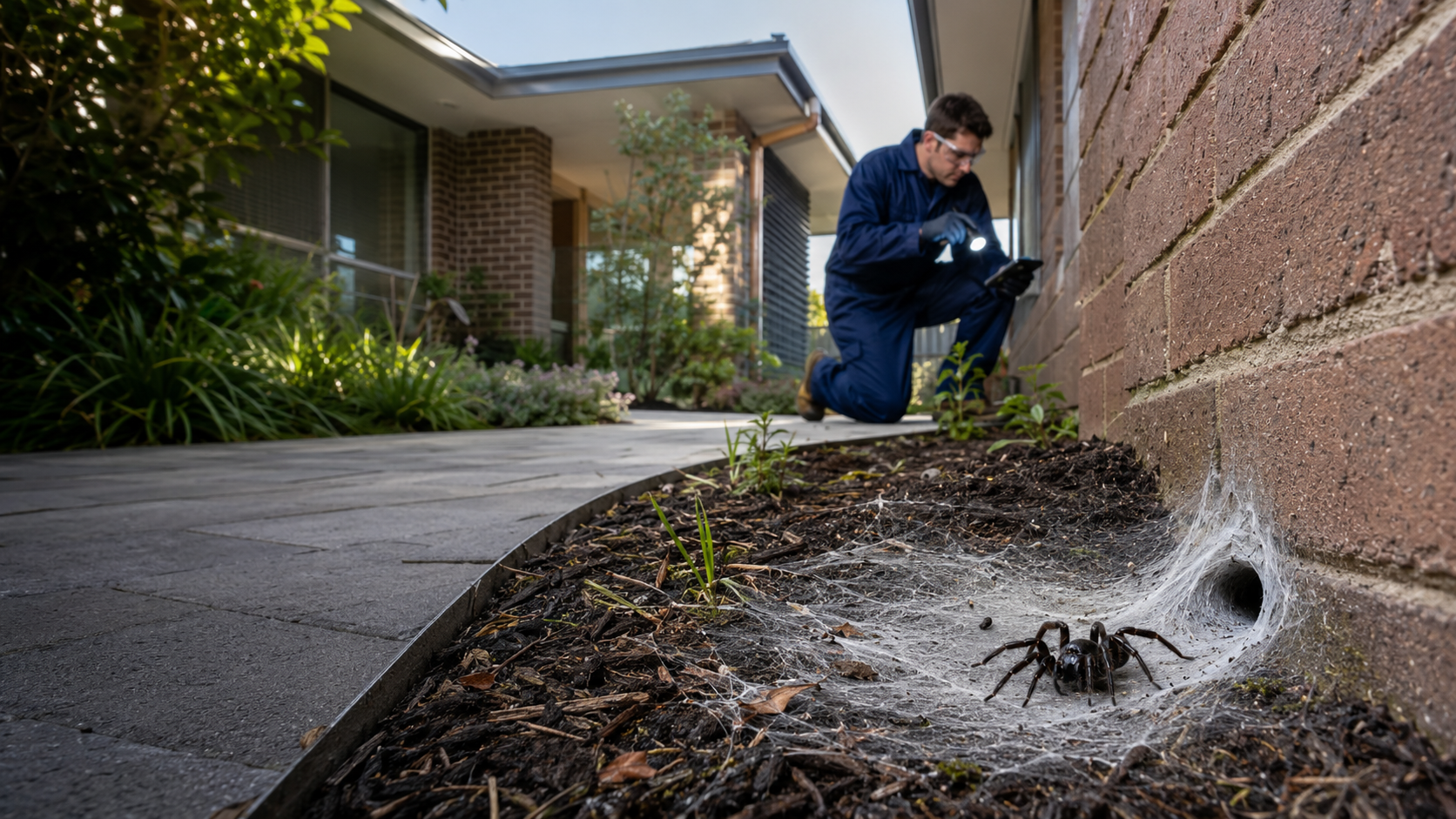
Melbourne redback, white-tail & house-spider specialists
Professional Spider Pest Control & Removal Melbourne
Targeted spider inspection, residual barrier treatment, void dusting and professional de-webbing for Melbourne homes and businesses. We locate active harbourages, remove accessible webs and egg sacs, treat high-risk entry routes and build a practical prevention plan for redbacks, white-tails, huntsman spiders, black house spiders and orb weavers—supported by a written elimination warranty for eligible services.
- ✓ Same-day spider control options
- ✓ Eaves, roof void and perimeter inspection
- ✓ De-webbing and targeted barrier protection
- ✓ Clear pricing before customer details
Same-day dispatch is subject to technician availability, access and safe treatment conditions.
Detailed Spider Inspection
Eaves, voids and entry routes
100% Elimination Guarantee
Eligible written service scopes
AEPMA-Certified
Spider treatment specialists
Police-Checked Local Team
Melbourne property specialists
Zero Hidden Fees
GST total shown before booking
Melbourne-Wide
South East to Peninsula
Why repeated spider activity deserves prompt attention
Why Spider Infestations Can’t Wait
One wandering spider does not always mean an infestation, but repeated sightings, active webs, egg sacs or redbacks around play areas justify a structured inspection. Early action reduces avoidable contact risk, prevents web build-up and reveals the prey and harbourage conditions supporting activity.
Venomous species in everyday living zones
Redbacks favour dry, sheltered, low-disturbance sites such as garden furniture, meter boxes, sheds, retaining walls, pot rims, pool equipment, toys and stored materials. These are precisely the places where a hand may enter before the spider is noticed. Children, gardeners, tradespeople and pets can be exposed when clutter or equipment is moved.
White-tail and huntsman spiders are active hunters rather than permanent web builders and may wander through open doors, windows or gaps while following insect prey. Professional spider pest control Melbourne work therefore combines risk-zone treatment with inspection, housekeeping and entry-point advice instead of assuming that every spider behaves the same way.
Webs and egg sacs multiply around sheltered edges
Black house spiders, orb weavers and other web-building species exploit corners where light, moisture and insects meet. Eaves, window frames, fences, verandas, pergolas and exterior lights can accumulate webbing quickly during warm conditions. Removing the visible strands alone does not treat the spider, protected retreat or egg sac.
Egg sacs can contain many developing spiderlings. After hatching, juveniles disperse to new edges and voids, creating the impression that treatment failed overnight. A professional spider exterminator plans residual placement around harbourages, removes accessible webbing at the correct stage and explains why monitoring through the hatching window is important.
Prey insects and building gaps sustain reinvasion
Spiders remain where food and shelter are reliable. Flying insects around lights, cockroaches in storage zones, ants near foundations, dense vegetation touching walls and unsealed service penetrations all increase opportunity. Repeated indoor sightings may point to a wider pest or exclusion issue rather than a single nest.
Our Melbourne spider inspection looks beyond the spider itself. We assess exterior lighting, screens, door seals, roofline gaps, vegetation, woodpiles, subfloor conditions and secondary pests. This broader diagnosis improves long-term control and helps households avoid unnecessary spraying across low-risk surfaces.
Transparent Melbourne spider treatment prices
Choose Your Property Size and See the Price
Customers comparing spider pest control cost can see the standard residential rates before submitting personal details. Prices below are before GST, and the booking calculator displays the final GST-inclusive total. Elevated access, extensive proofing, heavy webbing or unusual commercial conditions may require a separate written quote.
Pricing disclaimer: Prices and add-ons are shown before GST. The connected booking calculator keeps the chosen package and selected add-ons, then displays the final GST-inclusive total before customer details are submitted. Package inclusions apply to accessible areas and the written treatment scope. Major nest removal, extensive bird proofing, rodent exclusion, contaminated insulation, difficult access, elevated work or specialist cleaning may require an additional quote. Warranty and verification visits apply only where stated in writing.
Defined scope, responsible claims
Elimination Warranty, Licensing and Treatment Accountability
A strong guarantee is useful only when its scope is clear. TIM’s Pest Control documents the target spider group, accessible treatment zones, preparation, expected progress, de-webbing, re-entry instructions and warranty exclusions before relying on any elimination promise.
100% Elimination Guarantee for Eligible Spider Work
Where spider activity and harbourages can be reasonably established, the required zones are accessible, preparation is completed and prevention recommendations are followed, a written elimination warranty may be included. The service document—not a headline—defines the period, treated zones, response conditions and circumstances that require separately quoted work.
Outdoor spiders can naturally arrive from gardens, fences and neighbouring land, so no responsible company can promise that a property will remain permanently spider-free. Our guarantee applies to the eligible service provided and documented areas. Reducing prey, webs, clutter and entry gaps supports the barrier and gives the customer a realistic long-term protection plan.
Licensed, Insured and Evidence-Led
Treatment selection is based on spider behaviour, harbourage, building access, weather and occupant sensitivity. Products are used according to their registered label, with documented preparation and re-entry directions. Police-checked local technicians can be requested where available for occupied homes and managed properties.
Customers searching for AEPMA certified spider specialists can ask for confirmation of the technician’s current licence, training, insurance and relevant association credentials. TIM’s Pest Control explains where treatment will be applied, why those zones matter and which practical changes will protect the result.
Identification and biological behaviour
Which Spider Is Living Around Your Property?
Spider treatment succeeds when it matches the species, web style, hunting behaviour and harbourage. Melbourne properties can support medically significant redbacks, wandering white-tails and huntsman spiders, web-building black house spiders and seasonal orb weavers. Each requires a different inspection emphasis.
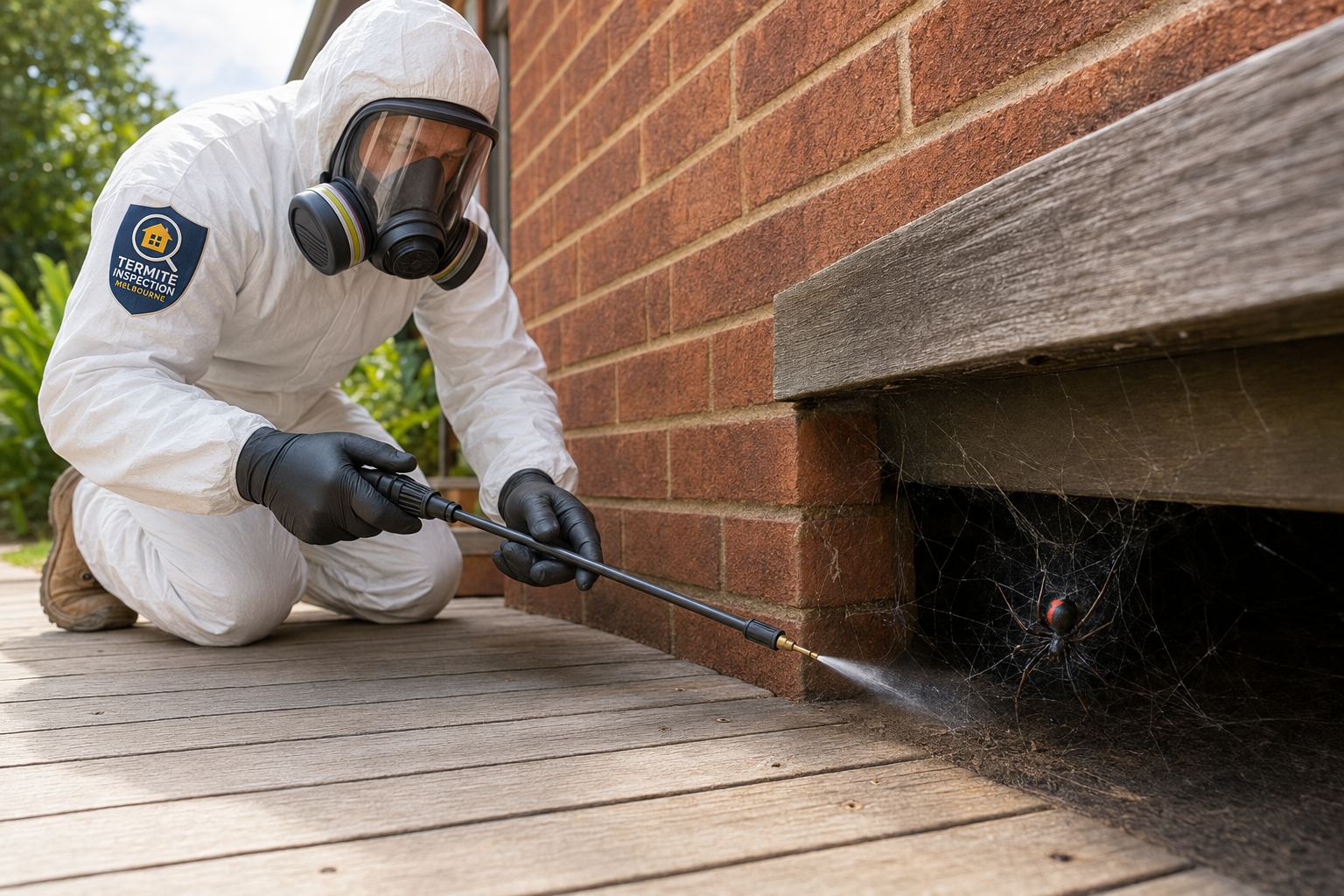
Medically significant web-building spider
Australian Redback Spider — Latrodectus hasselti
The redback is one of Australia’s best-known medically significant spiders. Adult females have a glossy dark body and often display a red or orange stripe on the upper abdomen, although markings vary and juveniles can look different. Females build irregular, strong, tangled webs with a sheltered retreat. The web is not a neat circular orb; it often contains supporting lines extending towards the ground where walking insects can be captured.
Redbacks prefer dry, protected sites that remain relatively undisturbed. Around Melbourne homes we inspect meter boxes, letterboxes, sheds, outdoor furniture, barbecue frames, fence posts, retaining walls, pot rims, pool-pump enclosures, cubby houses, toys, garages, subfloor edges and stored materials. Their habit of occupying low sheltered objects increases the chance of accidental contact when a hand reaches underneath or an item is moved.
Females may produce multiple egg sacs, each containing many eggs. Spiderlings disperse after hatching, while established females can remain close to a productive retreat. A surface spray directed only at the visible adult may leave protected sacs, web retreats and nearby harbourages untreated. Redback spider removal Melbourne work therefore begins with a careful inspection, avoids unsafe hand contact, treats the web structure and retreat as allowed by the product label, removes accessible webs and sacs, and improves storage and exclusion conditions.
- High-risk zones: children’s outdoor equipment, low garden furniture, gloves and boots stored in sheds, pool equipment, stacked pots and sheltered fence junctions.
- Do not handle: keep people and pets clear, avoid crushing the spider with bare hands and obtain medical advice immediately if a bite is suspected.
- Control focus: harbourage treatment, residual barrier placement, web and egg-sac removal, clutter reduction and routine checks of sheltered outdoor objects.
Fast wandering hunters
White-Tail and Huntsman Spiders
White-tail spiders, commonly associated with the genus Lampona, are active hunters that seek other spiders rather than relying on a permanent prey-catching web. Their elongated body and pale terminal marking can assist recognition, but identification should not rely on one photograph or a skin reaction. They may shelter beneath bark, leaf litter, rocks and outdoor debris, then enter buildings in clothing, towels, shoes, bedding, boxes or through unsealed doors and windows.
White-tails are often noticed at night as they move across walls or floors. A recurring indoor pattern can indicate abundant spider prey, cluttered storage, unscreened openings or harbourage along skirting, curtains and furniture. White tail spider treatment cost therefore reflects the property size and treatment zones rather than a single nest. We inspect both indoor routes and exterior conditions, target cracks and edges according to label directions, reduce prey webs and explain how to inspect laundry and stored items.
Huntsman spiders are large, flattened, fast-moving hunters. They frequently shelter beneath bark, behind shutters, in sheds, cars, roof spaces and narrow structural gaps. Their sudden appearance can be alarming, particularly when one enters a vehicle or bedroom, but they do not build the persistent capture webs associated with black house spiders. Treatment focuses on access points, exterior harbourage, prey reduction and careful removal of individual spiders rather than blanket indoor spraying.
- Indoor hotspots: curtains, wardrobes, stored cardboard, door tracks, window reveals, roof access points, picture frames and furniture gaps.
- Exterior sources: loose bark, woodpiles, dense vegetation, sheds, fence rails, roof junctions and items stored against walls.
- Medical accuracy: bites can cause local symptoms, but severe or worsening reactions require medical assessment; pest technicians do not diagnose bite wounds.
Why wandering spiders need a different strategy
A de-webbing service alone cannot control a spider that does not depend on a capture web. White-tails and huntsman spiders may move through a room while hunting prey and then shelter in a completely different gap. The plan must reduce the insects and smaller spiders they follow, treat practical travel routes and improve screens, door seals and storage habits.
When a customer reports repeated white-tail sightings, we look for black house spider webs and other prey around windows, walls and exterior lights. This relationship matters: suppressing the prey base can be more valuable than repeatedly spraying the last location where a wandering spider was seen.
Life cycle and egg-sac control
Spiders develop from eggs within a protective sac into spiderlings and then immature and adult stages. The time required depends on species and conditions. Egg sacs may remain protected in web retreats, under outdoor furniture, behind cladding edges or within stored material where a general surface application has limited reach.
This is why customers can observe tiny spiders after an adult has been removed. Accessible sacs are dealt with during professional de-webbing, and residual zones are positioned where emerging or dispersing spiders are likely to travel. The follow-up expectation is tied to the written package and hatching risk, not a promise that every hidden sac can be seen on day one.
Persistent web builders and seasonal garden spiders
Black House Spiders and Orb Weavers
Black house spiders, including Badumna species, construct dense, messy, lace-like webs around window frames, brickwork, eaves, fences, sheds and crevices. A funnel-shaped retreat leads into a protected gap where the spider waits for vibration. Exterior lights and windows supply a steady flow of prey, which is why the same corners can be recolonised after superficial web removal.
The professional response combines treatment of the retreat and surrounding contact surfaces, removal of accessible webbing and egg sacs, attention to window and eave junctions, and recommendations for lighting, screens and sealing. Because old silk remains visible long after a spider is gone, de-webbing also gives a cleaner monitoring baseline: fresh web construction after service is easier to detect.
Orb weavers build the familiar wheel-shaped webs across garden paths, verandas, trees and structures. Many are seasonal outdoor spiders and play a useful ecological role by capturing flying insects. Treatment is normally prioritised where web placement creates repeated human contact, blocks an entrance or affects a commercial presentation standard. Sensible management balances safety and cleanliness with the fact that not every garden spider requires chemical eradication.
- Black house spider hotspots include window corners, wall vents, pergolas, eaves, brick gaps, sheds and fence lines near lights.
- Orb-weaver activity often rises in warm weather where vegetation and flying insects are abundant.
- Long-term improvement depends on reducing prey attraction, pruning direct vegetation contact, changing unnecessary lighting and maintaining screens and seals.
Our evidence-led treatment framework
Our Proven 4-Step Spider Eradication Method
The method follows spider behaviour rather than relying on one blanket spray. We identify web builders and wandering hunters, treat the places they actually use, remove accessible web evidence and reduce the conditions that attract new activity.
Roof Void, Wall & Perimeter Inspection
We record sightings, identify likely species, inspect accessible eaves, window frames, doors, wall junctions, roof voids, subfloors, fences, sheds and stored items, and locate webs, retreats and egg sacs. We also assess lighting, vegetation, insect prey and practical entry points so treatment reaches the zones supporting activity.
Residual Barrier Spray & Targeted Dusting
Registered products are applied to agreed exterior and interior harbourages, travel edges, eaves, cracks and voids according to label directions. Dusting may be used in suitable dry, inaccessible spaces. The objective is controlled placement where spiders contact the treatment, not unnecessary spraying across furniture, bedding or open household surfaces.
Complete De-Webbing & Entry-Point Sealing
Accessible webs and egg sacs are swept from agreed eaves, frames and structural edges after inspection. This improves appearance and establishes a clean monitoring baseline. We identify practical gaps around screens, doors, vents, pipes and roof junctions, complete minor agreed sealing where included, and recommend separate proofing where specialist building work is required.
Verification & Post-Treatment Protection
Customers receive re-entry, cleaning and monitoring instructions. Where the package’s written scope includes verification, we review fresh web activity, sightings and hatching-cycle evidence before deciding whether a targeted adjustment is required. Prevention advice covers lighting, vegetation, storage, prey insects, screens and periodic perimeter maintenance.
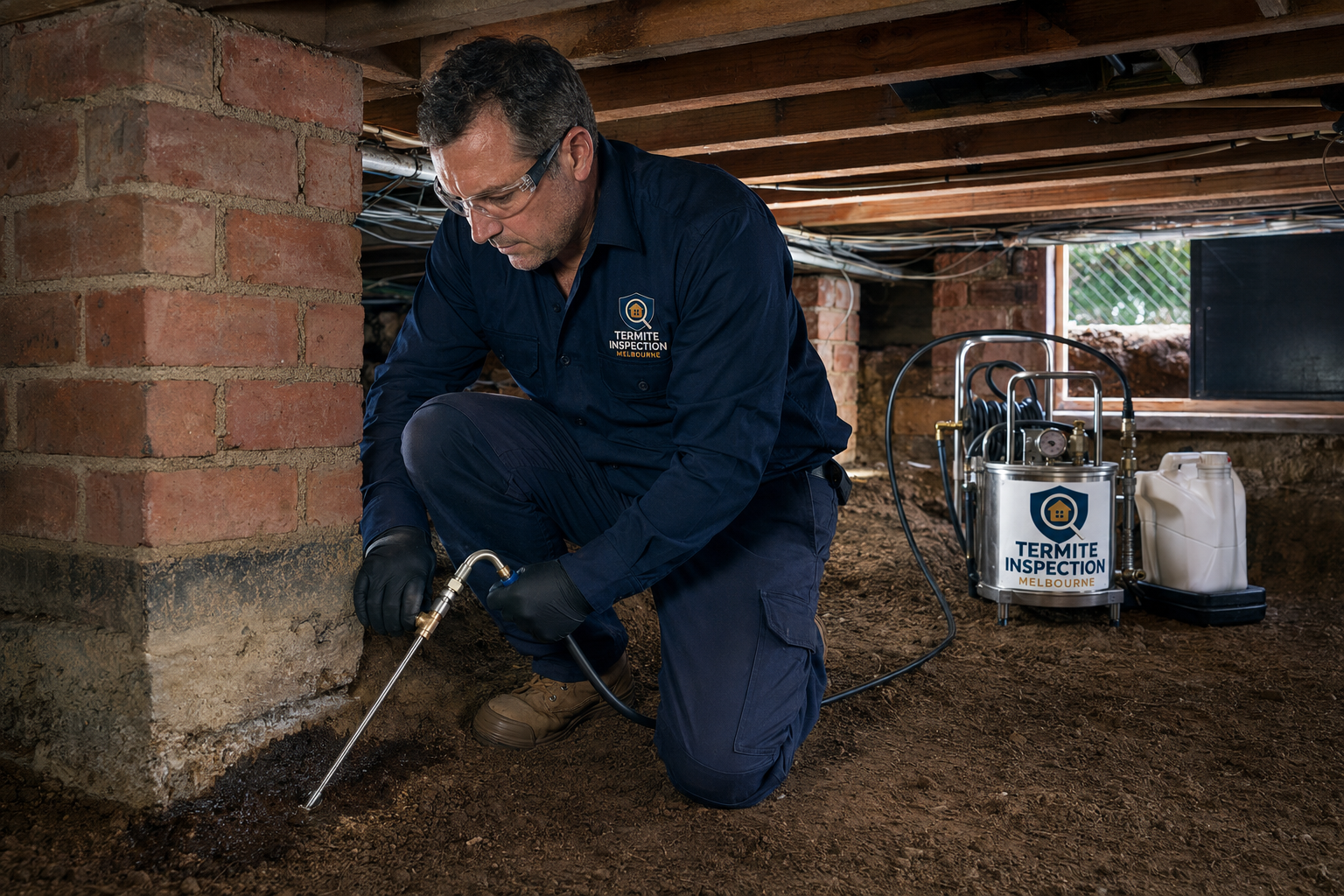
What to expect after treatment
Day-by-Day Spider Treatment Timeline
Day 1 — inspection, de-webbing and initial residual barrier
The technician confirms accessible harbourages, records web and egg-sac locations, completes the agreed residual and dusting treatment, and removes accessible webbing. Occupants follow the stated re-entry time and avoid washing treated structural edges. Individual spiders contacted during service may be removed or receive direct treatment where permitted.
Days 2–4 — active foragers contact the barrier
Wandering and emerging spiders crossing treated routes begin to contact the residual. An occasional sighting does not automatically mean failure because spiders may leave protected gaps after the initial disturbance. Record the location without layering supermarket sprays over the professional treatment.
Days 7–10 — hatching-cycle control and fresh-web review
Spiderlings emerging from hidden sacs should encounter active treatment where routes were correctly identified. Fresh web construction is easier to recognise after de-webbing. Continue monitoring windows, eaves, sheds and high-risk storage, and report concentrated new activity where the written scope includes support.
Day 30 — clearance and warranty review where applicable
Eligible services can be reviewed against the documented treatment zones and warranty conditions. The aim is controlled activity in the serviced areas, not a permanent promise against every outdoor spider. Maintaining screens, vegetation clearance, storage and prey control protects the result.
Treatment option comparison
Professional Spider Treatment vs DIY Products
Professional control combines inspection, correctly placed residual treatment, dusting where appropriate and physical web removal. A product used without understanding species behaviour may kill one visible spider while leaving retreats, egg sacs, prey and entry routes unchanged.
| Method | Source control | Effectiveness | Child & pet planning | Speed | Long-term result |
|---|---|---|---|---|---|
| Professional residual barrier & dusting | Inspection maps webs, retreats, egg sacs, prey and entry routes | High when species behaviour and harbourages guide placement | Documented preparation, exclusion and re-entry directions | Initial knockdown with continuing residual interception | Strongest when de-webbing, proofing and prey reduction are completed |
| Supermarket aerosol surface sprays | Usually limited to the spider or surface seen | Variable; often misses retreats, sacs and structural gaps | Misuse can create excess residue or exposure | Fast direct knockdown if the spider is contacted | Poor where web sites, prey and access remain |
| DIY bug bombs | No inspection or physical web and egg-sac removal | Unreliable in eaves, roof voids, subfloors and deep cracks | Requires strict label compliance; unsuitable for many situations | May kill exposed insects but provide little targeted control | Weak when protected harbourages remain |
| Professional de-webbing | Removes accessible webs and egg sacs and resets monitoring | Very useful as part of treatment; incomplete as a stand-alone method | Physical removal reduces unnecessary chemical dependence | Immediate visual improvement | Best when paired with residual treatment, prey control and exclusion |
Local inspection and treatment coverage
Spider Pest Control Across Melbourne
Our spider control Melbourne service covers the metropolitan area and the Mornington Peninsula. If you searched for spider pest control near me, spider control near me or local spider exterminators, our Clyde North team services Melbourne’s south east, eastern, northern and western suburbs. Vegetation, building age, exterior lighting, roof construction, stored materials and seasonal insect pressure vary across these areas, so treatment planning remains specific to the property.
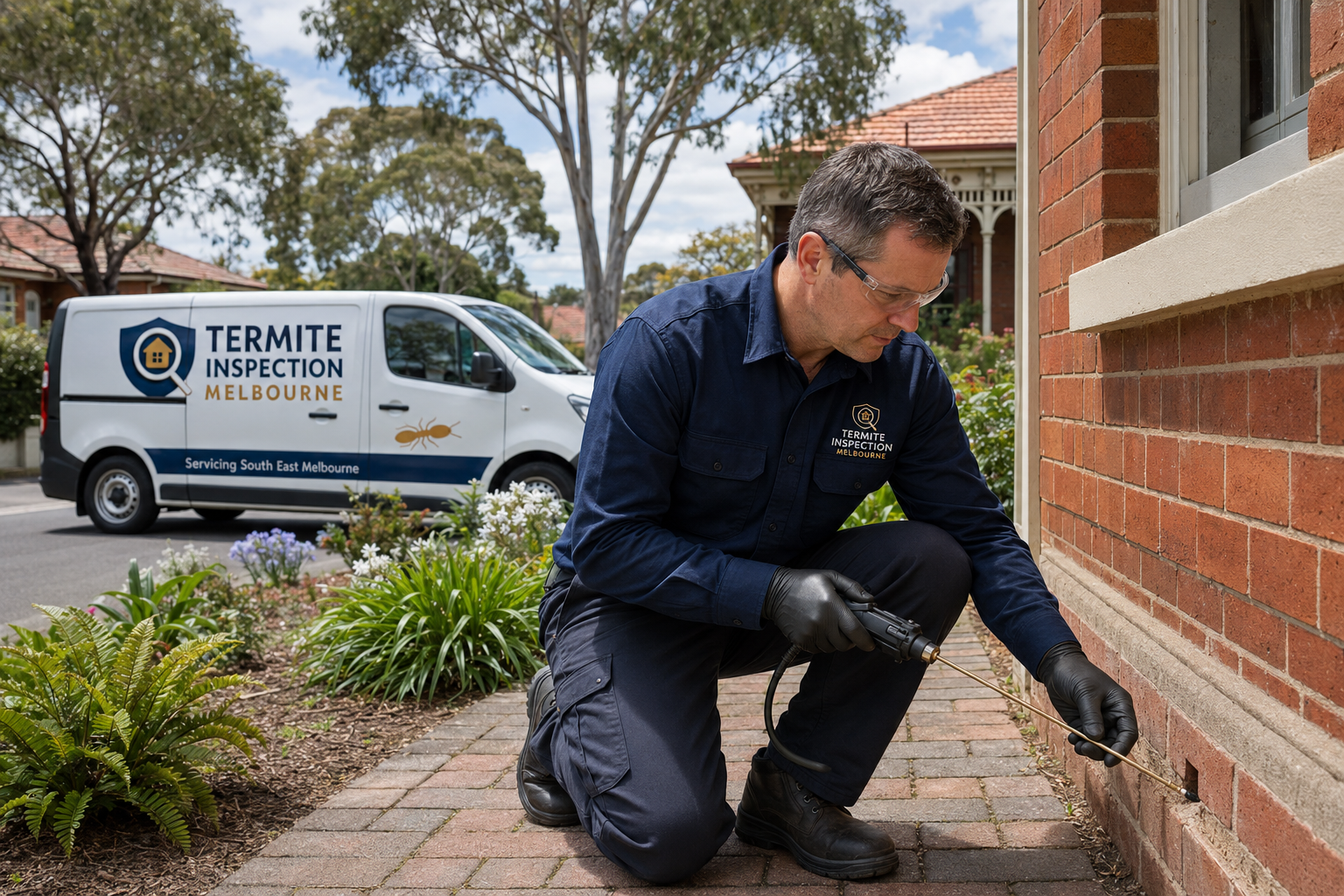
South East Melbourne & Clyde North
Clyde North pest control calls often involve modern tiled roofs, rendered walls, broad eaves, new fencing and landscaped estates near wetlands and open land. We service Clyde, Cranbourne, Berwick, Narre Warren, Pakenham, Officer, Dandenong, Keysborough and surrounding suburbs. Exterior lights and sheltered outdoor living areas can support web-building spiders, while building gaps allow huntsman and white-tail spiders to wander indoors. Same-day spider control is prioritised where scheduling and safe access allow.
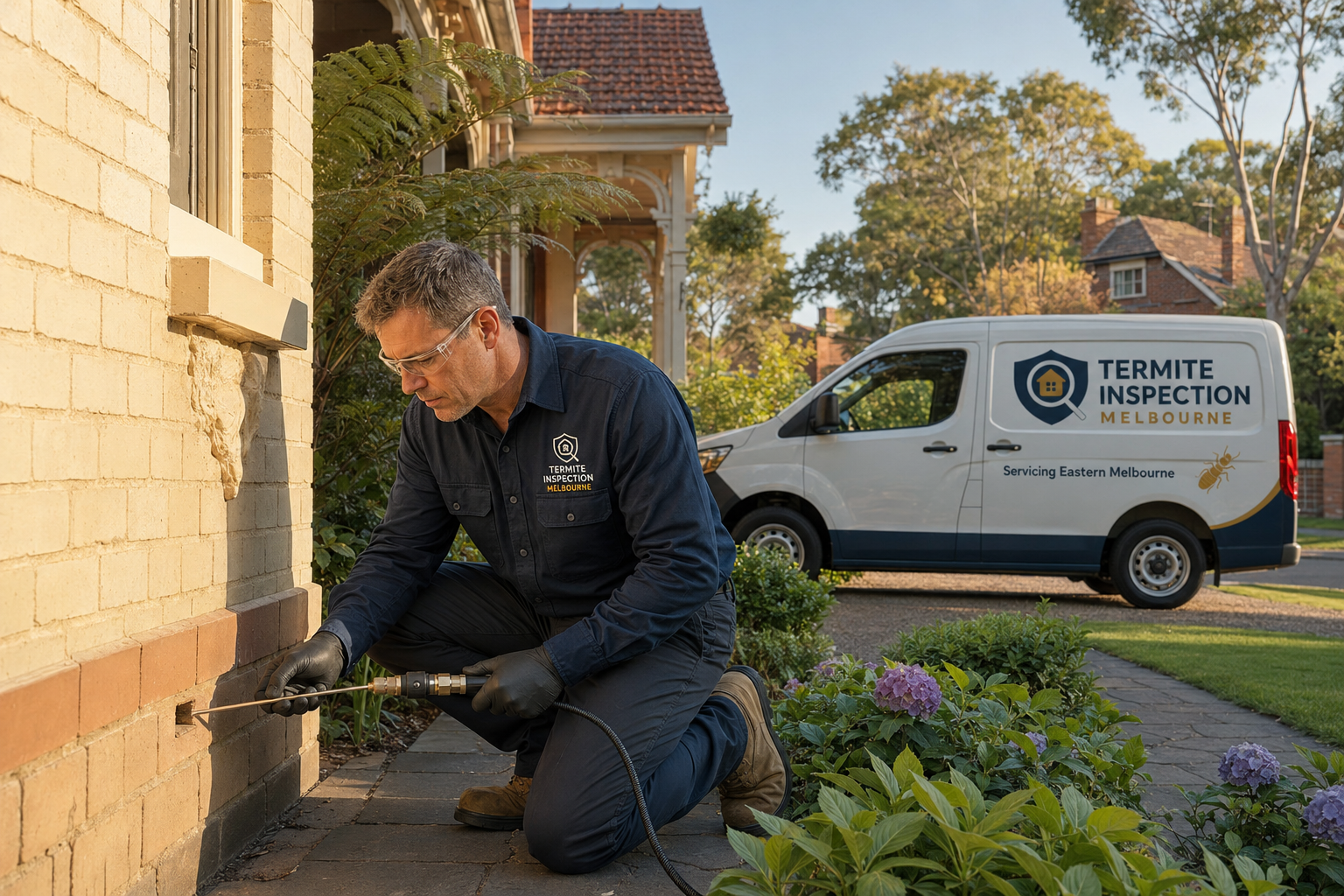
Eastern & Northern Melbourne
Leafy eastern and northern suburbs may have mature trees, older tiled roofs, subfloors, timber fences, sheds and vegetation touching buildings. We cover Ringwood, Croydon, Doncaster, Box Hill, Glen Waverley, Heidelberg, Preston, Brunswick, Coburg, Epping and nearby districts. Bark, woodpiles and dense gardens can support wandering spiders, while window frames and eaves near lighting attract the insects that sustain black house spider webs.
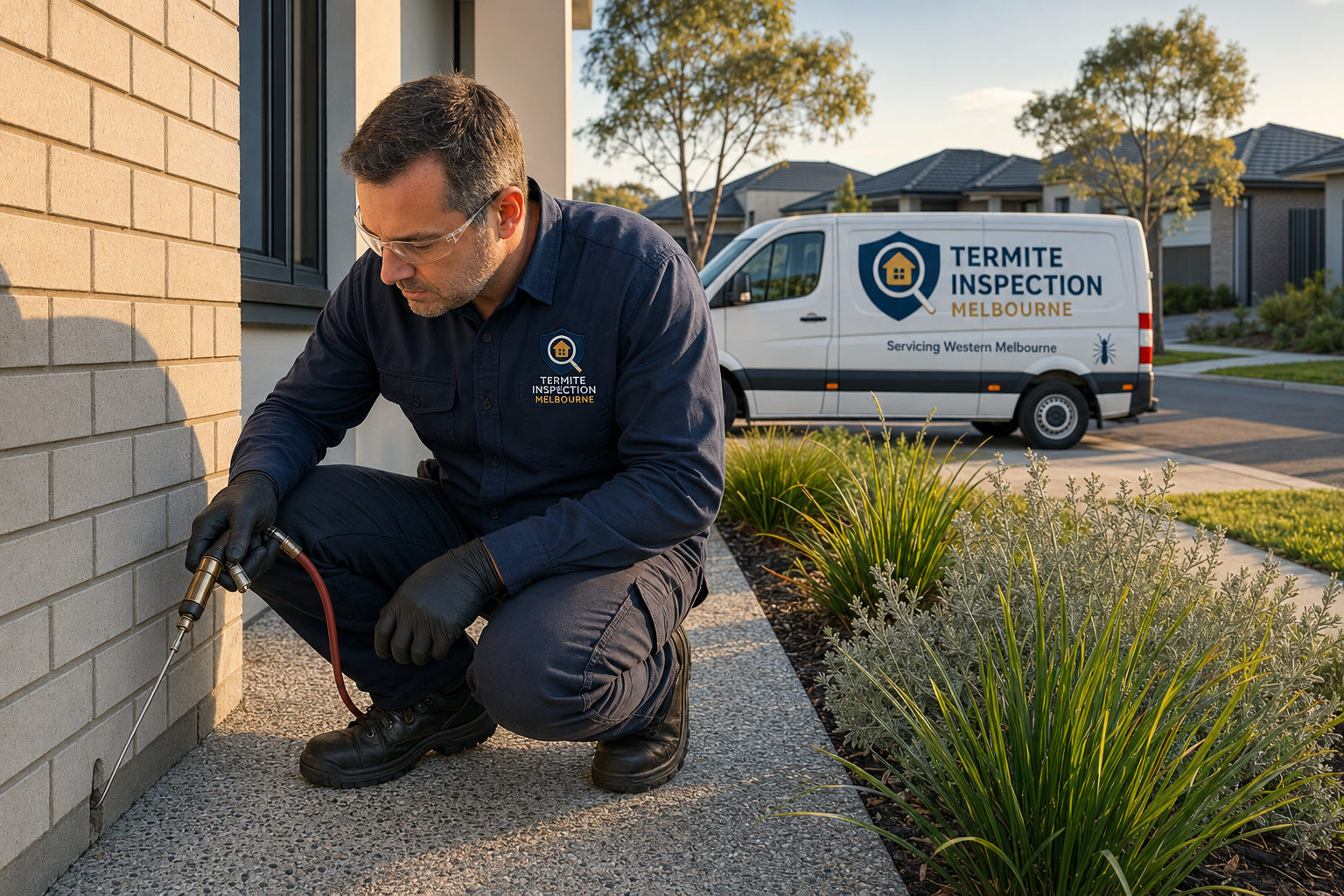
Western Melbourne & Melbourne CBD
Western suburbs and inner-city sites range from exposed new estates to warehouses, apartments and mixed-use buildings. We service the Melbourne CBD, Docklands, Footscray, Sunshine, Werribee, Point Cook, Altona, Williamstown and surrounding areas. Redbacks can exploit dry sheltered storage, equipment and retaining structures, while shared commercial access, elevated façades and presentation standards may require a documented IPM inspection before treatment is quoted.
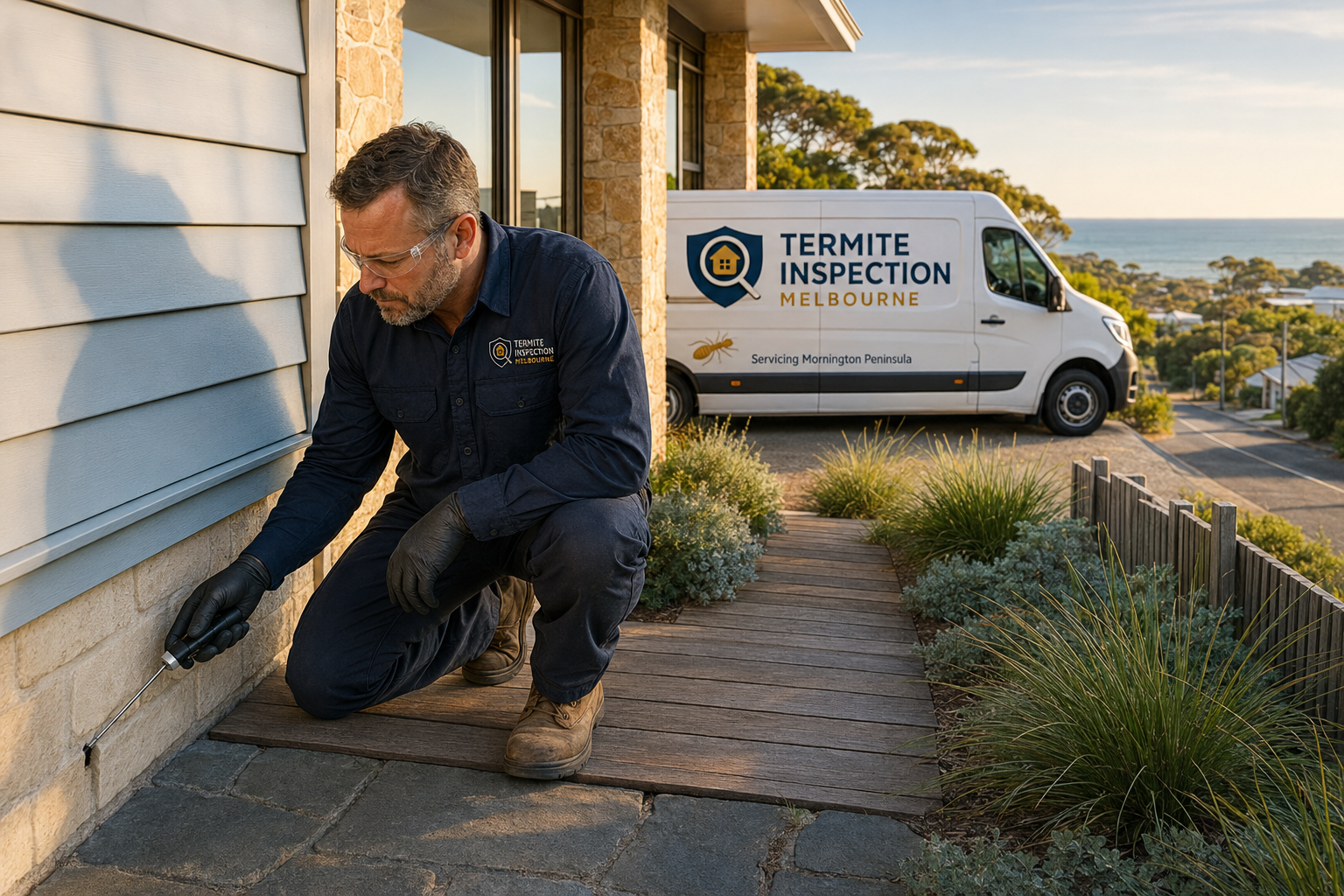
Mornington Peninsula
Coastal and peninsula homes combine vegetation, decks, sheds, fences, holiday-property vacancy and strong seasonal insect activity. We service Frankston, Mount Eliza, Mornington, Rosebud, Dromana, Hastings and surrounding communities. Orb-weaver activity can rise around gardens and paths, while less-disturbed storage areas can harbour redbacks and black house spiders. Inspection considers occupancy patterns, outdoor entertaining areas and weather exposure before defining the barrier.
Real social proof, no invented quotations
Check Verified Local Customer Feedback
We do not manufacture customer names or review quotes for a landing page. Use the links below to review current published feedback and service information for the area relevant to your booking.
★★★★★
Clyde North & South East Melbourne
Read current verified customer feedback, confirm service availability and judge our responsiveness before booking.
View verified reviews★★★★★
Melbourne CBD & Inner Suburbs
Read current verified customer feedback, confirm service availability and judge our responsiveness before booking.
View verified reviews★★★★★
Mornington Peninsula
Read current verified customer feedback, confirm service availability and judge our responsiveness before booking.
View verified reviewsProfessional safeguards
Licence, Insurance and Chemical Compliance
Every proposed treatment should be traceable to evidence, label directions and a written scope. Ask questions before work begins—especially where children, pets, asthma, food areas or occupied bedrooms are involved.
Licensed pest technicians
Request confirmation of the technician’s current Victorian licensing or authorisation relevant to the work.
Fully insured service
Appropriate business insurance supports accountable work in homes, rentals and commercial premises.
APVMA-registered products
Chemical products are selected and applied only within their registered label directions and approved use.
Police-check availability
Police-checked local technicians can be requested where available for occupied and managed properties.
Health note: pest treatment does not diagnose or treat a spider bite. Seek urgent medical help for severe pain, breathing difficulty, collapse, serious allergic reaction or rapidly worsening symptoms.
AEO and voice-search answers
Spider Pest Control Melbourne FAQs
Detailed answers about redbacks, white-tails, barrier sprays, treatment cost, preparation, child and pet safety, timing and warranty conditions.
Are white-tail spider bites dangerous?+
White-tail spiders can bite when trapped against skin, clothing, towels or bedding. Reported effects commonly include immediate pain, redness, swelling, itching or a local burning sensation, although symptoms vary and a skin lesion alone cannot identify the species responsible. Australian clinical evidence has not established white-tail spiders as a proven cause of the severe progressive tissue necrosis often attributed to them online. Any worsening wound, spreading redness, severe pain, systemic symptoms or suspected infection needs prompt medical assessment. Pest control cannot diagnose or treat a bite. Our role is to inspect the property, identify likely harbourages, reduce spider activity and explain prevention measures. If possible, retain a safely captured specimen for identification without risking another bite.
How do professional barrier sprays help prevent spiders from returning?+
A correctly selected residual barrier creates treated zones along surfaces that spiders commonly cross, including eaves, window frames, door surrounds, weep holes, service penetrations, fence interfaces and sheltered exterior junctions. The product must be registered for the intended use and applied according to label directions. Barrier treatment is strongest when combined with web removal, harbourage reduction, sealing of practical entry gaps and control of insects that serve as spider prey. It cannot create a permanent invisible shield against every spider arriving from gardens or neighbouring properties. Weather, UV exposure, porous surfaces, cleaning and new building gaps gradually reduce residual performance, so the technician explains realistic maintenance intervals and warranty conditions.
Why do spiders keep appearing near windows, lights and exterior walls?+
Exterior lights attract moths, flies and other insects, making nearby windows, eaves and wall corners productive hunting areas. Warm sheltered frames also provide attachment points for webs and egg sacs. Gaps around screens, sliding doors, pipes, rooflines and wall penetrations can allow wandering spiders inside. Removing a visible spider without addressing prey, webs and access points often produces only short-term relief. Our Melbourne spider inspection maps repeated web locations, checks lighting and vegetation, looks behind outdoor furniture and storage, examines eaves and window tracks, and recommends a combination of targeted treatment, web sweeping, exclusion and practical environmental changes.
How long does spider pest-control treatment take?+
A prepared small unit may take around one to two hours, while a three- or four-bedroom house with extensive eaves, fences, sheds, roof void access or heavy webbing may require longer. The treatment time depends on property size, accessibility, infestation pressure, selected zones, weather and whether optional roof-void, exterior or combined pest services are booked. The technician first confirms the species risk and accessible scope, then carries out the agreed residual, dusting and de-webbing work. Re-entry time depends on the products and surfaces treated and is provided before application. Commercial sites, elevated areas and complex access may require a separate inspection and written IPM plan.
Is professional spider treatment safe for children and pets?+
Professional spider treatment is planned around the property occupants and the registered product label. Children, pets, birds and other occupants must remain clear of active treatment zones during application and for the advised drying, ventilation or re-entry period. Toys, pet bowls, food, aquariums, bedding and sensitive items may need to be covered, removed or protected. Customers should disclose pregnancy, asthma, chemical sensitivity, fish tanks, reptiles, aviaries and other special circumstances before treatment. No pesticide is completely risk-free; safety comes from correct product selection, targeted application, measured dose, occupant exclusion and following the technician’s written directions.
What does white-tail spider treatment cost in Melbourne?+
Standard residential spider pest-control prices on this page are $150 before GST for a small one- to two-bedroom unit, $180 before GST for a medium three-bedroom house and $210 before GST for a large four-bedroom property. Those prices become $165, $198 and $231 including GST. This gives customers comparing spider pest control cost or spider removal service rates a clear starting point before personal details are submitted. The final white tail spider treatment cost depends on the agreed zones, access, activity level and optional add-ons such as a roof void, exterior front and back, large floor area, ant control, rodent control or general pest control. Commercial work begins with a $150 inspection-only IPM assessment; treatment is quoted separately after the site risks are understood.
Do you offer same-day spider control in Melbourne?+
Same-day spider control may be available when a suitable technician, safe treatment window and travel route are available. Call 0466 929 533 and explain the suburb, spider location, whether anyone was bitten, whether the spider is still visible, property size and any children or pets present. A bite causing serious symptoms is a medical matter—call emergency services or the Victorian Poisons Information Centre as appropriate rather than waiting for pest attendance. For a property infestation, we can prioritise an urgent Melbourne spider inspection, confirm available times and show the applicable service price before booking. Same-day attendance is subject to confirmation and is not represented as a guaranteed 24-hour emergency service.
Will bug bombs or supermarket sprays eliminate a spider infestation?+
Aerosol sprays may kill a spider that receives a direct application, but they rarely provide the inspection, coverage and prevention needed for repeated activity. Total-release foggers can distribute product onto exposed surfaces while failing to penetrate protected eaves, roof voids, subfloors, wall junctions, stored materials and egg-sac locations. Indiscriminate use may also increase occupant exposure and is unsuitable around many pets and sensitive environments. Professional spider control combines identification, targeted residual treatment, void dusting where appropriate, physical de-webbing, egg-sac removal where accessible and practical exclusion. The result depends on reaching harbourages and reducing the insect prey that attracts spiders.
Should I remove spider webs before the technician arrives?+
Leave representative webs, egg sacs and activity zones undisturbed where safely possible because they help the technician identify harbourages and plan treatment. You can remove obvious household clutter and provide access to skirting, windows, doors, sheds and exterior walls, but do not climb ladders or handle suspected redbacks. Note where and when spiders were seen, photograph specimens from a safe distance and keep children and pets away. Professional de-webbing is normally carried out after inspection and treatment planning so evidence is not erased too early and the appropriate surfaces can receive residual protection.
What does the spider elimination guarantee cover?+
A written elimination guarantee may apply to eligible spider services when the nominated species, accessible treatment zones, preparation and prevention conditions are clearly documented. It relates to the service scope, not a promise that no outdoor spider can ever enter a Melbourne property again. New landscaping, unsealed gaps, untreated neighbouring areas, weather exposure, cleaning of treated surfaces, inaccessible roof or wall voids and failure to reduce harbourage or prey can affect results. The written service agreement defines the warranty period, included response, treated areas and exclusions. Customers should rely on that document rather than a general advertising headline.
Sunday dispatch windows may still be available
Remove Active Spiders, Webs and High-Risk Harbourages Today
Call now for urgent redback, white-tail, huntsman or web-building spider control across Melbourne. We will confirm availability, explain the likely inspection and treatment pathway, and show the final GST-inclusive service price before booking.