
Rechargeable Pipe Network
Commercial-grade flexible perforated lines distribute compatible termiticide through designed foundation zones
Request reticulation assessment →Install a purpose-designed flexible pipe network around footings, slab perimeters and other approved zones so compatible termiticide can be distributed and later replenished through secure access points. TIM's Pest Control engineers zoning, pipe layout, manifolds, fill ports, flow testing and initial chemical charge around the actual building—not a generic loop with unverified pressure or uneven distribution.
Request a same day termite quote subject to route availability. A serviceable rechargeable termite barrier pipe network can reduce future re-trenching or repeat drilling across covered zones, but chemical protection remains finite and requires inspection and scheduled recharge. Relevant work references AS 3660—not the commonly searched but incorrect “AS3650.”
One transparent installation rate with GST shown clearly
Pricing is based on the measured reticulation pipe installation length—not bedrooms or broad property-size categories. Standard installation is $30 per lineal metre before GST, equal to $33 per lineal metre including GST. Enter the estimated lineal metres below and the booking calculator will show the calculated total.
Final measurement is confirmed on site. Difficult excavation, concrete cutting or drilling, damaged existing networks, specialised manifolds, active termite treatment and future chemical recharge are outside the standard lineal-metre installation rate unless expressly included in the written scope. No additional work proceeds without customer approval.
*The $30 rate is per installed lineal metre before GST. The booking calculator shows $33 per lineal metre including GST and includes selected paid add-ons. Final measured length and any non-standard site work are confirmed before installation. Work outside the approved written scope requires separate customer authorisation.
Rechargeable infrastructure engineered around the foundation
A termite reticulation system Melbourne installation divides the property into engineered underground delivery zones. Perforated flexible pipe is laid around relevant footings or under approved concrete interfaces, connected to controlled manifolds and accessible ports, pressure tested, documented and charged with a compatible registered termiticide.
Customers sometimes search for “AS3650 compliant reticulation networks.” The correct termite management reference is the AS 3660 series. Our proposal identifies the applicable installation pathway and never treats an incorrect keyword as a substitute for the relevant standard.
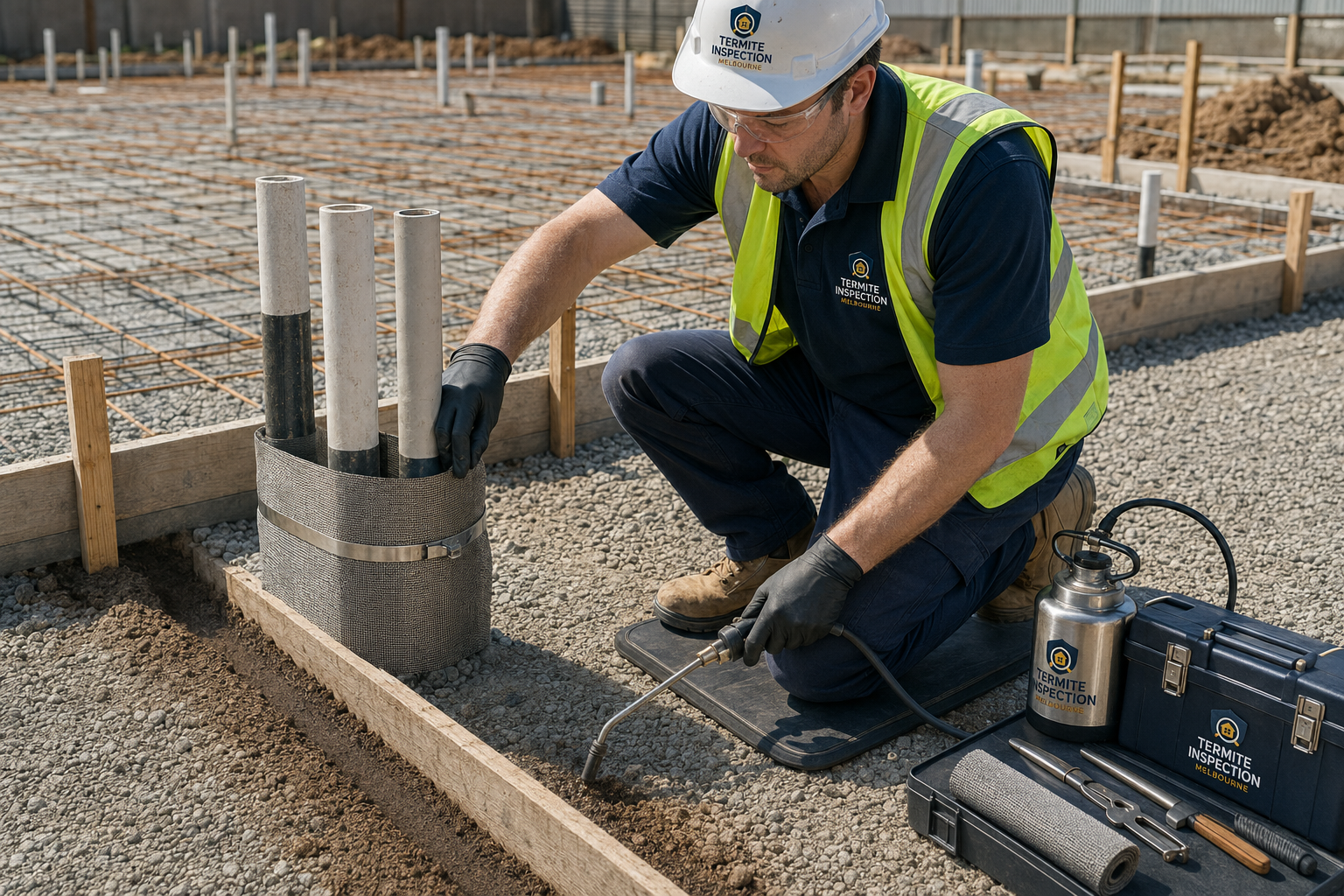
Commercial-grade flexible perforated lines distribute compatible termiticide through designed foundation zones
Request reticulation assessment →Independent circuits balance pressure and chemical volume across long or complex perimeter layouts
Request reticulation assessment →Clearly identified fill points allow authorised recharge work without exposing occupants to open pipework
Request reticulation assessment →Calculated product volume and delivery pressure support more uniform distribution through each serviceable zone
Request reticulation assessment →Installation and maintenance checks identify leakage, blockage or uneven delivery before chemical charging
Request reticulation assessment →Networks installed before paving or slab completion can reduce repeated drilling during future recharges
Request reticulation assessment →Clay movement, sandy soils, drainage and trench stability are assessed before pipe depth and zoning are confirmed
Request reticulation assessment →As-built diagrams, charge records, inspection dates and qualifying product conditions remain traceable
Request reticulation assessment →Accountable high-value infrastructure work

TIM's Pest Control operates from Clyde North and services Melbourne Metropolitan Area, South East Melbourne, Eastern Melbourne, Northern Melbourne, Western Melbourne and the Mornington Peninsula. Our process is built around competent inspection, traceable evidence, measured treatment zones and a clear written scope that matches the building. Customers should verify the current licence, insurance certificate and any professional accreditation before relying on a provider.
The business represents its timber-pest work as supported by up to $10 million liability cover for the applicable insured activities. Insurance does not make inaccessible cavities inspectable or turn a visual inspection into a structural guarantee. Ask for the current certificate of currency and written warranty conditions. A responsible inspector explains both protection and limitation instead of hiding qualifications in fine print.
Police-checked local personnel, AEPMA certified timber pest specialists and current verified customer feedback are valuable trust signals only when they can be substantiated. We do not invent review quotations or freeze a rating forever in code. Visitors are encouraged to check the live Google Business Profile for current reviews from Clyde North, Melbourne CBD, South East Melbourne and Mornington Peninsula customers.
Local South East Melbourne response for active termites, barriers, baiting and annual maintenance.
Apartment, terrace and shared-building treatment scopes with access and ownership limits documented.
Coastal moisture, decks, subfloors and variable soils considered in the management design.
New estates, established homes, concrete paths and concealed slab-edge risks mapped before installation.
Chemical zones are protective systems with finite service lives
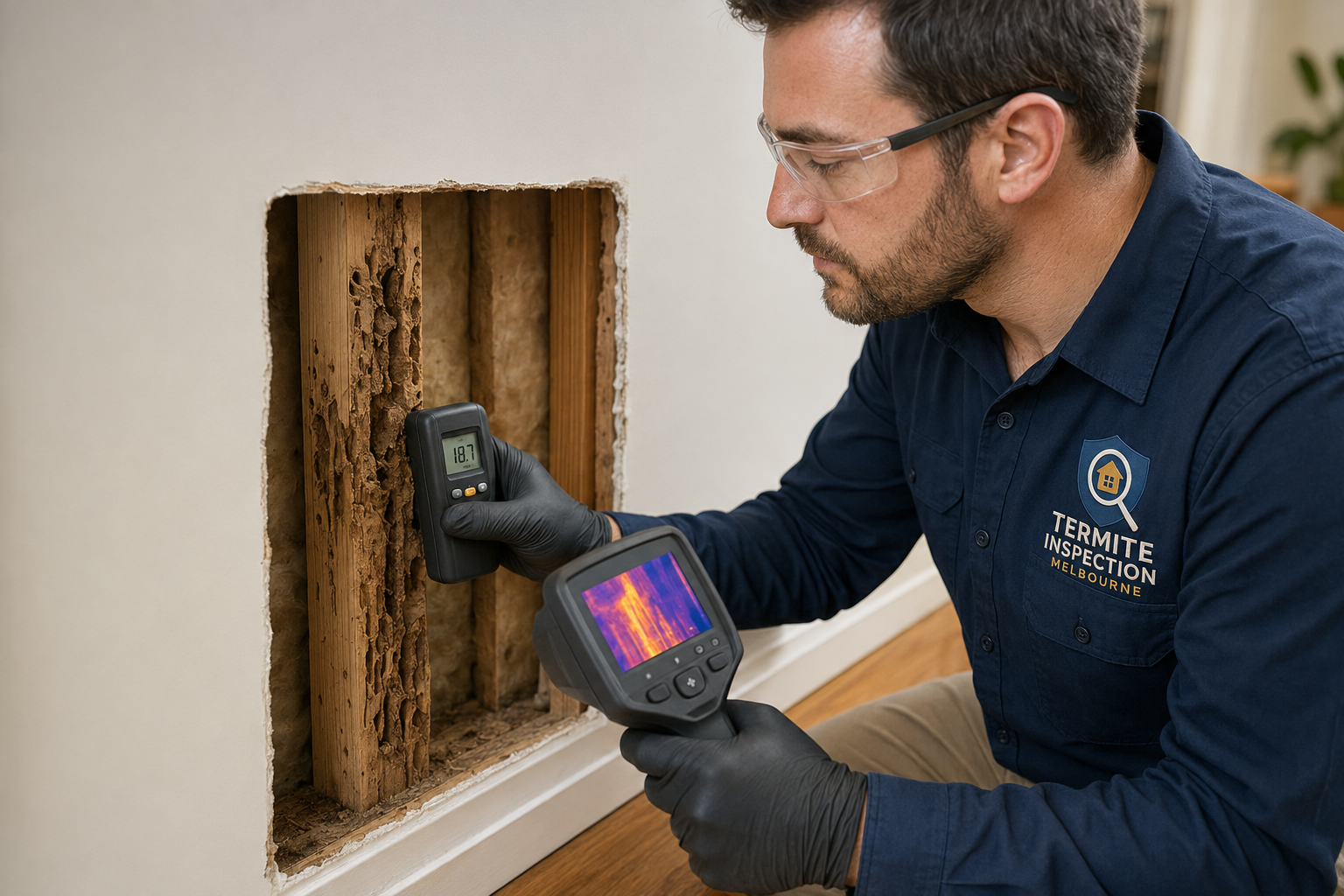
Subterranean termites live within organised colonies and forage through soil, concealed joints and protected mud galleries. Workers can remove cellulose from framing, flooring, skirtings and joinery while leaving a thin outer surface that still appears intact. Fresh plaster, paint or renovation finishes may hide previous repairs and active entry routes. By the time doors distort, floors soften or paint blisters, damage may extend well beyond the first visible location.
Coptotermes species are among the most destructive structural termites in Australia. Schedorhinotermes—often misspelled “Shedrinotermes”—can also cause serious damage and may present soldiers of more than one size. The activity of either group must be managed according to evidence, construction and colony behaviour. Spraying a visible tube can kill exposed individuals while disturbing the colony and making professional tracing more difficult. Contact aerosols rarely reach the nest; they can interrupt the visible gallery while workers redirect through another concealed route.
Many standard Australian home insurance policies exclude gradual termite or insect damage, although each Product Disclosure Statement is different. This is why annual termite inspection is commonly recommended and why higher-risk homes may need shorter monitoring intervals. An inspection cannot prevent entry between visits, but it can identify evidence, damaged timber and conducive conditions before they become more expensive. Property value can also be affected when unresolved active activity, incomplete treatment records or widespread damage appears in a future timber-pest report.
Soil-applied termiticide does not remain at its original performance indefinitely. Registered longevity is influenced by product, dose, soil composition, drainage, microbial activity, excavation and physical disturbance. Melbourne clay can crack, swell and move; landscaping and plumbing work can cut through treated interfaces. A serviceable permanent termite management system refers to the installed delivery infrastructure—not permanent chemistry. The network must still be inspected, tested and recharged at the documented interval.
Without reticulation, renewing soil beneath paths or adjoining slabs may require fresh drilling, injection access or renewed trenching. A correctly located pipe network can reduce that future disruption in the zones it serves. It cannot eliminate every future excavation forever: blocked, damaged, undocumented or inaccessible lines may require repair or an alternative treatment method. This limitation is recorded during the engineering audit.
Subterranean termites do not need a visible crack through the centre of a slab. They can exploit concealed slab edges, construction joints, service penetrations, subfloor piers and bridged inspection zones near weep holes. New-building termite management is coordinated with the National Construction Code, applicable state requirements, registered systems and the AS 3660 series. Existing homes require a site-specific retrofit plan because later paths, decks, render and gardens may conceal or bypass original inspection provisions.
Species, caste and colony behaviour
Correct identification matters because termite groups differ in moisture needs, nesting, foraging behaviour and treatment strategy. A qualified inspector uses specimens where available, mud-work characteristics, damage patterns and site context rather than guessing from one photograph.
Subterranean colonies generally maintain contact with soil or another reliable moisture source. Workers forage through underground galleries and protected mud tubes, locating cellulose in buildings, fences, stumps and landscaping. They can cross small gaps, exploit cracks, travel through service penetrations and bridge physical systems when inspection zones are concealed.
Coptotermes acinaciformis, Schedorhinotermes, Nasutitermes and Heterotermes groups may be encountered in Australian timber-pest work. Species certainty requires suitable evidence. The report should state whether identification is confirmed, probable or unavailable.
Dampwood termites are associated with timber containing high moisture and are more likely in decayed logs, stumps, leaking structures or persistently damp timber than in dry sound framing. Their presence can signal a moisture or decay problem that needs repair even when the colony is not behaving like a major subterranean species.
Management may require removal of the moisture source, replacement of decayed timber and targeted pest advice. Simply treating insects without correcting the leak, drainage or ventilation problem can leave the property vulnerable to continuing decay and other timber pests.
Drywood termites can live within timber without regular soil contact. They are much less common in Melbourne than subterranean termites, but unusual imported timber, furniture or local evidence still requires competent identification. Dry pellet-like frass and contained gallery patterns may justify specimen collection or specialist confirmation.
The correct response is not to assume every hole or pellet is drywood termite evidence. Wood borers, ants and ordinary debris can be misidentified. Treatment scope depends on confirmed activity, affected items and the extent of accessible timber.
Workers perform most foraging, feeding and construction. Soldiers defend the colony and can provide important identification features. Winged reproductive alates leave mature colonies during suitable weather to establish new colonies; discarded wings near windows can be an early warning. The primary queen can live deep within the nest and produce large numbers of eggs, while supplementary reproductives may support growth in some colonies.
Killing visible workers does not prove colony elimination. Professional treatment seeks to exploit termite behaviour, create a continuous treated zone or maintain an effective monitored system. Follow-up evidence and annual checkpoints are therefore essential parts of a defensible plan.
Termites construct protected tubes and packed workings that help conserve humidity and shield movement from light and predators. Inspectors examine slab edges, foundation walls, piers, ant caps, plumbing penetrations, subfloor timbers, skirtings and other junctions for these signs. Sounding can identify timber that has lost internal substance while retaining an outer veneer.
Sounding is an indicator, not a complete diagnosis. Timber can sound hollow because of construction, delamination or old damage. Findings are combined with moisture readings, thermal patterns, radar where appropriate and direct evidence before a conclusion is reported.
From hydraulic design to initial chemical charge
Effective termite management is a sequence—not a single spray. Diagnosis comes first, active-colony treatment follows where required, the building receives an appropriate management system, and scheduled inspections verify that the plan remains intact.
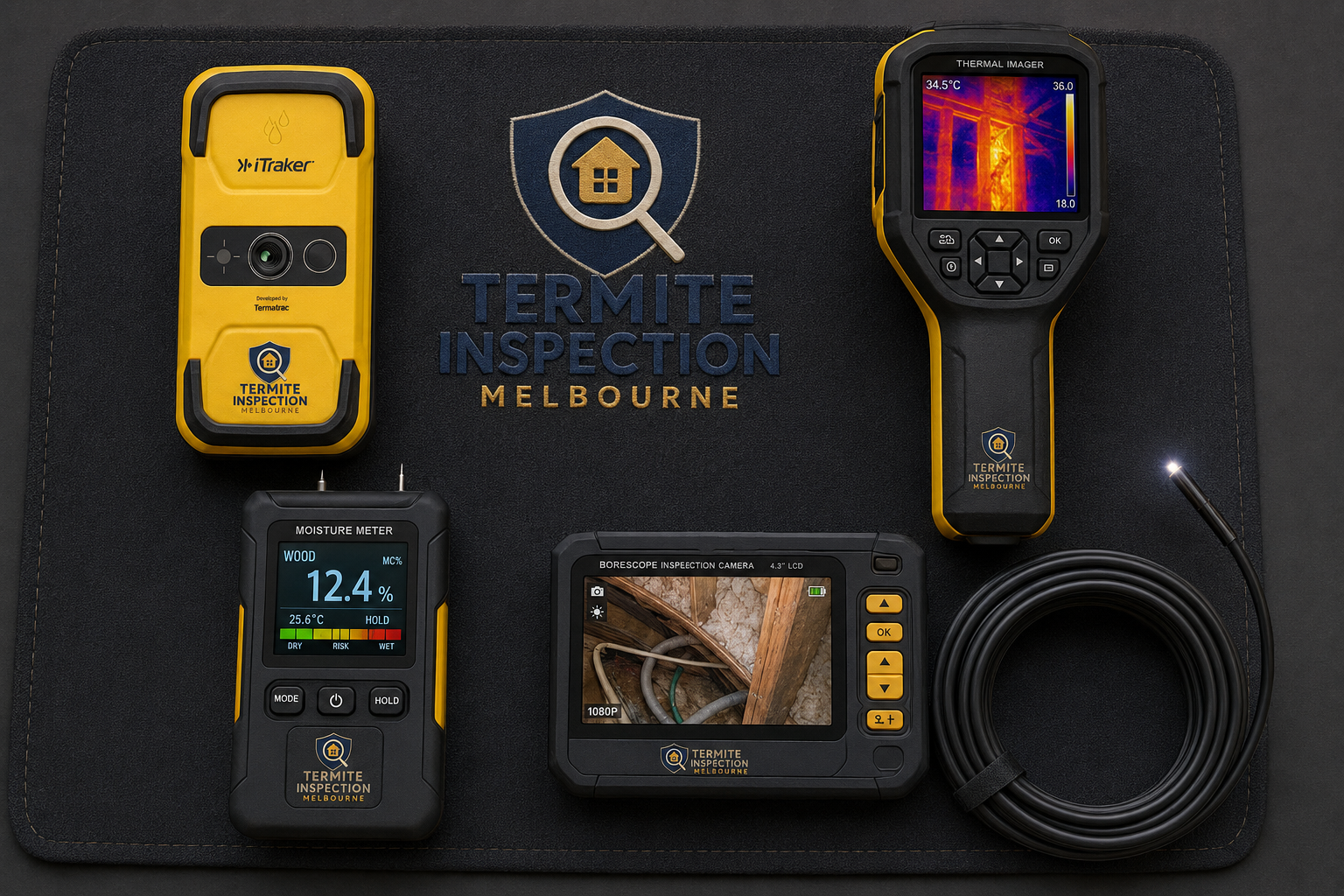
The inspector examines accessible interiors, exteriors, roof voids, subfloors, outbuildings and relevant grounds. FLIR thermal imaging maps surface-temperature differences; a moisture meter identifies unusual dampness; Termatrac radar may detect movement or moisture patterns within suitable materials. These tools do not see through every wall and must be interpreted with physical evidence.
Findings include active termites, previous workings, damaged timber, mud leads, conducive moisture, concealed slab edges, bridging, restricted access and other timber pests. The written report separates confirmation from suspicion and explains when invasive investigation or structural advice is justified.
Accessible soil beside footings is trenched to the engineered depth and width without undermining the structure. Commercial-grade flexible reticulation hose is placed in compatible bedding and protected from crushing, sharp aggregate and later landscaping. Pipe spacing, perforation orientation and zone length follow the selected system design.
The installer divides the perimeter into calculated circuits so one long run does not receive excessive flow near the port and insufficient flow at its far end. Crossings, corners, step-downs, service penetrations and future concrete areas are photographed and added to the as-built drawing before the network is covered.
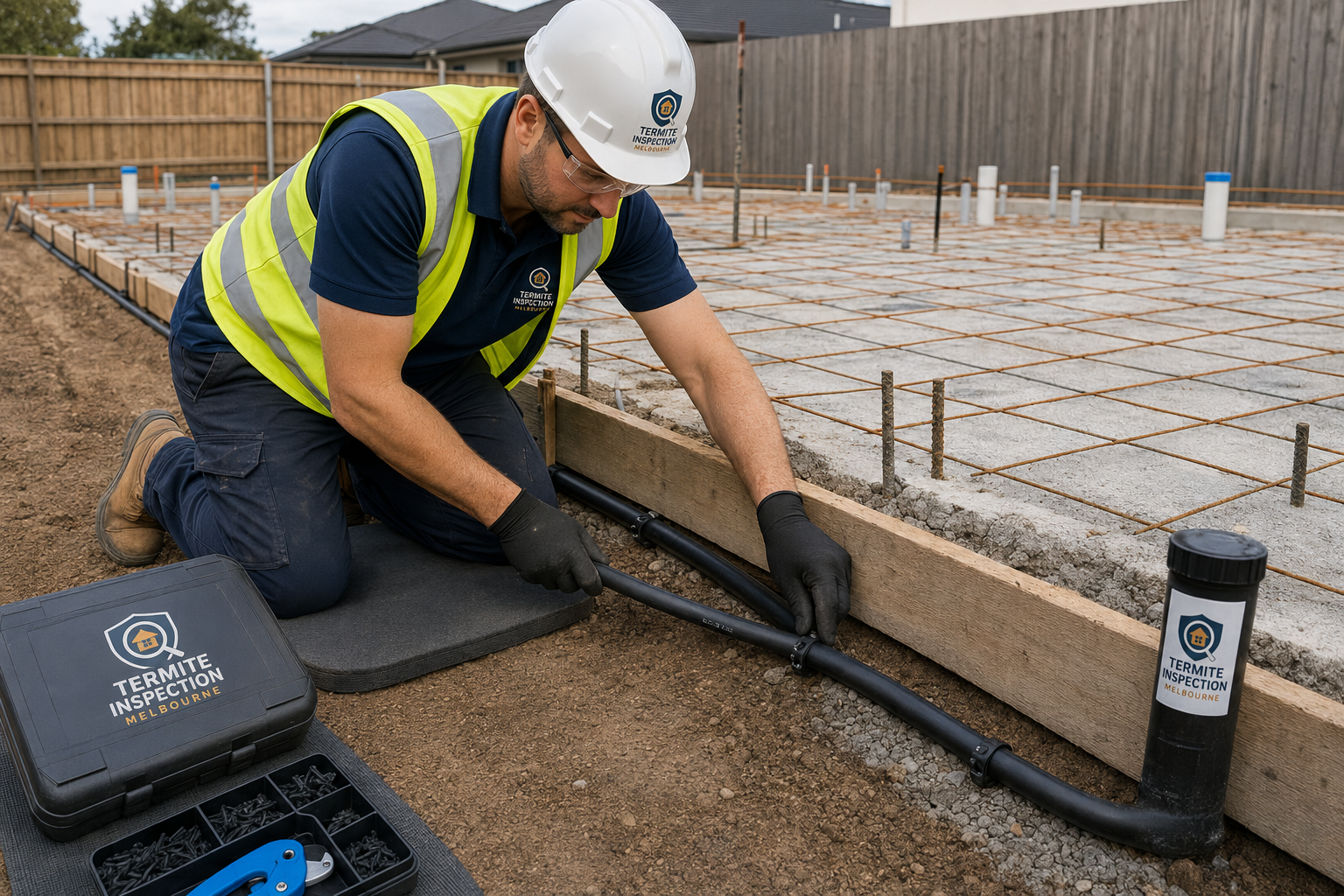
Each pipe circuit connects to an identified manifold or locked access box. Before any chemical charge, the technician tests system integrity and distribution using the approved commissioning procedure. Pressure behaviour, flow, leakage and blockage are checked zone by zone; a failed circuit is repaired or excluded rather than hidden in a whole-property claim.
Controlled metering valves and separate circuits help deliver the calculated quantity to each zone. Pressure is not a marketing number: it must suit the pipe, soil and system specification. Results, repaired sections, inaccessible zones and future test points are documented before the initial chemical charge is approved.
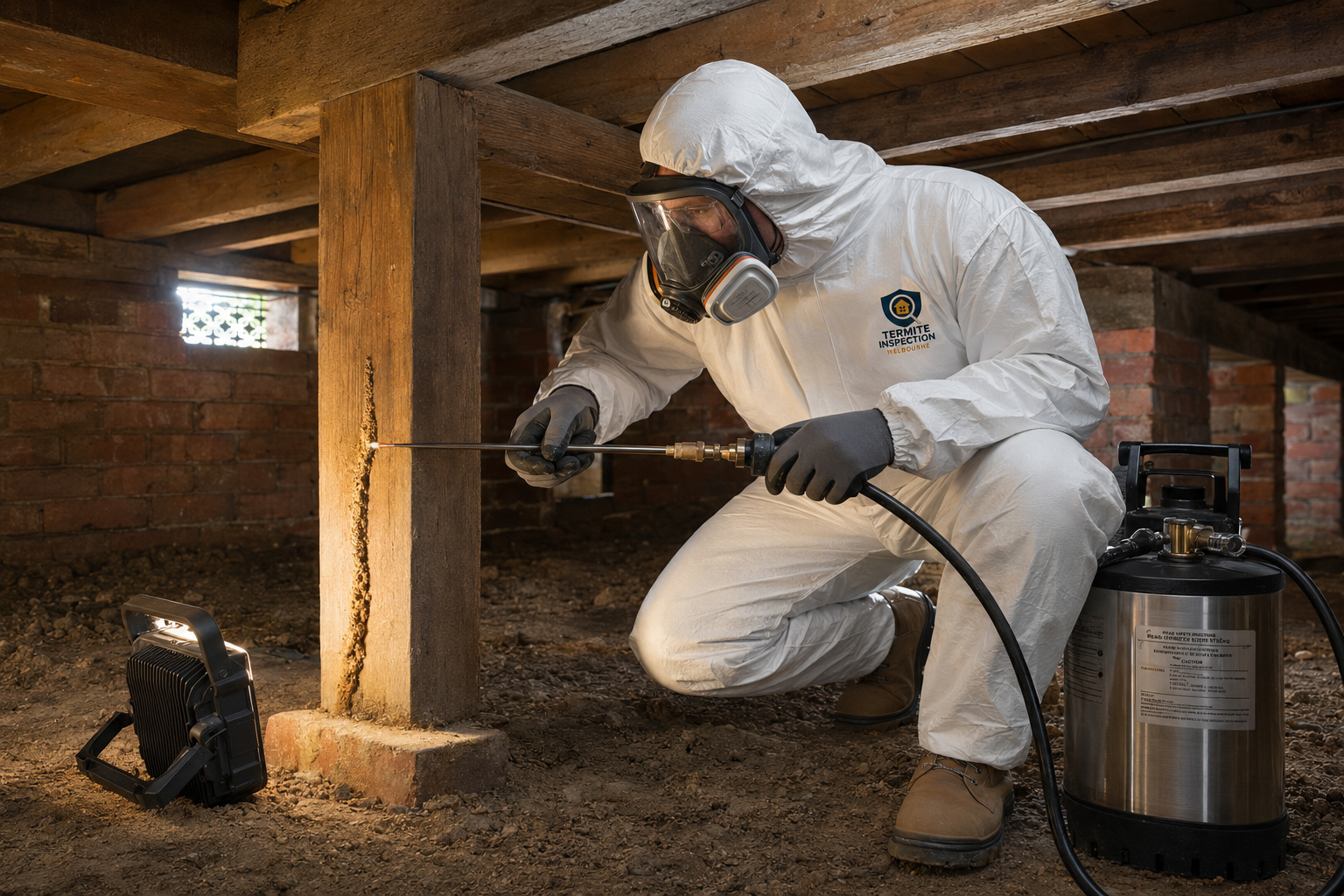
The selected registered termiticide is prepared and introduced into each verified zone at the calculated rate. Charging records identify product, active constituent, dilution, delivered quantity, circuits, installation date and safety directions. Access ports are secured and clearly labelled for future authorised servicing.
The owner receives AS 3660-aligned installation documentation, as-built network plans, recharge and inspection guidance, limitations and qualifying warranty terms. This is not an “AS3650 certificate”: that number is an incorrect search phrase. Warranty continuity depends on timely inspections, serviceable access ports and correction of conditions that bridge or damage the managed zone.
Local treatment routes from Clyde North
Customers search for termite treatment Melbourne, local termite control, termite exterminator near me, chemical barriers in Berwick and Cranbourne, baiting in Ringwood, reticulation in Werribee and termite control across Mornington Peninsula. Every site is still designed around construction, evidence and access rather than a suburb label.
Inner-city terraces, apartments and converted warehouses can have shared walls, concealed plumbing, paved boundaries and owners-corporation interfaces. A termite treatment Melbourne CBD plan must identify which soil, wall and service-entry zones can legally and safely be treated. Where trenching is impossible, targeted active-colony work or monitored baiting may be more practical. Written scopes distinguish private property from common property and record any inaccessible areas that could interrupt a complete management zone.
From our Clyde North base, South East Melbourne is a core route for active termite and same day termite quote enquiries. New estates often combine concrete paths, concealed slab edges, garden beds and later landscaping that bridges inspection zones. Established houses may add suspended subfloors, extensions, wet areas and mature vegetation. Clyde North pest control recommendations are engineered around actual perimeter length, access, soil and evidence—not a postcode-only package.
Leafy eastern suburbs frequently combine mature trees, sloping sites, retaining walls, garden timbers and older suspended-floor construction. These features can complicate chemical termite barrier installation because soil levels, drainage and perimeter access change around the structure. Treatment design may divide the site into trenchable soil zones, concrete drill zones and monitored points, with active-colony control completed before long-term protection is commissioned.
Northern Melbourne includes Victorian timber homes, post-war brick veneer houses, renovated dwellings and new infill construction. Subfloor clearance, ant caps, masonry joins and later additions vary widely. A professional termite exterminator maps active workings first, then chooses between localised treatment, external soil zones, baiting and access improvements. Annual inspection and protection plans must also account for renovation joins, plumbing upgrades and concealed cavities.
Western Melbourne properties range from new slabs to weatherboards, warehouses and industrial conversions. Lower regional rainfall does not mean zero subterranean termite risk. Irrigation, plumbing leaks, garden changes and concealed slab edges can create localised moisture. Treatment specifications consider soil characteristics, wind-exposed gardens, paved perimeters and commercial access so the selected chemical, reticulation or baiting program can be installed and monitored correctly.
Mornington Peninsula homes can combine coastal moisture, decks, holiday-property vacancy, vegetation, outbuildings and humid subfloors. Timber decay may accompany termite activity, and sandy or variable soils influence installation planning. A termite reticulation system Melbourne assessment, liquid soil treatment or monitored baiting program is chosen only after the technician maps the dwelling, detached structures, perimeter surfaces, drainage and practical maintenance requirements.
From site audit to documented commissioning
The sequence depends on construction access, perimeter length, soil, drainage and the number of hydraulic zones. The written proposal controls the installation method, registered product, site preparation, safety directions, commissioning tests and future service dates.
The technician records footing lines, accessible soil, hard surfaces, drainage, services, retaining walls, step-downs and likely future building work. Perimeter measurements are converted into practical pipe circuits so each zone can receive a controlled quantity rather than relying on one oversized loop.
Active termite evidence is assessed separately because a delivery network is not an automatic colony-eradication program. Plans identify fill-point locations, trench access, concrete interfaces and exclusions. The fixed specification is confirmed before excavation or charging begins.
Trenches are prepared without undermining footings. Compatible perforated hose is installed in protected bedding at the designed spacing, divided into labelled zones and connected to secure manifolds or fill boxes. Corners, services and changes in level receive detailed attention because they can affect distribution and durability.
As-built photographs and drawings record pipe routes before backfilling or paving. Weather, wet clay, unsafe trenches or construction delays can change scheduling. They do not justify crushing pipe, hiding inaccessible gaps or departing from the selected system specification.
Each circuit is commissioned for integrity, flow and distribution before chemical is introduced. A failed or uneven zone is corrected, isolated or documented. The compatible registered termiticide is then charged at the calculated quantity and access ports are secured for future authorised servicing.
The handover includes product and dilution details, delivered volume, zone map, limitations, safety information, inspection schedule and qualifying warranty terms. AS 3660-aligned documentation records what was installed; it does not remove the need for annual inspection or imply unlimited chemical life.
Annual inspections review accessible timber, fill points, inspection zones, moisture and changes such as paving, garden beds, plumbing, decks or extensions. A pressure test can identify blocked, leaking or disconnected circuits before a future refill. Recharge timing follows the compatible product label and written service plan.
A three-to-eight-year interval may be discussed as an indicative range only where the original system and chemistry support it. Warranty continuity may depend on timely inspections and correction of conducive conditions. Keep all plans, charge records, invoices and alterations together for future technicians and property buyers.
Compare installation, rechargeability and construction suitability
Reticulation is a maintainable delivery method, not automatically the best answer for every building. This matrix compares future servicing, disruption, construction access and ongoing obligations. The approved plan still controls product, installation limits and warranty.
| Decision factor | Reticulation system | Standard trenching barrier | Drill-and-inject paths | Baiting stations |
|---|---|---|---|---|
| Future recharge work | Compatible chemistry is introduced through accessible ports after system testing | Soil is re-trenched or otherwise accessed where the zone needs renewal | Existing or replacement treatment holes provide renewed sub-slab access | Stations are opened and serviced on their monitoring schedule |
| Landscape disruption | Low during a routine recharge when every circuit remains serviceable | Can disturb soil, turf, edging and garden beds during renewal | Usually limited to drilling access, dust control and plug replacement | Low, although stations remain visible and accessible in the ground |
| Service life | Pipe infrastructure may be long-lived; chemistry remains finite and must be replenished | Chemical life depends on label, soil, drainage and disturbance | Chemical life follows the registered product beneath the hard surface | Ongoing program life depends on regular inspection and bait maintenance |
| Concrete compatibility | Strong when designed before paving or slab completion; retrofit feasibility varies | Direct trenching is limited where concrete covers the soil | Purpose-built access method for suitable paths and patios | Does not create a treated zone beneath concrete |
| AS 3660 pathway | Can form part of an AS 3660-aligned management plan with correct design and records | Can form a compliant treated zone when installed to the applicable specification | Can extend a chemical zone beneath suitable hard surfaces | Can support monitored colony management where the site plan specifies it |
| Ongoing obligation | Annual inspection, port access, pressure testing and scheduled recharge | Annual inspection and protection from excavation or bridging | Annual inspection and preservation of documented access lines | Frequent station monitoring plus annual building inspection |
Technical components of a maintainable underground network
A reliable rechargeable termite barrier pipe network depends on more than burying a hose. Hydraulic zoning, protected pipe bedding, accessible fill points, compatible chemistry, commissioning evidence and service records must operate as one maintained system.
Flexible perforated pipe is laid around selected footings in calculated circuits. The layout accounts for perimeter length, soil type, trench cross-section, elevation, corners, service penetrations, drainage and future paving. Pipe requires compatible bedding and protection from sharp aggregate, crushing and later garden excavation.
Long runs are divided into zones because pressure and volume can fall unevenly across an oversized circuit. The as-built plan should state pipe type, lineal metres, circuit locations, fill points, protected crossings and excluded interfaces. This engineering record helps prevent later trades from damaging an invisible underground asset.
Individual circuits terminate at labelled manifolds or secure fill boxes positioned for future service. Accessible ports mean a technician can test and recharge zones without excavating the entire perimeter. Valves, connectors and seals must suit the chosen system and remain protected from weather, vehicles and unauthorised access.
Controlled metering helps each circuit receive its calculated volume. Excessive pressure can damage pipe or force uneven discharge; insufficient pressure can leave distant sections under-supplied. Commissioning tests therefore examine pressure, flow, leakage and blockage before chemical is added.
Once every zone passes commissioning, the technician introduces a compatible registered termiticide at the calculated concentration and quantity. A non-repellent chemistry may be selected where permitted by the system, label and site plan. The delivered product creates the treated soil zone; the pipe remains its serviceable distribution infrastructure.
At a future termite reticulation refill, circuits are assessed again rather than blindly pumped. Recharge frequency is product- and site-specific—commonly discussed as an indicative three-to-eight-year range only when documentation supports it. Annual inspection remains necessary because chemistry, building conditions and the termite threat can change between scheduled recharges.
Existing properties may already contain capped pipes or a reticulation access box, but visible hardware does not prove that every footing has a complete, compatible network. We request original installation plans, identify circuits, inspect fittings and test serviceability before recommending a chemical recharge.
Crushed lines, blocked perforations, failed joins, missing ports or later extensions can create unserved zones. Repair may involve exposing a short section, replacing a manifold or installing an independent circuit. If the system cannot be verified, the proposal explains alternative trenching, drill-and-inject or monitoring options rather than representing a partial refill as complete property protection.
Clear engineering before a premium infrastructure investment
Searches for termite reticulation system Melbourne, Altis termite reticulation installation, termite reticulation hose, system cost or refill cost can return incomparable scopes. TIM's Pest Control publishes a $30-per-lineal-metre installation rate and provides a direct booking pathway. Customers enter estimated metres, add relevant maintenance services and see GST before requesting the physical engineering assessment.
Our audit-first method avoids prescribing a network before the building has been measured. Thermal cameras, moisture meters and radar can focus investigation; hydraulic layout, physical access and termite evidence remain the foundation. The written proposal separates pipe installation, initial charge, active-colony work, repairs and future recharge so the customer understands each component and responsibility.
Same day termite quote availability depends on postcode, property size, safe access and technician routing. Call early and explain whether you have visible activity, weakened timber, a recent treatment, an existing reticulation system or an annual warranty deadline. Urgent enquiries are triaged, but no arrival time, price, recharge interval or protection claim is final until the network, construction and site conditions are confirmed.
Direct answers before you book
Detailed answers about underground networks, future recharges, soil compatibility, household safety, AS 3660 documentation, system lifespan and written warranty conditions.
A licensed technician first identifies the system, zones and compatible registered chemistry. Each accessible circuit is checked for condition, blockage, leakage and distribution. The calculated termiticide volume is then introduced through locked fill points at the pressure permitted by the manufacturer and site plan. Charging records should identify the product, dilution, quantity, zones and date. The underground pipes distribute the liquid; the treated soil created around the footings provides the termite-management effect.
A serviceable, correctly documented reticulation network is intended to permit future replenishment through accessible ports without repeating the original full trenching program. Gardens and paving normally remain in place during a routine recharge. Excavation may still be required if a pipe is crushed, blocked, disconnected, undocumented or bypassed by later building work. A pressure and flow assessment confirms what can be recharged before any whole-property claim is made.
Recharge timing is not universal. An indicative interval may fall between three and eight years, but the registered product label, original system specification, soil, drainage, disturbance, inspection findings and written warranty determine the actual date. Annual timber pest inspections remain important between recharges. TIM’s Pest Control records the next review date after identifying the network and compatible chemistry.
Reticulation can be designed for many Melbourne properties, including reactive clay and variable sandy soils, but pipe bedding, hydraulic zoning, drainage, trench stability and chemical distribution must suit the site. Flood-prone areas, retaining walls, rubble, inaccessible slab interfaces and later landscaping can require a combined solution. A pre-installation engineering audit determines whether reticulation alone can form an adequate managed zone.
AS3650 is a common search phrase, but the relevant Australian termite-management standards are in the AS 3660 series. Where applicable, TIM’s Pest Control can provide installation records identifying the system, product, active constituent, zones, commissioning results, limitations, inspection schedule and warranty conditions. Documentation records the completed scope; it is not an unconditional promise that termites can never approach the building.
Our standard reticulation installation rate is $30 per lineal metre before GST, or $33 per lineal metre including GST. The measured installation length determines the calculator total. Work outside standard pipe installation—such as difficult excavation, concrete access, network repairs, specialised manifolds, active termite treatment or chemical recharge—is identified and authorised separately after the site assessment.
The pipe network is long-lived service infrastructure when correctly installed, protected and maintained, but the termiticide delivered through it has a finite registered protection period. Pipes can be damaged by excavation, roots, renovations or ground movement, and accessible ports must remain serviceable. Therefore “permanent termite management system” describes rechargeable infrastructure—not permanent chemistry or a lifetime guarantee without inspection and maintenance.
Yes, subject to identification and access. We review original plans where available, locate fill points, assess visible components, test zones and confirm whether the pipework and proposed chemistry are compatible. A system that cannot hold or distribute the commissioning medium evenly may need sectional repair, new zones or an alternative treatment. We do not inject an unidentified network merely because a cap is visible.
Registered products must be handled by an appropriately licensed technician in accordance with the label and Safety Data Sheet. Tell us about children, pets, birds, reptiles, aquariums, edible gardens, bores and sensitive plants before service. The termiticide is delivered into planned underground zones, but customers must still follow preparation, exclusion and re-entry directions. No pesticide treatment should be described as completely harmless or risk-free.
No. An Altis-type termite reticulation installation uses a rechargeable underground hose or pipe network to distribute compatible termiticide. Kordon is a physical termite-management product installed at suitable construction interfaces and is not a chemical refill pipe. Both can form part of an AS 3660-aligned strategy, but their installation, servicing and documentation are different. The proposal should name the actual system rather than using the terms interchangeably.
Sunday priority reticulation assessments may still be available
Call 0466 929 533 for priority on-site reticulation engineering and a same day termite quote where route availability permits. Ask about the $300 seasonal discount for eligible complete installations. We confirm soil and concrete access, circuits, initial chemistry, commissioning, warranty conditions, exclusions and the final GST-inclusive price before work begins.