Rapid, Year-Round Breeding
Cockroaches, ants and spiders reproduce quickly in Melbourne's mild conditions. A small, ignored problem can become an established infestation within weeks, spreading through shared walls, subfloors and roof spaces.
Advanced diagnostics • Non-invasive termite detection technology
We find hidden termites with science, not guesswork. Military-grade FLIR thermal cameras, Termatrac microwave radar motion sensors and non-destructive Tramex moisture mapping let us uncover concealed colonies behind walls and under floors — before they cause structural collapse. No obligation, state-of-the-art diagnostic dispatch, and exact fixed pricing before you commit.
Start here
Book online this Wednesday & save 10% with our VIP Members offer. No obligation, no hidden fees.
High-resolution imaging
Sees through walls
Non-destructive mapping
Compliant diagnostics
Timber pest specialists
199+ Melbourne suburbs
Inspect early — treat at the source
Melbourne's climate lets common pests breed year-round, and what you see is usually a fraction of what's harbouring in wall cavities, subfloors and roof voids. A proper pest inspection finds the source and conducive conditions, so treatment targets the whole problem — not just the pests on the surface.
Cockroaches, ants and spiders reproduce quickly in Melbourne's mild conditions. A small, ignored problem can become an established infestation within weeks, spreading through shared walls, subfloors and roof spaces.
Cockroaches and rodents contaminate food-preparation surfaces and can spread bacteria and allergens. In homes and especially food businesses, that's a genuine health and compliance risk — not just an inconvenience.
Supermarket sprays kill the pests you see and hide the ones you don't, so the infestation keeps building out of sight. A professional inspection identifies the species, source and entry points a spray can't.
Science, not guesswork
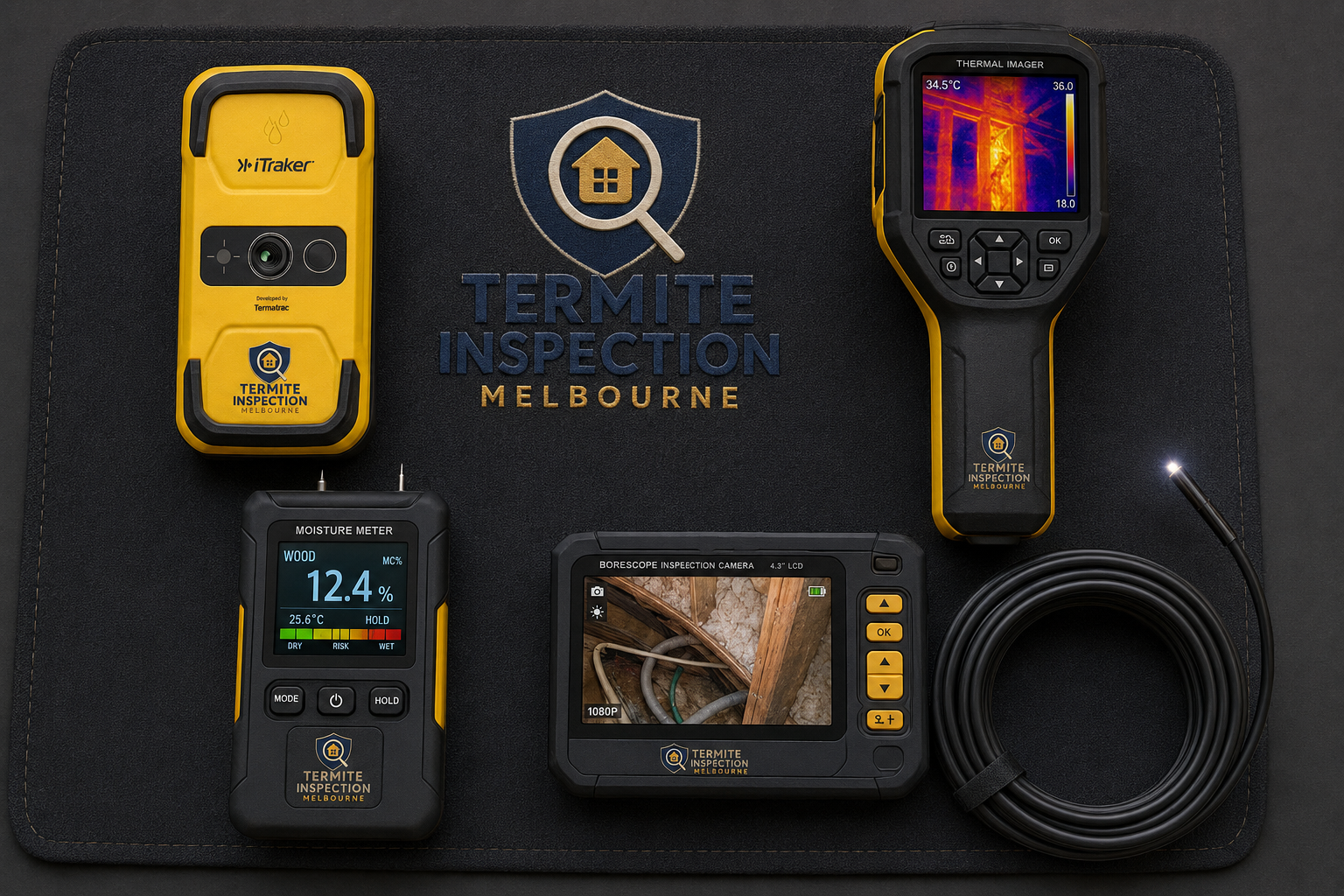
Termites hide inside the very structure they're destroying. Our professional termite inspection equipment is built to see through that concealment — detecting heat, movement and moisture behind finished surfaces without cutting a single hole. These are the four core tools our inspectors carry.
FLIR thermal cameras detect the minute temperature differentials behind walls and ceilings caused by active termite nesting, trapped humidity and metabolic heat. It turns an invisible problem into a visible thermal signature — the backbone of thermal imaging termite inspection Melbourne owners rely on.
The Termatrac radar termite detector emits safe microwave signals through plasterboard, brick and timber to track live termite movement, crawling speed and exact location — all without cutting into the wall. It confirms activity where a thermal image raises a question.
A Tramex moisture meter timber test pinpoints hidden dampness in subfloors, bathrooms and wall cavities — mapping the exact moisture zones subterranean termites are drawn to, so we find the conditions that invite them, not just the termites themselves.
Fibre-optic borescopes let us see inside wall cavities through a tiny access point, while acoustic sounding confirms hollow or compromised timber by impact. Together they verify internal framing integrity as non-invasive termite detection tools.
Seeing & tracking the hidden
Two technologies do the heavy lifting on a modern inspection: thermal imaging shows where something is wrong, and radar confirms exactly what's moving inside.
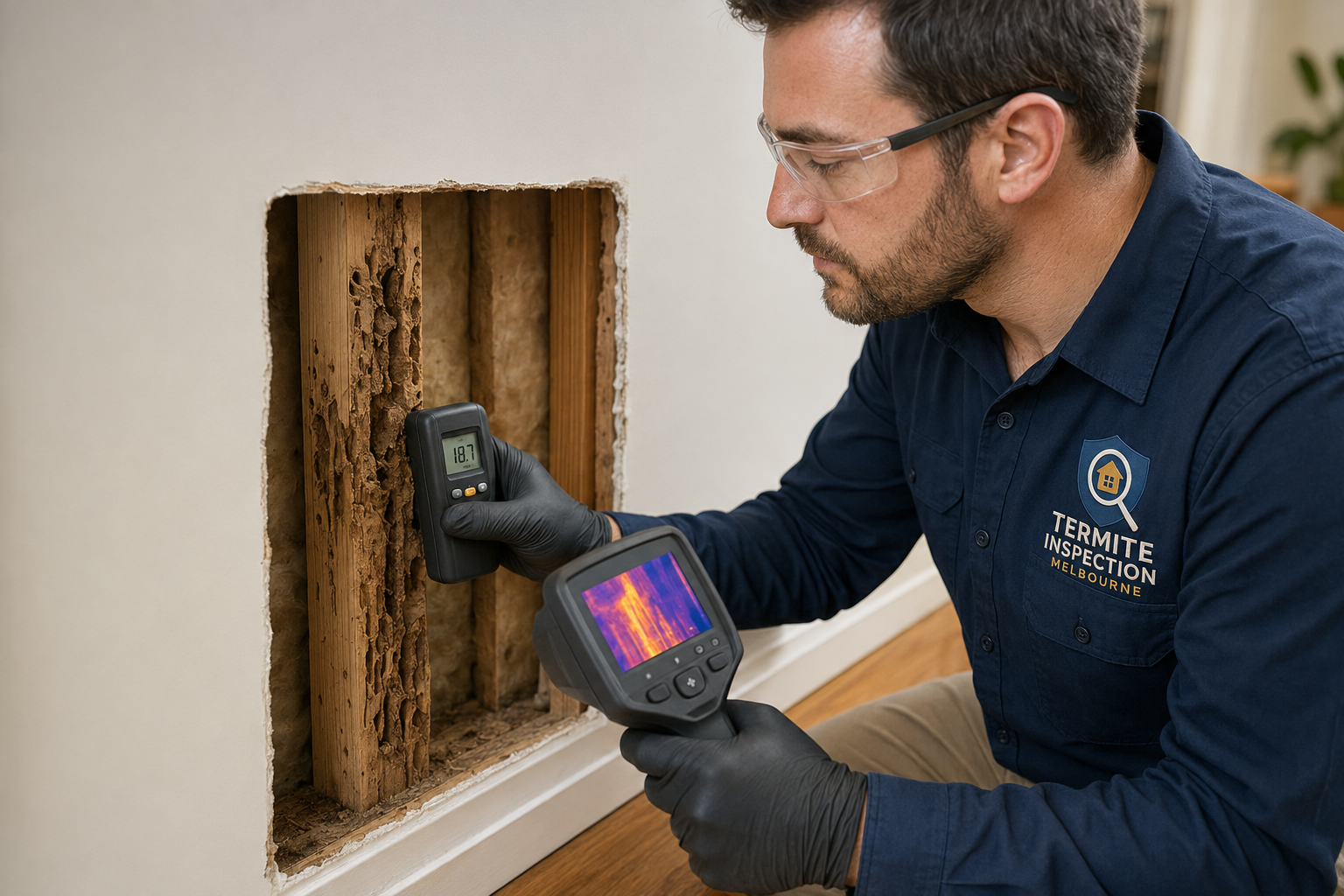
Termite activity and the moisture around it change the surface temperature of a wall by a fraction of a degree — invisible to the eye, obvious to a high-resolution thermal camera. Scanning ceilings, walls and skirtings, our inspector reads those heat signatures to flag concealed nesting and damp zones for closer investigation, entirely non-destructively.
Where a thermal image raises a question, the Termatrac radar termite detector answers it. Its safe microwave sensor reads through plasterboard, brick and timber to detect live termite movement — presence, direction and crawling speed — pinpointing a colony's location without a single hole cut in your wall.
Moisture & internal integrity
Termites follow moisture, and damage hides inside timber. These tools find both — the damp zones that attract termites, and the internal condition of the framing itself.
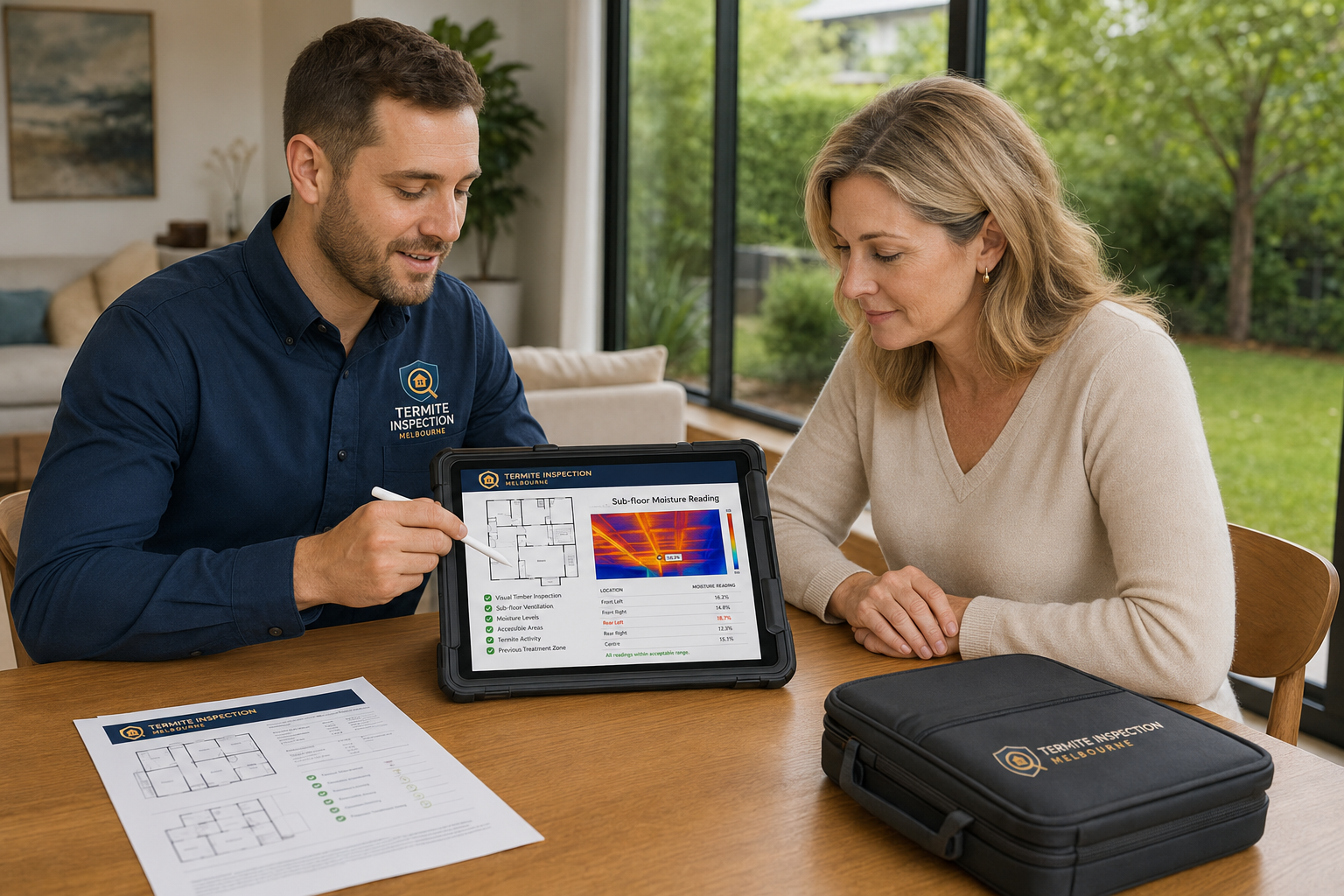
A Tramex moisture meter timber test reads moisture non-destructively through surfaces, letting us map the damp in subfloors, bathrooms, laundries and wall cavities. Because subterranean termites need moisture, those readings often point straight to the conditions — and locations — they favour, and every reading is documented in your report.
Acoustic sounding confirms hollowed or weakened timber by impact, while a borescope threads a fibre-optic camera through a tiny access point to inspect inside a wall or subfloor cavity — verifying framing integrity as genuinely non-invasive termite detection tools, with no wall smashing required.
Equipped & on the road
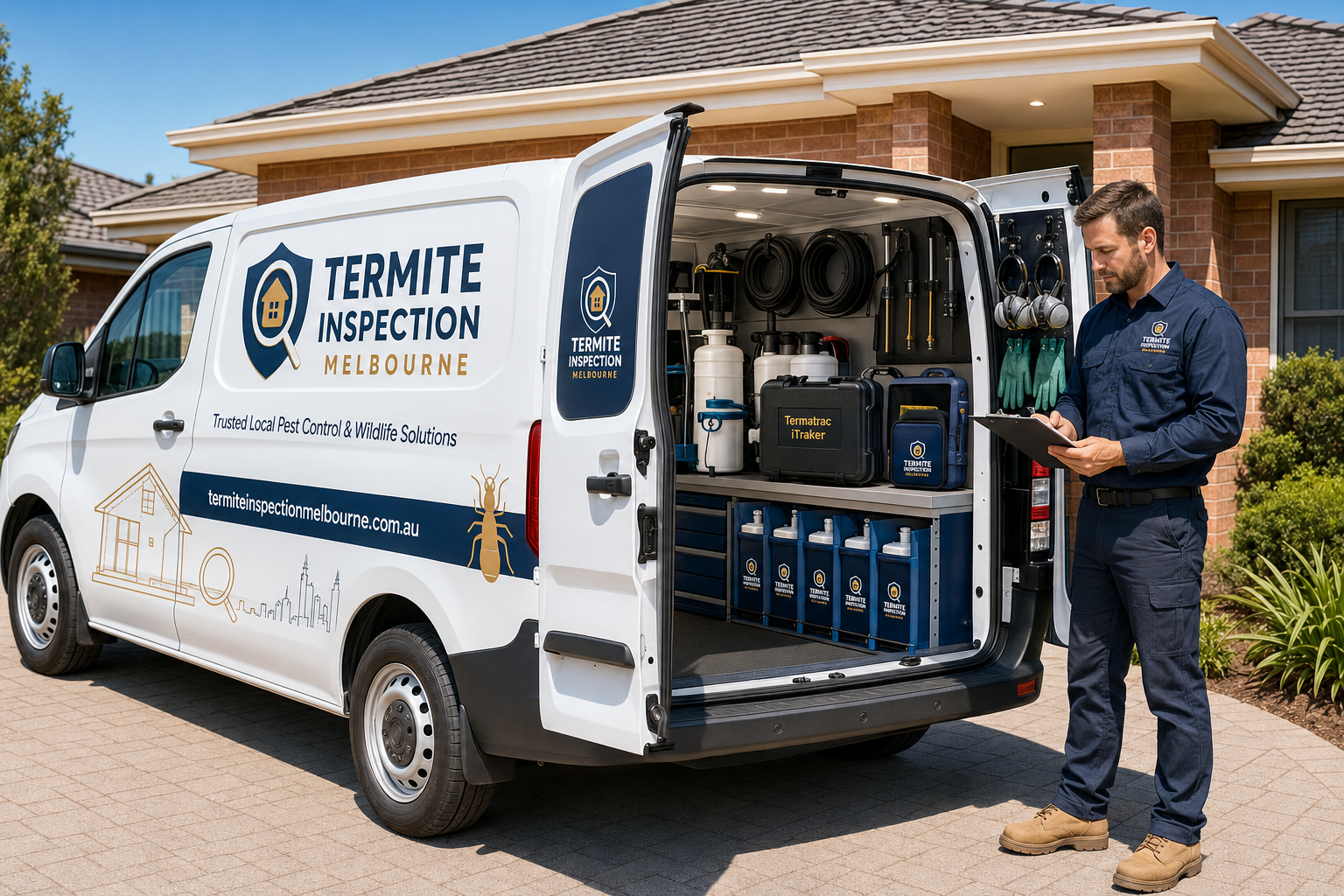
Our service vehicles carry the full diagnostic arsenal to every job, so a thermal camera, radar unit, moisture meter and borescope arrive with the technician — not "back at the office". That means a complete, science-backed inspection in a single visit, wherever you are in metropolitan Melbourne.
Behind the gear are AEPMA certified timber pest specialists trained to interpret what the instruments show — because a thermal image or radar trace is only as good as the professional reading it. From our Clyde North pest control base we reach the south-east, the eastern suburbs, the north, the west, the CBD and the Mornington Peninsula, often with a same day termite quote available.
Call 0466 929 533Technology vs the naked eye
| Capability | TIM's Tech Arsenal | Visual Handyman Check | DIY Hardware Probes | Basic Pest Exterminator |
|---|---|---|---|---|
| Thermal imaging included | ✓ FLIR, every job | ✗ No | ✗ No | Rarely |
| Radar motion tracking | ✓ Termatrac T3i | ✗ No | ✗ No | ✗ No |
| Non-destructive moisture mapping | ✓ Tramex meters | ✗ No | Basic pin probe | Sometimes |
| AS 4349.3 compliance | ✓ Standard | ✗ No report | ✗ No report | Varies |
Non-destructive by design
Not long ago, confirming termites behind a wall could mean cutting into the plaster. That's the last thing you want in a heritage home, a freshly renovated interior or a commercial fit-out. Modern professional termite inspection equipment removes that trade-off entirely: thermal imaging, microwave radar and moisture meters let us investigate thoroughly while leaving your finishes completely intact.
This matters most in exactly the properties where damage is most costly. Melbourne's mix of period homes, modern plaster finishes and fitted-out commercial spaces can't simply be opened up on suspicion. With non-invasive termite detection tools, we scan, track and map — building a complete picture of activity, moisture and structural risk — without a single unnecessary hole. When a borescope is used, it's through an access point smaller than a coin, not a demolished wall.
The pay-off is both accuracy and confidence. FLIR thermal imaging termite inspection Melbourne owners can trust, backed by Termatrac radar confirmation and Tramex moisture mapping, and documented to AS4349.3 compliant diagnostic equipment standards, gives you a report you can act on — for a purchase, a treatment plan or peace of mind. And because we're a local Clyde North team, a same day termite quote is often available. The technology finds the problem; our AEPMA certified timber pest specialists tell you what it means.

Clyde North based • 199+ suburbs
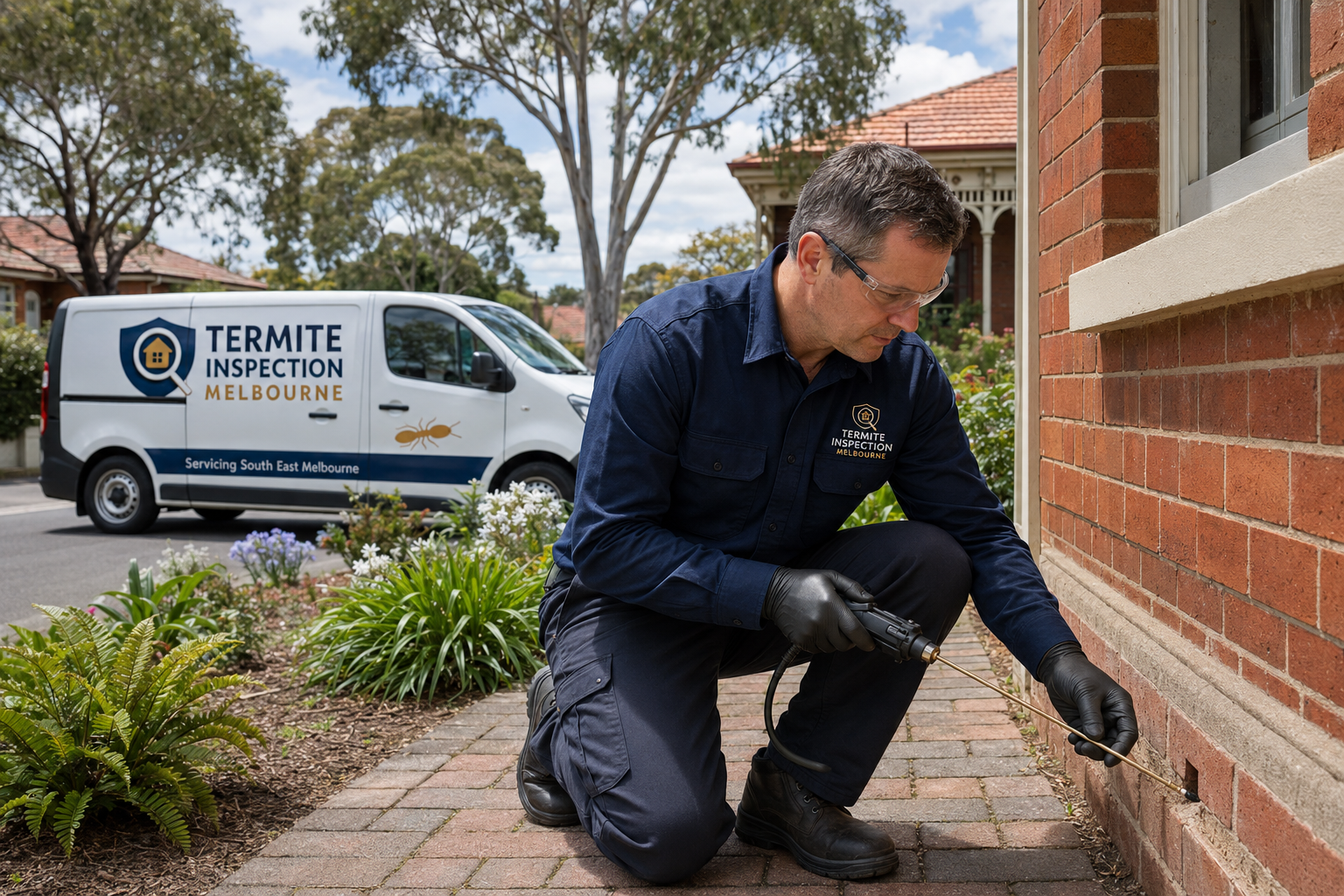
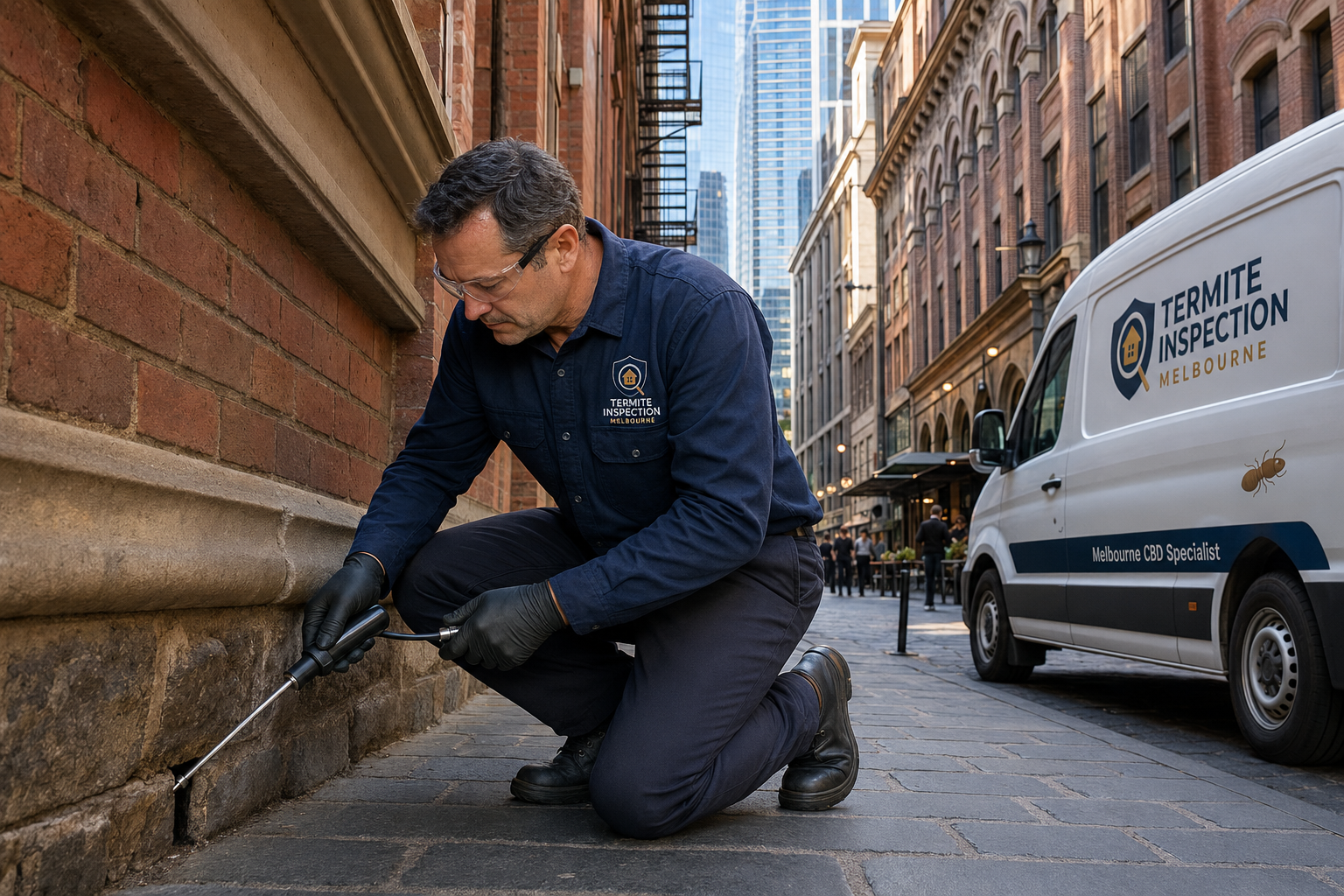
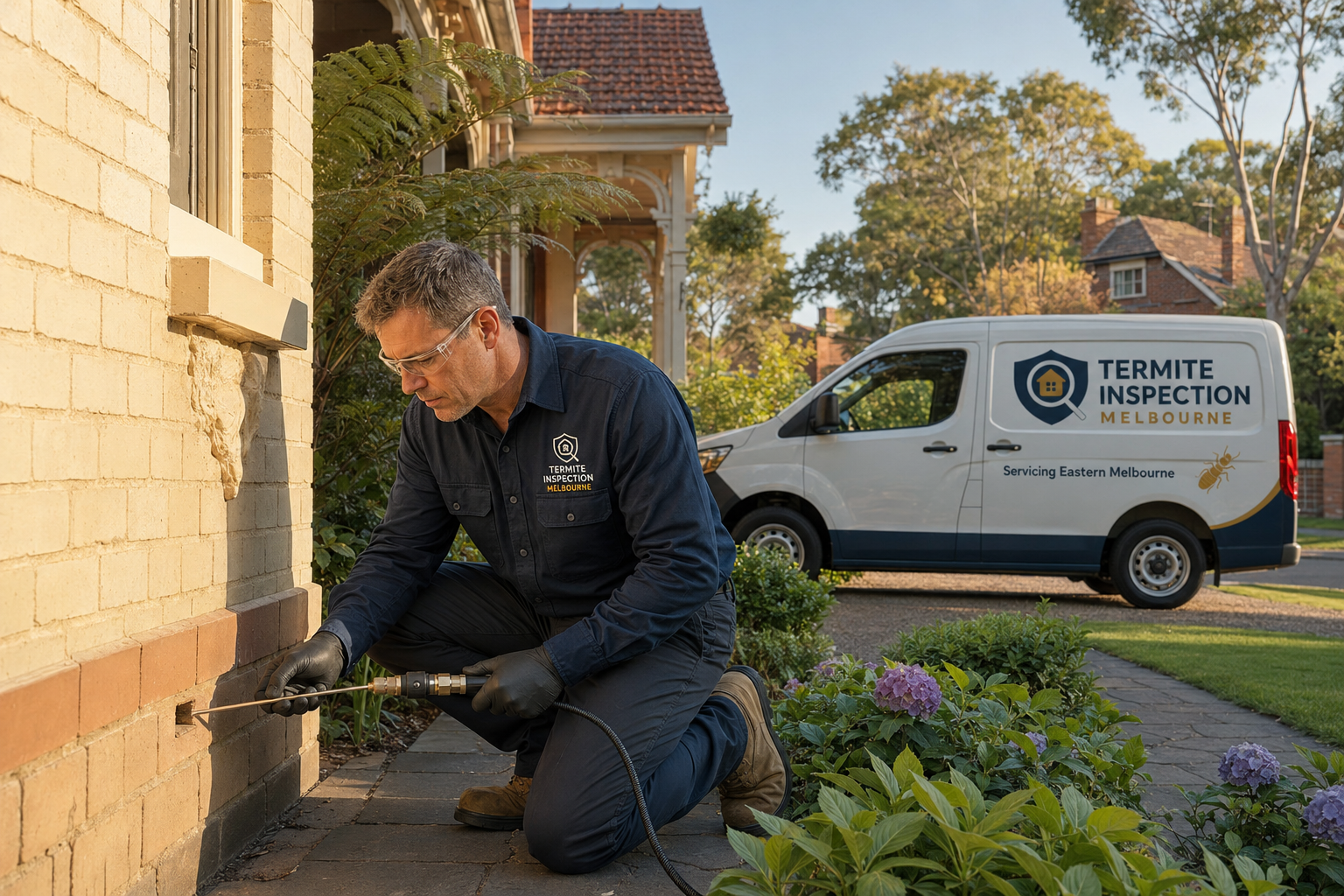
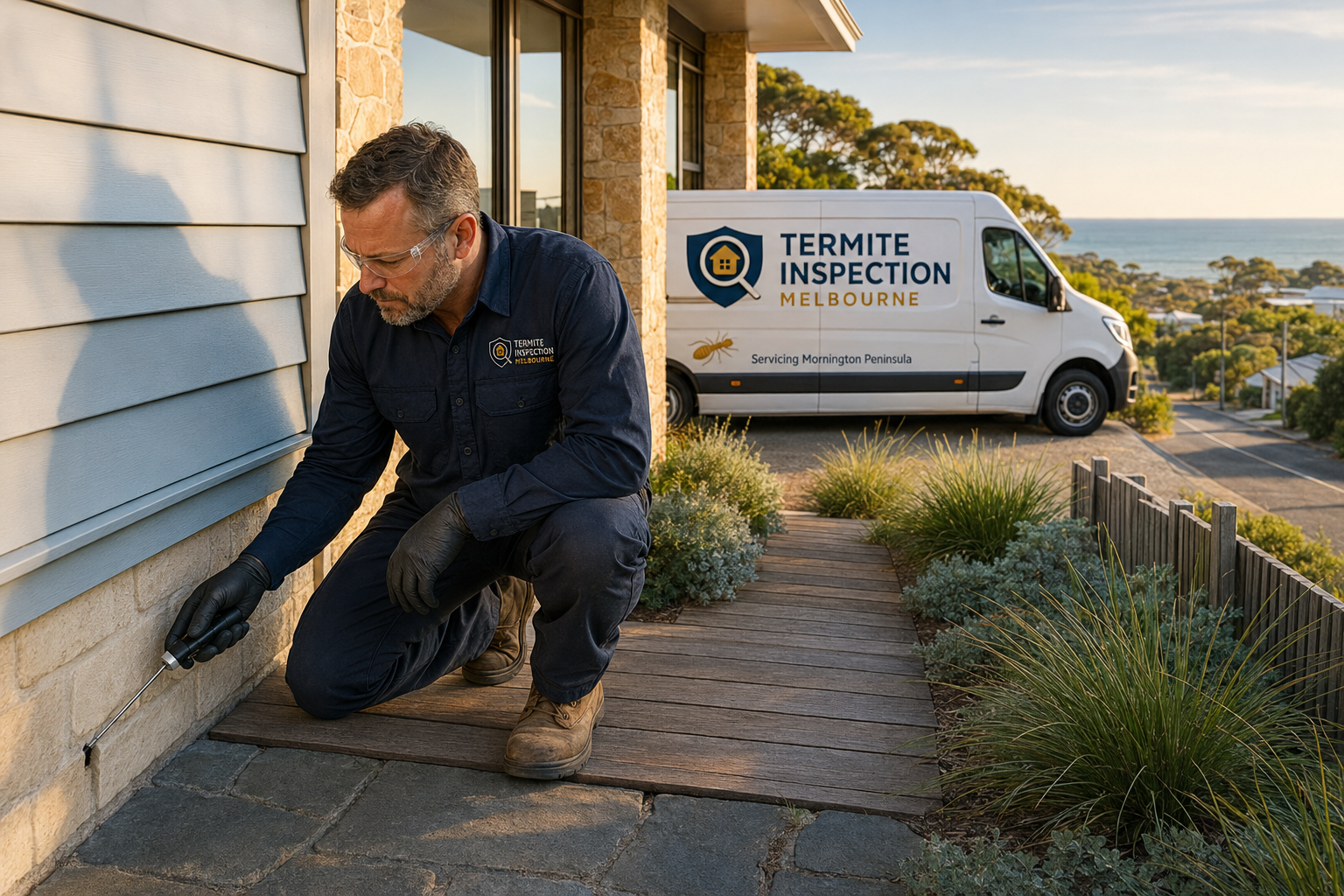
From our Clyde North pest control base to inner Melbourne and the Mornington Peninsula, the same fully-equipped diagnostic team attends every job — thermal, radar and moisture tools on board — whichever suburb you're in.
Our operational base. Priority same-day pest inspections across Cranbourne, Berwick, Hallam and the south-east corridor, where new estates and family homes see high cockroach, ant and spider activity.
Discreet pest control for apartments, rentals, cafes and share houses across the inner suburbs, where cockroaches and rodents move between adjoining buildings.
Family homes across Box Hill, Camberwell and Glen Waverley, where established gardens, subfloors and roof voids support spiders, ants and the occasional rodent.
Larger blocks, acreage and coastal homes where gardens, sheds and outbuildings drive pest activity. We treat the interior, and the exterior and roof void where booked.
Instruments in expert hands
It's easy to claim to be the best termite inspection company in Melbourne — every company does. What actually matters is verifiable: AEPMA certification, licensed timber pest inspectors VIC, $10 million insurance, real diagnostic equipment and standards-aligned reports. We publish only genuine, verifiable Google reviews — never invented testimonials — and we'd rather tell you honestly what we can and cannot guarantee than win your trust with a promise that doesn't hold up.
About our reviews: we publish only live, verifiable Google reviews from our confirmed business profile — we do not use invented testimonials. Star ratings and review totals change over time, so please check our current Google profile for the latest genuine feedback from Melbourne customers.
See our current Google reviewsCredentials you can verify
Every technician who arrives at your door is qualified, background-checked and using approved, pet-safe methods — not a subcontractor you have never met.
Current pest-management licence and full public-liability insurance. Certificates available on request before we start.
Members of the Australian Environmental Pest Managers Association, trained to national best-practice standards.
Only APVMA-registered residual and baiting products, applied strictly to label directions with clear re-entry advice for family and pets.
Every technician is background-checked and Melbourne-based — the same trusted faces at your door, every visit.
Licence, insurance and product-safety documentation is available to every customer on request — ask us before you book.
Answers before you book
Termite activity, and the moisture and metabolic heat that come with it, subtly change the surface temperature of a wall or ceiling — differences far too small for the eye but clear to a FLIR high-resolution thermal camera. During a thermal imaging termite inspection Melbourne technicians scan those surfaces and read the heat signatures to flag concealed nesting and damp zones for closer investigation, without touching the structure. Thermal imaging highlights where to look; we then confirm with radar and moisture tools.
No. Our whole diagnostic approach is built around non-invasive termite detection tools — thermal imaging, microwave radar and moisture meters all read through finished surfaces. If we ever use a borescope to view inside a cavity, it goes through an access point smaller than a coin, not a demolished wall. Your plaster, paint and finishes stay intact.
The Termatrac radar termite detector is a specialised sensor that emits safe microwave signals through plasterboard, brick and timber. Those signals reflect off moving termites, letting the device detect live activity, its direction and crawling speed, and pinpoint a colony's location — all without cutting into the wall. It's how we confirm and track activity that a thermal image only hints at.
Because termites do their damage out of sight — inside wall cavities, subfloors and roof timbers. A visual-only check can only report what's on the surface, so it can miss an active infestation entirely. Adding thermal imaging, radar and Tramex moisture meter timber testing lets us assess the concealed areas where the real risk sits, which is exactly what an AS 4349.3 inspection is meant to cover.
Our inspections are carried out to the AS 4349.3 standard for timber pest inspections, and our AS4349.3 compliant diagnostic equipment — thermal, radar, moisture and optical tools — supports that standard by allowing a thorough, non-destructive assessment. The result is a report prepared to a recognised benchmark, suitable for property settlements, council records and treatment planning.
A Tramex moisture meter timber test reads moisture levels non-destructively through surfaces, so we can map hidden damp in subfloors, bathrooms, laundries and wall cavities. Because subterranean termites are drawn to moisture, those readings often reveal both the conditions that invite termites and the areas most at risk — information that goes straight into your inspection report.
Often, yes. As a local Clyde North team carrying the full diagnostic kit in every vehicle, we can frequently offer a same day termite quote and prioritise urgent thermal-imaging inspections, depending on your suburb, our route and access. Call 0466 929 533 as early as possible for the best chance of a fast appointment.
Don't rely on a naked-eye guess for something this costly. Call now to speak with our certified diagnostic specialists, book a thermal-imaging termite inspection with radar and moisture mapping, lock in a same day termite quote (subject to suburb and route), and get transparent fixed pricing with no obligation.
🎯 Offer ends 15th September 2026 • ✓ Licensed & Insured • ✓ AEPMA-certified