Urgent Warning Offer Noticed signs of termites? Book an emergency thermal inspection online this Wednesday & save $250 off complete barrier treatments + Free Thermal Scan ($150 value)
Call 0466 929 533
☰ Explore Services & Menu
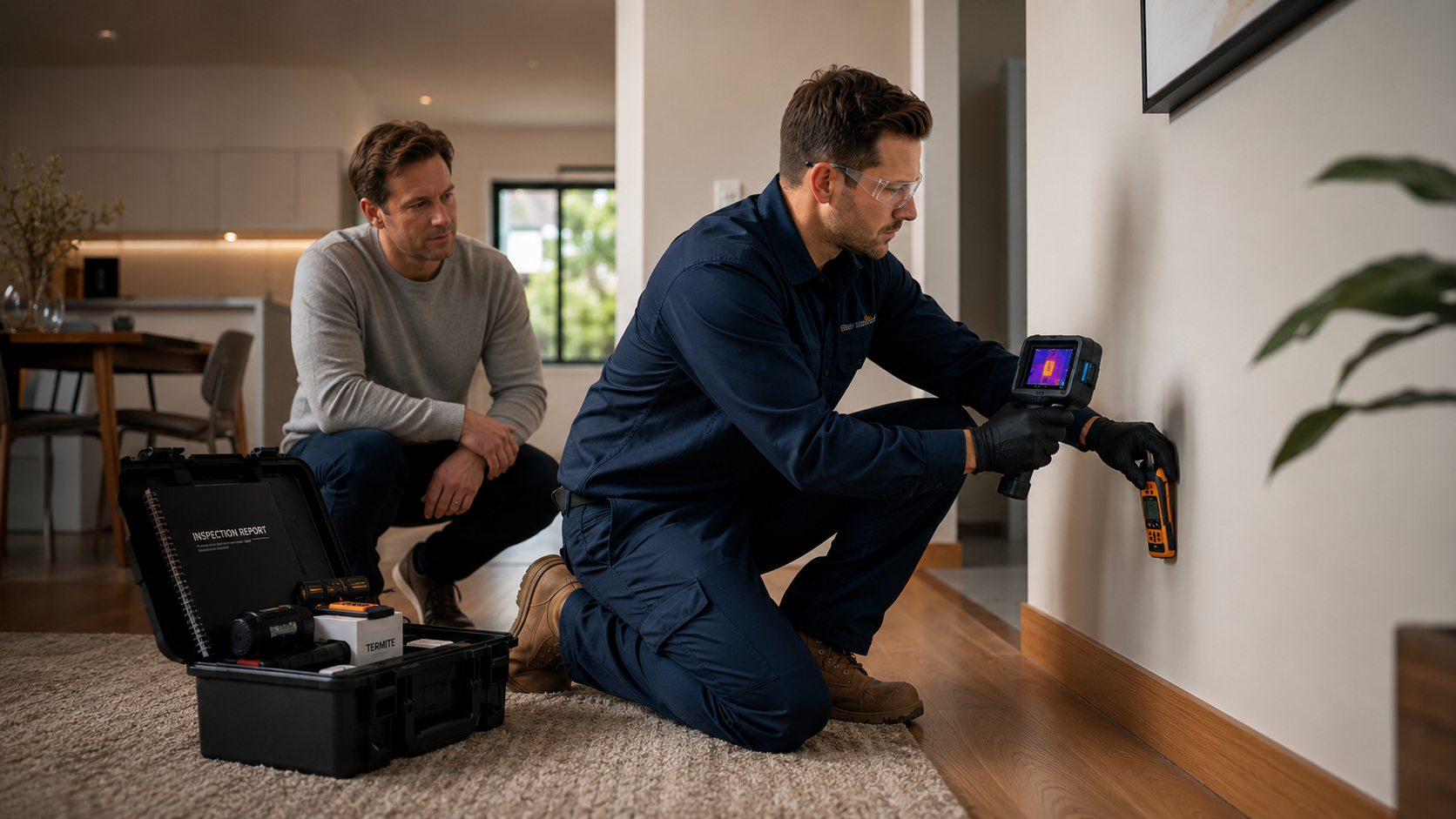
Termite warning signs guide — mud tubes, hollow timber and structural damage indicators in a Melbourne home

AEPMA-certified timber pest specialists • Clyde North to greater Melbourne

Termite Warning Signs Melbourne | Spot the Signs Early

Subterranean termite symptoms in Victoria are often subtle — a mud tube along a stump, hollow-sounding timber behind a skirting board, a door that suddenly sticks. Learn exactly what to look and listen for, and how professional thermal imaging catches hidden damage a visual check alone will miss, before it compromises your home's structural integrity.

  • AS 4349.3 compliant inspection report
  • Thermal imaging & moisture assessment
  • Subfloor & roof void access included
  • Same-day digital report target

Start here

Get a Same-Day Termite Diagnostic Quote

No obligation, expert technician assessment, exact fixed pricing. Book online this Wednesday & save with our VIP Members offer.

✓ No obligation • ✓ No sales calls • ✓ Price shown before contact

🌡️
Thermal Imaging

Included on inspections

📋
AS 4349.3 Report

Same-day digital target

🔍
Subfloor & Roof Access

Hidden colony detection

$
Zero Hidden Fees

Price before booking

📍
199+ Suburbs

Clyde North to CBD

4.9 Rating

2,000+ reviews

Why early detection matters

Why Termite Warning Signs Can't Wait

Subterranean termites work silently, hidden inside wall cavities, subfloors and roof voids, often for months or years before any sign becomes visible above the surface. By the time damage is obvious to the naked eye, a colony may already have compromised load-bearing timber. Catching the early, subtle signs is what keeps a termite problem a minor, affordable fix instead of a major structural repair.

🏚️

Structural Collapse Risk

A mature subterranean colony can consume the cellulose core of load-bearing studs, joists and bearers while leaving the painted surface almost untouched. Left long enough, that hidden hollowing can lead to sagging floors, cracked cornices and, in extreme cases, structural failure of a wall or roof section.

💰

Repair Costs Escalate Fast

A diagnostic inspection and early-stage treatment is a fraction of the cost of structural timber replacement, re-stumping or wall reconstruction. The earlier a warning sign is confirmed and acted on, the smaller and cheaper the fix.

📄

Insurance & Resale Implications

Most home and contents insurance policies exclude gradual termite damage, and undisclosed or unresolved termite activity can complicate a property sale or building inspection. A documented, professional inspection report protects you either way.

Know exactly what to look and listen for

The 5 Warning Signs of Termites in Your House

These are the physical and behavioural indicators our technicians train property owners to check for between annual inspections. None of them confirm a colony on their own — but any one of them is reason enough to book a professional diagnostic assessment.

1

Mud Tubes (Shelter Tubes)

Mud-like tunnels built across brickwork, concrete footings, stumps and subfloor walls, protecting subterranean termites from drying air as they travel between the soil and a timber food source. A mud tube on an external wall is one of the clearest, most reliable signs of an active colony — it means termites have already built a safe corridor into the structure above.

2

Hollow-Sounding Timber

Skirting boards, architraves or flooring that sound paper-thin or drum-like when tapped with a knuckle or the handle of a screwdriver, because the internal cellulose has been eaten away while the painted surface stays largely intact. This is one of the most accessible DIY checks — but a hollow sound only tells you where to probe further, not how far the damage extends.

3

Sagging Floors or Jamming Doors/Windows

Structural distortion caused by subterranean colonies eating through load-bearing framing timbers, bearers and joists. A floor that has developed a slight bounce or dip, or a door and window that has started sticking without an obvious cause (like humidity or a settling foundation), can indicate the frame behind it has lost structural integrity.

4

Frass & Timber Droppings

Small, gritty, sand-like pellets (frass) — the discarded droppings of drywood termites — collecting near window sills, skirting boards or beneath furniture, often alongside tiny "kick holes" in the timber. Discarded, papery wings scattered near doors, windows or light fittings after a warm evening indicate an active swarm has just occurred and a colony is establishing nearby.

5

Paint Blistering or Discolouration

Bubbled, peeling or water-stain-like discolouration on wall or ceiling paint that hides a subterranean gallery eating just beneath the surface, or the moisture that colony activity brings with it. Because this looks so similar to ordinary water damage or a plumbing leak, it's one of the most commonly misdiagnosed warning signs — and exactly the kind of hidden activity thermal imaging is built to confirm.

Why professional diagnosis beats a DIY check

Warning Sign Detection Methods Compared

A hollow-sounding skirting board or a screwdriver probe can flag that something is wrong. Only a licensed diagnostic inspection can tell you how far it extends, whether the colony is still active, and what's hidden behind plaster, under flooring or in the roof void.

Diagnostic Method Thermal Imaging Accuracy Subfloor / Roof Void Access AS 4349.3 Reporting Hidden Colony Detection
TIM's Professional Diagnostic Inspection ★★★★★ Full thermal + moisture scan ✓ Full access & inspection ✓ Formal compliant report ★★★★★ Excellent
DIY Visual Checks ✗ None ⚠️ Limited, untrained access ✗ No report ★ Poor — surface signs only
Hardware Store Probes / Detectors ✗ None ⚠️ Point-testing only ✗ No report ★★ Fair — where you happen to probe
Basic Handyman Assessment ✗ None ⚠️ Variable, not specialist-trained ✗ Informal opinion only ★★ Fair — general building knowledge, not species-trained
Our recommendation: a screwdriver probe or a walk-through with a handyman can be a useful early habit, but neither can see behind plaster, into a wall cavity or under flooring the way a thermal imaging camera and a licensed AS 4349.3 inspection can — and neither produces the documented report insurers, buyers and lenders often ask for.

Local conditions, local risk

Why Melbourne Properties Are at High Risk

Melbourne's climate and soil profile are close to ideal for subterranean termite activity, which is why vigilance and regular professional inspection matter as much here as anywhere in Australia.

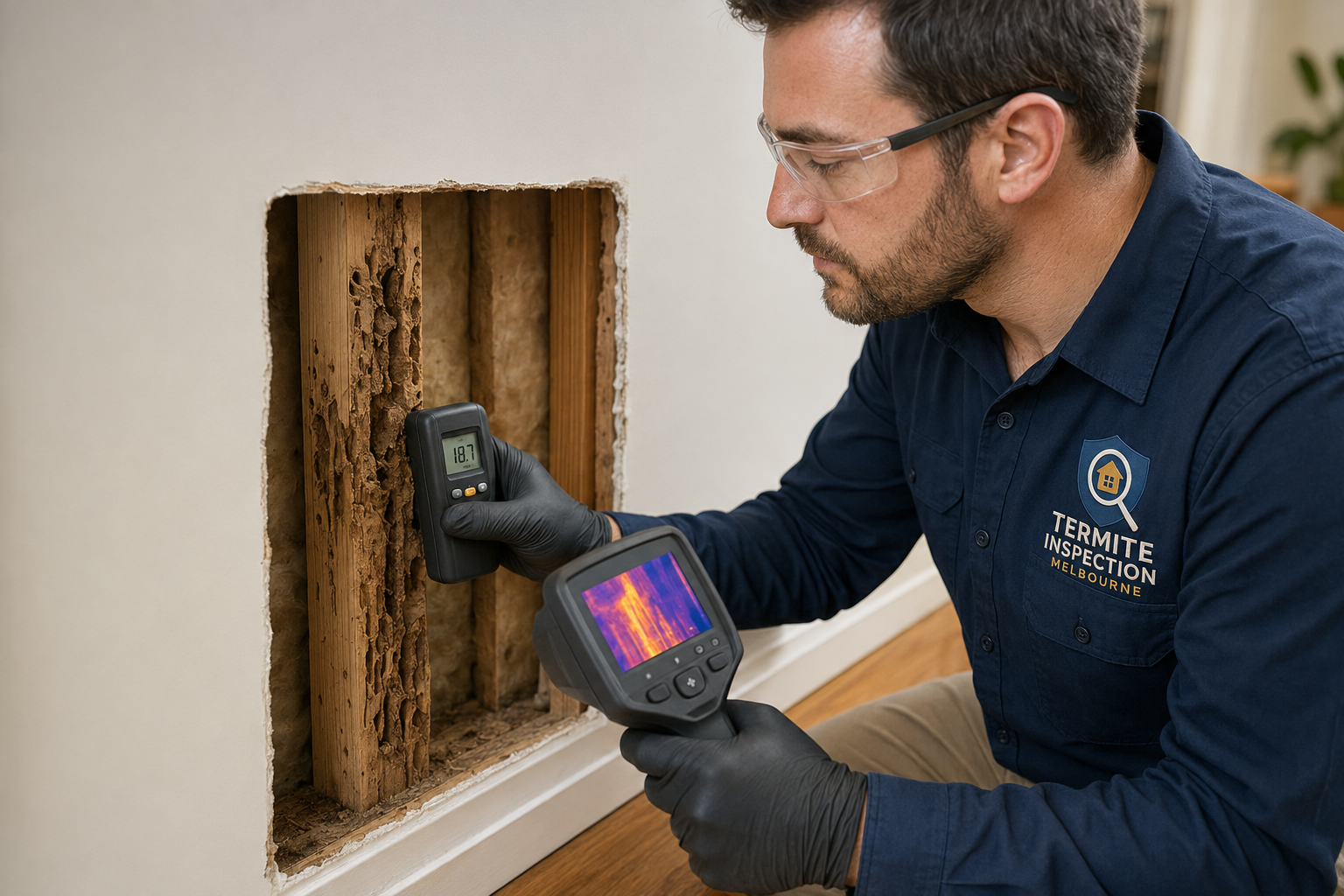
Thermal imaging camera used during a Melbourne termite inspection to detect hidden colony activity

Melbourne's Clay Soils Hold Moisture

The reactive clay soils common across greater Melbourne expand and hold moisture near foundations, creating exactly the damp, stable micro-climate subterranean termite colonies need to establish and travel to timber above ground.

Damp Subfloors & Poor Ventilation

Older weatherboard and brick-veneer homes with restricted subfloor airflow, along with garden beds, mulch and retained timber built up hard against the foundation, all raise the moisture level that draws colonies toward a property.

Aggressive Local Coptotermes Species

Coptotermes species, among the most destructive subterranean termites in Australia, are well established across Victoria. Colonies can number in the hundreds of thousands and consume timber quickly once they establish a feeding route into a structure.

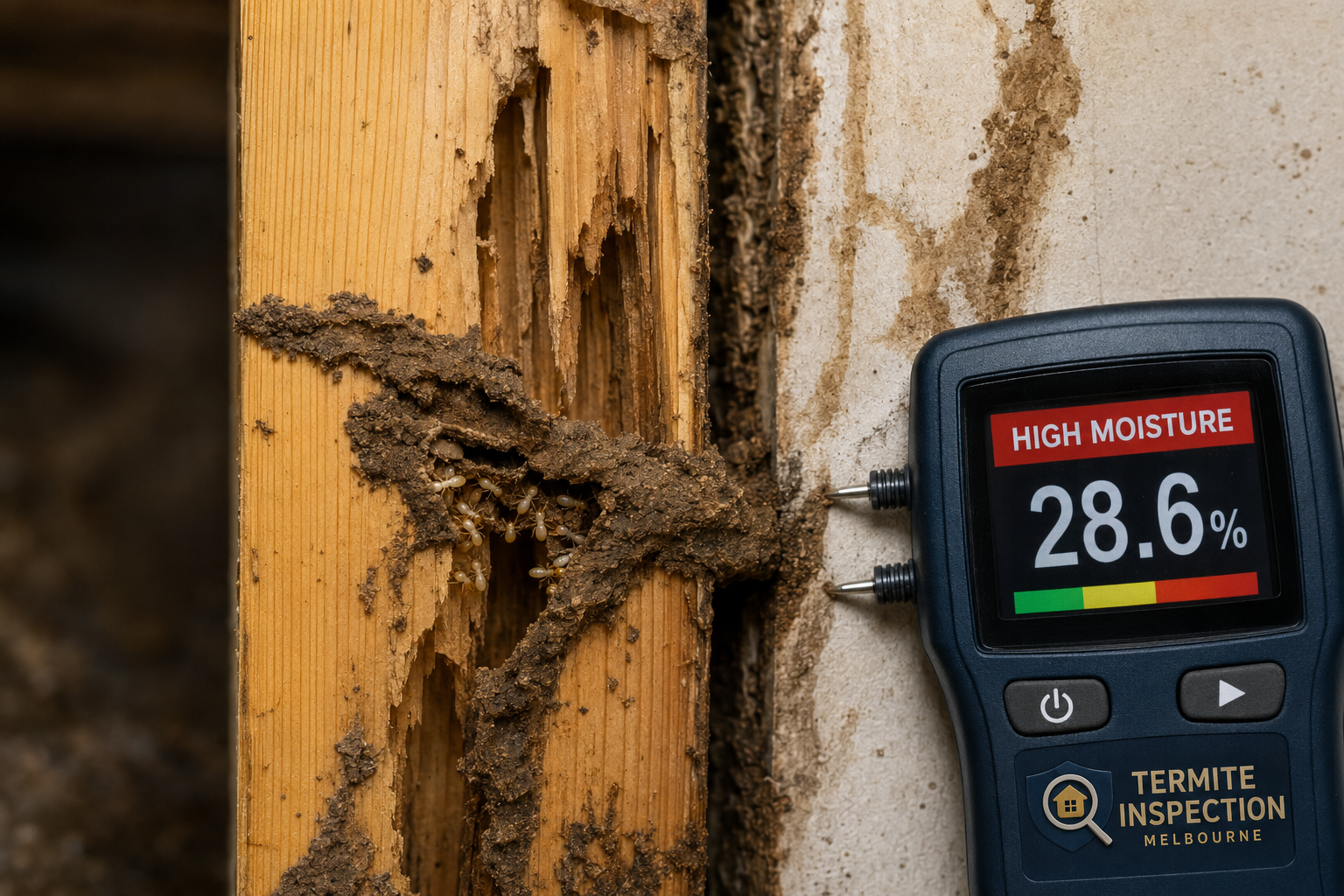
Termite damage assessment showing structural timber damage in a Melbourne property

What Undetected Damage Looks Like

When warning signs are missed for an extended period, a full termite damage assessment often reveals hollowed wall studs, weakened bearers and joists, cracked cornices from floor movement, and — in the most advanced cases — sections of structural timber requiring full replacement. Every one of these outcomes traces back to signs that were present, visible and diagnosable, months or years earlier.

Learn about our termite damage assessment service

Beyond the naked eye

Professional Inspection Equipment We Use

Every diagnostic inspection combines trained visual assessment with purpose-built detection equipment, so signs invisible to a walk-through are caught and documented.

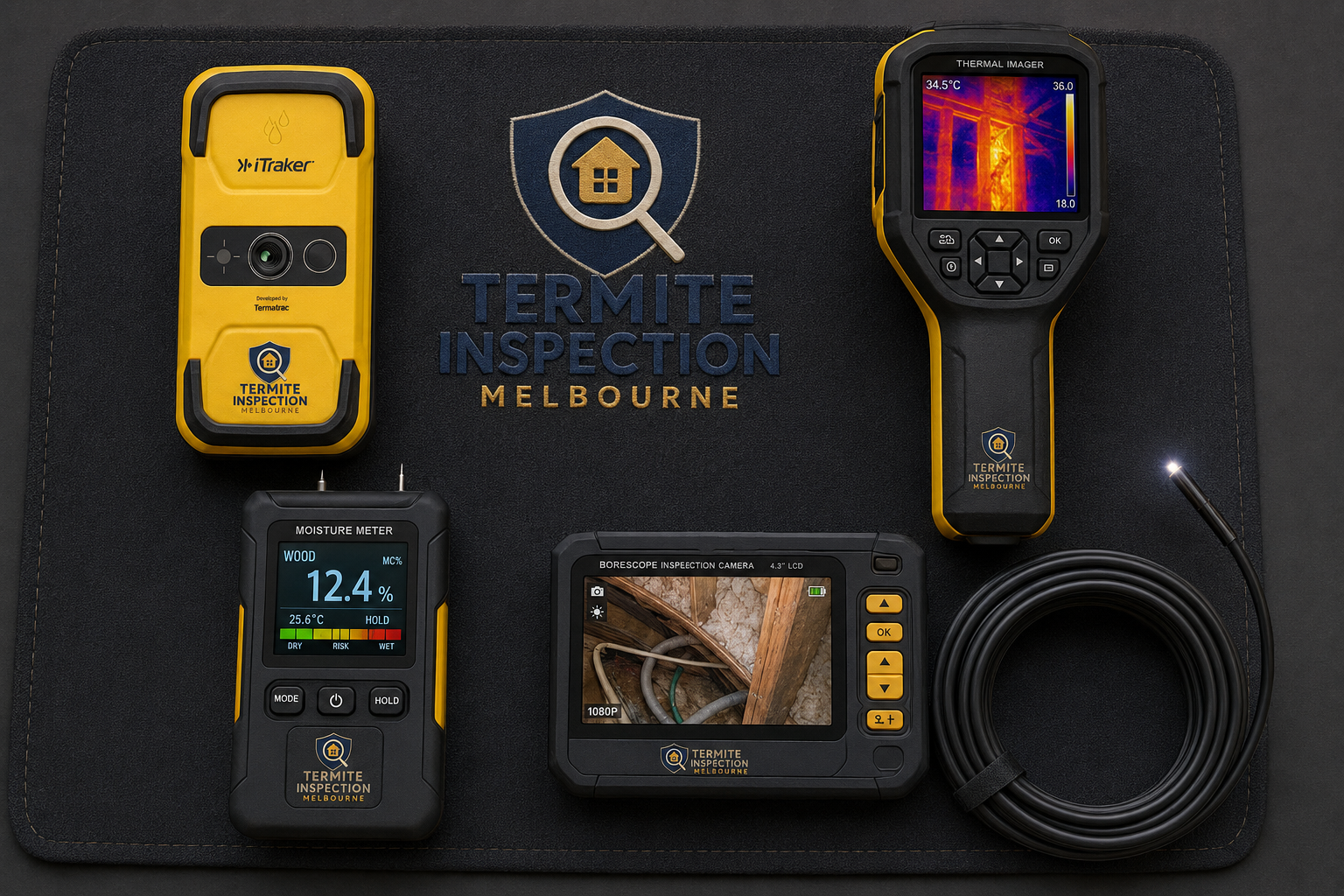
Professional termite and pest inspection equipment used across Melbourne properties

🌡️ Thermal Imaging Camera

Maps temperature variance behind plaster and flooring to flag moisture and hidden colony activity before any surface is opened up.

💧 Moisture Meter

Confirms elevated moisture readings in timber and subfloor framing — the conditions termites need and a key corroborating data point alongside thermal imaging.

🔨 Sounding & Probing Tools

Calibrated tapping and probing of skirting, architraves and structural timber to physically confirm any hollow or softened section a thermal reading identifies.

🔦 Roof Void & Subfloor Access Kit

Headlamps, borescopes and confined-space access equipment to physically inspect roof voids and subfloor areas that a visual walk-through of living spaces cannot reach.

Methodical, evidence-based, fully reported

Our Termite Warning Sign Diagnostic Process

When you book a diagnostic inspection after noticing a warning sign, here's exactly what happens.

1

Full Visual & Physical Assessment

We inspect accessible timber, skirting, architraves, external walls, stumps and footings for mud tubes, hollow sounds, frass and paint discolouration — the same signs covered in this guide, checked systematically.

2

Thermal Imaging & Moisture Scan

A thermal camera scans walls, ceilings and flooring for temperature and moisture anomalies that indicate hidden activity behind intact surfaces, directing the inspection to the areas that need closer attention.

3

Subfloor & Roof Void Inspection

Where access allows, the subfloor and roof void are physically inspected — the areas a visual walk-through of living spaces cannot reach and where colonies frequently establish undetected.

4

AS 4349.3 Report & Recommendation

Findings are compiled into a formal, AS 4349.3-aligned report with a same-day digital delivery target, along with a clear treatment recommendation if activity is confirmed.

What a professional termite inspection costs

Prices shown before GST. Includes moisture assessment and a same-day digital report target; commercial and larger or unusual sites receive a custom on-site quote.

Small

1–2 bed unit or apartment

$270

+ GST

Medium

3 bed house

$300

+ GST

Large

4+ bed house

$330

+ GST

Book My Diagnostic Inspection

Trusted across Melbourne

What Melbourne Homeowners Say

4.9

Rated on Google

from 2,000+ local Melbourne properties

Verified customer reviews

“Noticed a mud tube on the back stump and called straight away. The thermal camera picked up damage behind the laundry wall we would never have found ourselves. Caught early and treated fast.”

LB

Lisa B.

Berwick

“The skirting board sounded hollow so I booked an inspection. Turned out termites had already reached the frame. So glad we caught it when we did — could have been a lot worse.”

GH

Grant H.

Cranbourne

“Doors had started sticking and I put it down to the weather. The inspection found active termites in the subfloor. Detailed report, thermal images included, explained everything clearly.”

NT

Natalie T.

Frankston

“Saw winged termites near the window one evening and called the next morning. Same-day inspection confirmed a nearby colony. Quick, professional and reassuring.”

RC

Ryan C.

Pakenham

“Paint had started bubbling on a bedroom wall and I assumed it was a leak. Turned out to be termite damage. The moisture meter and thermal scan found it fast.”

SW

Sophie W.

Narre Warren

“As a local business we appreciated the fast response. Full AS 4349.3 report same day with clear photos of every warning sign they found. Exactly what we needed for our records.”

TK

Tom K.

Clyde North

Credentials you can verify

Certified Melbourne Termite Diagnostic Specialists

Every technician who inspects your property for warning signs is qualified, background-checked and trained specifically in timber pest diagnostics — not a generalist subcontractor.

TIM's Pest Control accredited team of Melbourne termite and pest control technicians

Fully Licensed & Insured

Current pest-management licence and full public-liability insurance. Certificates available on request before we start.

AEPMA-Certified Technicians

Members of the Australian Environmental Pest Managers Association, trained to national best-practice diagnostic standards.

AS 4349.3 Compliant Reporting

Every diagnostic inspection is documented to the Australian Standard for timber pest inspection reports — the standard insurers, buyers and lenders recognise.

Police-Checked Local Experts

Every technician is background-checked and Melbourne-based — the same trusted faces at your door, every visit.

Answers before you book

Termite Warning Sign FAQs

What are the absolute first signs of termites in a Melbourne home? +

The earliest signs are usually the quietest ones: thin mud (shelter) tubes running up an external brick wall, a stump or a subfloor pier; skirting boards or architraves that sound papery or hollow when tapped; and doors or windows that have started sticking for no obvious reason. Discarded, papery wings near window sills after a warm, humid evening are another early tell — that is a termite swarm looking for a new site to colonise, and it means an active colony is already close by. Because subterranean termites (the dominant risk species in Melbourne) work from the inside out, most early activity is invisible until you know exactly what to tap, probe and look for.

Can I check for termites myself using a screwdriver? +

A screwdriver or similar probe test can flag a problem — if the tip sinks easily into skirting, an architrave or a stump with little resistance, or the timber sounds hollow when tapped, that is a red flag worth acting on. What it cannot do is tell you how far the damage extends, whether the colony is still active, or what is happening inside wall cavities, behind plaster, under flooring or in the roof void, none of which a screwdriver can reach. A DIY probe test is a useful early-warning habit, not a substitute for a licensed AS 4349.3 inspection with thermal imaging and moisture assessment.

Why do mud tubes appear on brick walls? +

Subterranean termites need a humid, dark micro-climate to survive — direct exposure to open air dries them out within hours. Mud tubes (also called shelter tubes) are how they solve that: they build enclosed tunnels from soil, saliva and chewed timber across bare surfaces like brick footings, concrete stumps, piers and subfloor walls, giving the colony a protected, moisture-controlled route from the soil to a timber food source above. Finding a mud tube on an external wall means termites have already built a safe corridor into your home's timber — it is one of the clearest and most reliable visual warning signs there is.

How does thermal imaging reveal hidden termite damage behind plastered walls? +

Termite galleries and the moisture that comes with an active colony change how a surface holds and releases heat compared with the timber and plaster around it. A thermal imaging camera reads those subtle temperature differences across a wall, ceiling or floor and displays them as a colour-mapped image, highlighting cooler or warmer patches that correlate with hidden voids, moisture and termite activity behind an intact, undamaged-looking surface. It does not replace a physical inspection, but it directs the inspector straight to the areas that need a closer probe, moisture-meter reading or targeted access point — finding problems that a purely visual walk-through, DIY or otherwise, would miss entirely.

What should I do immediately if I spot live termites? +

Do not disturb them, spray them, or poke at the mud tube or timber — disturbing an active colony can cause it to retreat deeper into the structure or relocate to a harder-to-treat area, making the job more difficult later. Leave the area undisturbed, note down where you saw the activity (room, wall, approximate height), and call a licensed technician for an urgent diagnostic inspection as soon as possible — same-day appointments may be available depending on your suburb and route. The goal is to let a professional map the full extent of the colony with thermal imaging and moisture assessment before any treatment decision is made.

How much does a professional termite inspection cost in Melbourne? +

A full AS 4349.3-aligned termite inspection with moisture assessment starts at $270 + GST for a small property, $300 + GST for a medium 3-bedroom home, and $330 + GST for a large property, with a same-day digital report targeted where possible. Commercial buildings and larger or unusual sites require a custom on-site quote rather than a fixed online price. Your exact GST-inclusive total is confirmed in the booking calculator before you enter any personal details, and licensed technician attendance is included in every price shown.

Are termite warning signs different for subterranean vs drywood termites? +

Yes. Melbourne's dominant risk is subterranean termites (notably aggressive Coptotermes species), which need soil contact or a moisture source and give themselves away through mud tubes, damp-affected paint and timber that stays cool and hollow-sounding near ground level or in the subfloor. Drywood termites are less common locally but do not need soil contact at all — instead, look for small, gritty, sand-like faecal pellets (frass) pushed out of tiny "kick holes" in furniture, skirting or roof timbers, along with discarded wings after a swarm. Because the two types nest, feed and present differently, correct species identification during inspection changes both the diagnosis and the treatment plan.

How often should I have my Melbourne property inspected for termites? +

Industry guidance and most home insurance and building-warranty requirements recommend a minimum of one professional termite inspection every 12 months, and every 6 months for properties in higher-risk areas — those with established gardens close to the foundation, known clay soils, timber-in-ground contact, or a prior history of termite activity nearby. An annual inspection is what catches early warning signs (a fresh mud tube, a newly hollow-sounding skirting board) while treatment is still simple and inexpensive, well before the sagging floors and structural repairs that come with a colony left undetected for years.

Noticed a Warning Sign? Get a Same-Day Termite Diagnostic Quote

Don't wait for a mud tube to become a sagging floor. Speak directly with our certified Melbourne termite experts and dispatch an urgent thermal-imaging diagnostic inspection today — save $250 off complete barrier treatments plus a free thermal scan ($150 value) when you book this week.

🎯 Offer ends 15th September 2026 • ✓ Licensed & Insured • ✓ 4.9★ Rated