Comprehensive Pest Offer Book any residential or commercial pest treatment online this Wednesday & save $250 off complete termite barrier installations + Free Thermal Scan ($150 value)
Call 0466 929 533
☰ Explore Services & Menu
Common Melbourne pests guide — termites, cockroaches, rodents and household pests

AEPMA-certified pest technicians • Clyde North to greater Melbourne

Common Melbourne Pests Guide | Residential & Commercial Pest Control

Melbourne's shifting climate — wet winters, warm dry summers and everything between — creates ideal conditions for subterranean termites, household invaders, urban wildlife and, for hospitality operators, the strict HACCP-compliant pest management restaurants and cafes are held to. This guide covers the pests most commonly found across Melbourne homes and businesses, what puts your property at risk, and how professional treatment differs from a DIY fix.

  • Residential & commercial coverage
  • HACCP-compliant kitchen programs
  • Licensed, AEPMA-certified technicians
  • 4.9★ Google rating, 2,000+ served

Start here

Get Your Free Instant Quote

No obligation, expert pest assessment, exact fixed pricing. Book online this Wednesday & save with our VIP Members offer.

✓ No obligation • ✓ No sales calls • ✓ Price shown before contact

🏠
Residential & Commercial

One trusted provider

🍽️
HACCP Programs

Restaurants & cafes

🐜
4 Pest Categories

Fully covered

$
Zero Hidden Fees

Price before booking

📍
199+ Suburbs

Clyde North to CBD

4.9 Rating

2,000+ reviews

A complete picture, category by category

Melbourne's Pest Landscape at a Glance

Ask any Melbourne pest control services provider and they'll tell you the same thing: this city's pest pressure is unusually broad. Reactive clay soils and damp subfloors sustain subterranean termites year-round. Established gardens, older weatherboard housing stock and busy commercial kitchens all create separate, overlapping pest ecosystems. A property owner in Frankston deals with a different risk profile to a cafe operator in the CBD, and both are different again from a strata building in the eastern suburbs — which is exactly why this guide is organised by category rather than treated as a single generic pest list.

This guide draws on the same species identification, seasonal behaviour and treatment logic our technicians apply on-site every day across Melbourne, condensed here so you can identify what you're dealing with, understand the actual risk level, and know when a DIY response is reasonable versus when it's time to call a licensed professional.

Each category below covers identification, the specific risk it poses, and how professional treatment differs from a DIY response — jump straight to the one relevant to you, or read through for the full picture of what "common pests in Melbourne" actually covers across a residential home, a rental property, and a commercial kitchen.

Category 1

Timber Pests & Termites

Subterranean termites are the number one structural threat to Victorian homes, and wood borers run a close second. Both attack the timber that holds a building together, often for months or years before visible damage appears — which is exactly why this category gets treated with more urgency than any other pest on this list.

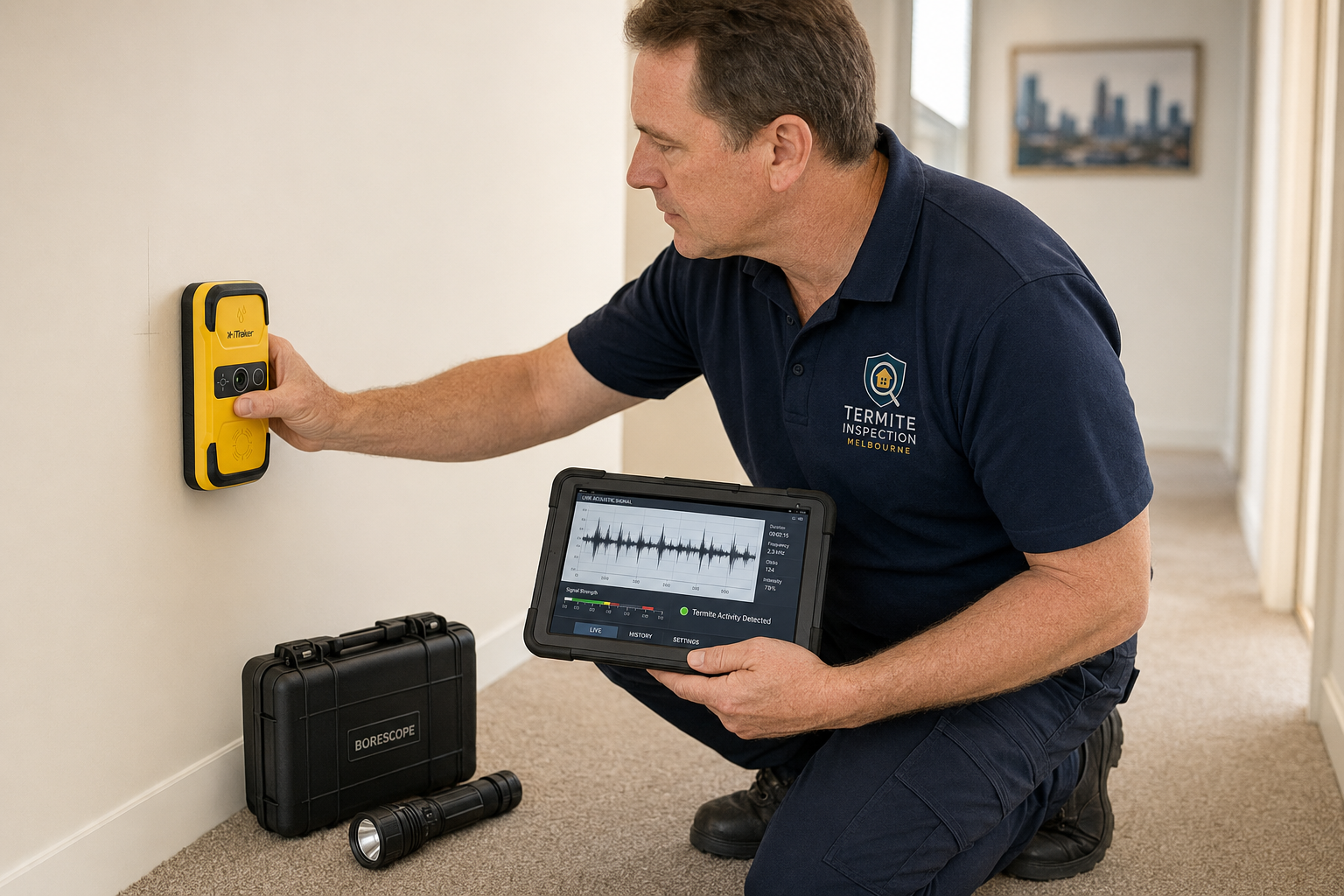
Professional termite inspection in a Melbourne subfloor, checking for subterranean Coptotermes activity

⚠️ Subterranean Termites (Coptotermes)

Coptotermes species are the dominant and most destructive subterranean termites found across Victoria, and they are responsible for the overwhelming majority of termite damage claims in Melbourne homes. Colonies live in the soil and travel to timber through mud (shelter) tubes built across brick footings, stumps and subfloor walls, protecting the workers from drying air as they feed. A mature colony can number in the hundreds of thousands and, left undetected, can hollow out structural studs, bearers and joists while leaving the painted or plastered surface looking almost untouched.

Risk: structural weakening, sagging floors, jamming doors and windows, and — in advanced cases — the need for full structural timber replacement. Treatment: a licensed AS 4349.3 inspection with thermal imaging and moisture assessment to confirm activity and extent, followed by a physical termite barrier, chemical soil treatment or a baiting and monitoring system depending on the property's construction and site conditions.

Book a termite inspection

🪵 Wood Borers

Unlike termites, wood borers (various beetle species whose larvae feed inside seasoned timber) don't need soil contact or a colony structure to cause damage. Adult beetles lay eggs in cracks, joints or the end grain of structural and decorative timber, and the larvae then tunnel through the wood for months or years before emerging as adults, leaving a network of tiny round exit holes — often 1–3mm across — as the first visible sign.

Risk: weakened flooring, roof timbers, furniture and structural framing, particularly in older Melbourne homes with original hardwood or softwood construction. Fine, powdery frass beneath exit holes is a telltale sign of active infestation. Treatment: targeted timber treatment with borer-specific insecticide, and in severe cases, replacement of badly affected structural members.

Why this category comes first: subterranean termites in Victoria cause more structural damage to homes than fire, storm and flood combined over a property's lifetime, according to industry data widely cited across the Australian pest management sector. An annual inspection is the single most cost-effective thing a Melbourne property owner can do to protect their investment. The cost gap is stark in practice: a routine inspection and, where needed, a barrier treatment typically runs to a few hundred dollars, while structural timber replacement after an undetected colony has been active for several years can run into tens of thousands — which is why this category, alone among the four in this guide, warrants a fixed annual calendar reminder rather than a reactive, wait-and-see approach.

Category 2

Commercial Kitchen & Hospitality Pests

Restaurant and cafe pest control Melbourne operators rely on isn't optional — it's a food-safety and council compliance requirement. Warmth, food residue and constant moisture from dishwashing and food prep make commercial kitchens one of the highest-pressure pest environments in the city, and the pests involved differ in important ways from a typical residential infestation.

The stakes are higher here than in a residential setting too: a failed health inspection can mean a public rating downgrade, a follow-up visit on a tighter timeframe, or in serious cases a temporary closure — all of which cost far more in lost trade than a properly documented, ongoing pest program ever would. This is why commercial and hospitality clients are usually the fastest to move from a one-off treatment to a scheduled maintenance visit once they understand what an inspector is actually looking for on the day.

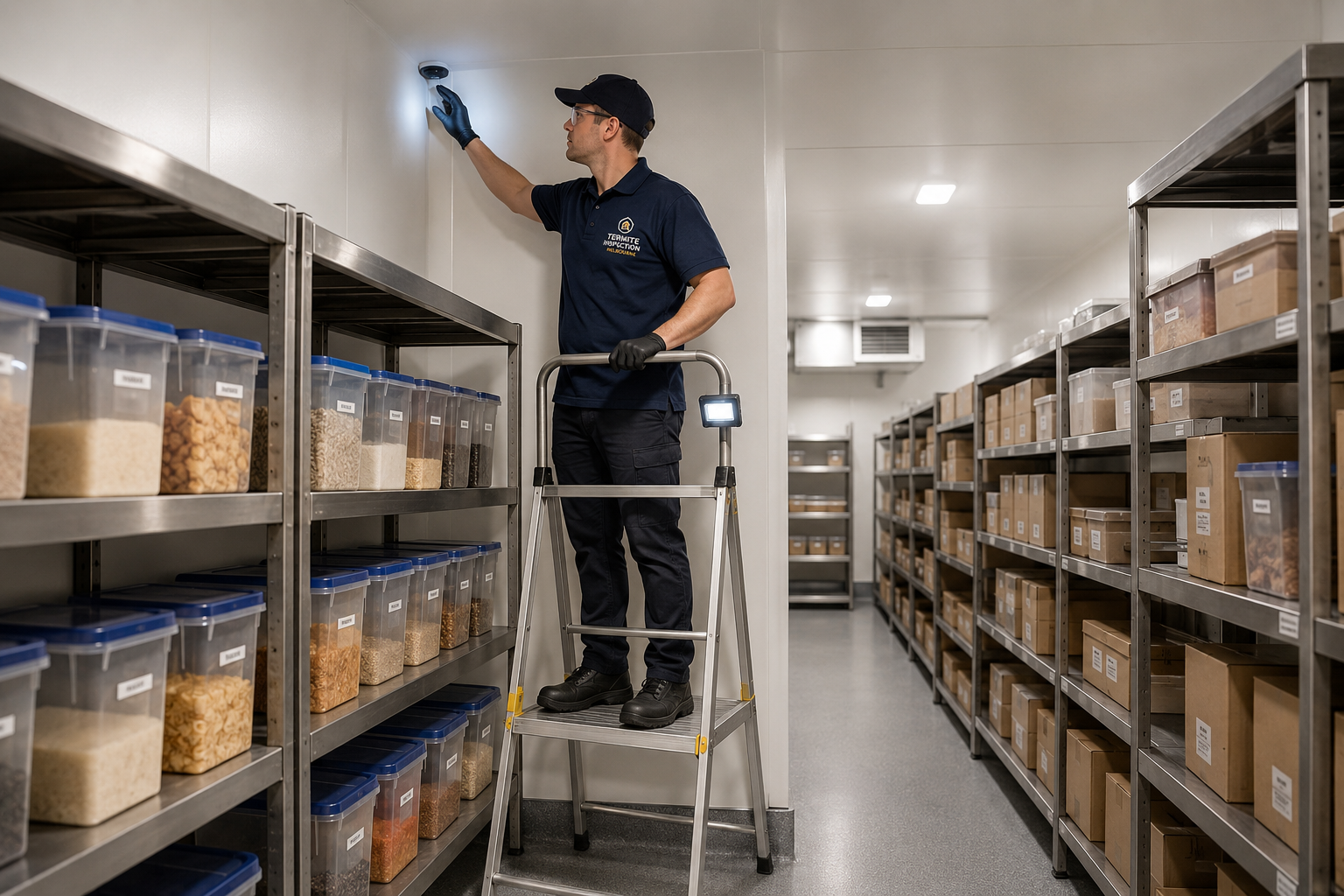
Commercial German cockroach pest control treatment in a Melbourne restaurant kitchen

German Cockroach Treatment

German cockroaches are the single most common commercial kitchen pest in Melbourne, breeding rapidly in warm, humid voids around dishwashers, coolroom motors, cooking-line equipment and wall cavities behind fixed fittings. A female can produce hundreds of offspring across her lifespan, which is why an infestation that looks minor at first inspection can escalate within weeks if left untreated. They contaminate food-contact surfaces, trigger allergic and asthmatic reactions in sensitive individuals, and are a leading cause of failed council health inspections for food businesses.

Treatment: non-repellent gel baiting placed in cracks, voids and behind equipment away from food-contact zones, combined with insect growth regulators to break the breeding cycle and a documented monitoring and reporting schedule that satisfies HACCP and council auditors.

Mice & Rats in Commercial Kitchens

Rodents entering a commercial kitchen present an immediate compliance risk — droppings, gnaw marks on packaging, and a single sighting can be enough to trigger a failed inspection or a temporary closure order. Deliveries, waste storage areas and rear-of-house access points are the most common entry routes, and rodents are drawn to the same warmth and constant food supply that make a kitchen attractive in the first place.

Treatment: exterior bait stations, interior monitoring, exclusion work on entry points, and a documented service log — the same paper trail council inspectors and HACCP auditors expect to see on file.

Drain Flies

Small, moth-like flies that breed in the organic film and grease buildup inside floor drains, grease traps and dishwasher waste lines — a near-universal issue in busy commercial kitchens if drains aren't cleaned on a strict schedule. They're more a hygiene and nuisance issue than a structural one, but a visible swarm around a drain during a health inspection is a fast way to raise red flags.

Treatment: enzymatic drain treatment to break down the organic film breeding sites, combined with a cleaning schedule review — treatment alone won't hold if the underlying grease buildup isn't addressed.

HACCP Compliance in Practice

HACCP compliance isn't a single treatment — it's an ongoing, documented program covering scheduled inspections, treatment records, monitoring station placement and a pest activity trend log an auditor or council inspector can review at any time. For restaurants, cafes, schools and other food-handling sites, this documentation is often as important to compliance as the treatment itself.

See our restaurant & cafe pest control program

Category 3

Household & Structural Pests

The most common pests in Melbourne homes — the ones prompting the majority of everyday pest control calls. Individually manageable, but each has a habit of returning if only the visible activity is treated rather than the source.

🐜 Ants

Black house ants, coastal brown ants and Argentine ants are common across Melbourne suburbs, forming trails to food and moisture and nesting in wall voids, subfloors and garden beds. Repellent sprays often split a colony into multiple new nests (budding). Non-repellent baiting carried back to the queen is what delivers lasting control.

🕷️ Spiders

From common huntsman and orb-weavers to the medically significant redback, spiders are drawn to eaves, garages, woodpiles and garden edges. Perimeter treatment targeting webbing sites and entry points reduces both population and the risk of an indoor bite.

🦟 Silverfish

Silvery, wingless insects thriving in damp, dark areas — bathrooms, basements, roof voids and stored paper or cardboard. They feed on starches, so damage to books, wallpaper and stored documents is often the first sign of an established population.

🦠 Fleas

Usually introduced by pets or wildlife, flea populations explode quickly in carpets, pet bedding and shaded outdoor areas during Melbourne's warmer months. Treatment must cover the whole property, not just the pet, since eggs and larvae persist in carpet fibres and soft furnishings for months.

🛏️ Bed Bugs

Small, flat, reddish-brown insects that hide in mattress seams, bed frames and skirting during the day and feed at night, commonly spread via travel, secondhand furniture or shared building walls. Rust-coloured spotting on sheets and small itchy bite clusters are the usual first signs — professional heat or chemical treatment is needed, as DIY sprays rarely reach every hiding point.

🐝 Wasps & Bees

European wasps and native paper wasps build nests in roof voids, wall cavities, garden sheds and under eaves, becoming increasingly aggressive as the nest grows through late summer and autumn. Unlike bees, wasps can sting repeatedly and will defend a nest vigorously if disturbed, making DIY removal genuinely risky for anyone with a sensitivity or allergy. Professional removal uses a targeted dust or spray treatment applied directly to the nest entrance, followed by physical removal once activity has stopped, along with advice on sealing the cavity to prevent re-nesting the following season.

🦟 Mosquitoes

Mosquito activity across Melbourne rises sharply after rain, breeding in any standing water — blocked gutters, pot plant saucers, unused pools, water features and poorly draining garden beds. Beyond the nuisance factor, mosquitoes are a genuine disease-vector concern, with Ross River virus and other mosquito-borne illnesses reported across Victoria in warmer months. Effective control combines breeding-site reduction (removing or treating standing water around the property) with residual barrier treatment to garden vegetation and shaded resting areas where adult mosquitoes shelter during the day.

🪳 Household Cockroaches

Residential cockroach activity in Melbourne is usually driven by American cockroaches (larger, reddish-brown, often entering through drains and subfloors) or German cockroaches finding their way from a shared wall in units and townhouses. Both are drawn to warmth, moisture and food residue in kitchens, bathrooms and laundries, and both can trigger allergic and asthmatic reactions through shed skin and droppings, quite apart from the hygiene concern of surfaces they cross. Non-repellent gel baiting and targeted crack-and-crevice treatment, rather than surface sprays, is what actually reaches the harbourage areas where they breed.

Full service pages available

Dedicated Treatment Pages for Every Household Pest

Every pest in this category has its own dedicated treatment page with species-specific detail, pricing and booking — from European wasp nest removal to mosquito breeding-site reduction and silverfish control.

See all household pest control services

Reduce risk between professional visits

Melbourne Pest Prevention Checklist

Professional treatment handles the pests already established on a property, but a handful of ongoing habits genuinely reduce how quickly each of the four categories in this guide can re-establish between scheduled visits — none of these replace a professional inspection, but each one buys time and reduces severity.

Reducing Termite & Timber Pest Risk

Keep garden beds, mulch and retained timber clear of direct contact with external walls and stumps, since built-up organic matter against the foundation raises moisture and gives termites an easy, concealed bridge to the structure. Fix leaking taps, downpipes and irrigation lines promptly — persistent dampness around a foundation is one of the strongest attractants for a subterranean colony. Improve subfloor ventilation where airflow is restricted, and book an annual professional inspection rather than waiting for a visible sign, since by the time damage is obvious the colony has often been established for a long time.

Reducing Commercial Kitchen Risk

Stick to a strict end-of-shift cleaning schedule for drains, grease traps and behind fixed equipment, since food residue in these hard-to-reach areas is what sustains German cockroach and drain fly populations between professional visits. Store deliveries off the floor and away from walls to remove easy rodent harbourage, and report any gap, crack or unsealed penetration around pipework or the rear-of-house entry promptly — these are the entry points rodents and cockroaches use to move between a kitchen and the outside.

Reducing Household Pest Risk

Seal obvious gaps around windows, doors and utility penetrations, store pet food in sealed containers rather than open bags, and keep firewood, garden edging and mulch away from direct wall contact to reduce ant, spider and silverfish harbourage. For bed bugs specifically, inspect secondhand furniture and mattresses before bringing them into the home, and check luggage after travel — early detection before a population establishes makes treatment considerably simpler.

Reducing Rodent & Wildlife Risk

Trim tree branches back from the roofline, since overhanging branches are a common bridge for both rodents and possums to reach a roof void without touching the ground. Seal roofline gaps, damaged flashing and vent penetrations — most rodent entry points are smaller than a 10-cent coin, so what looks insignificant to a homeowner is a clear doorway to a mouse. If you hear activity in the roof at night, avoid attempting to block the entry point yourself until a professional has confirmed the animal isn't currently trapped inside, particularly if a possum may be involved.

Category 4

Rodents & Urban Wildlife

Scratching noises in the ceiling at night are one of the most common calls we get across Melbourne, and the cause is almost always one of four animals — each requiring a genuinely different approach, from bait station placement to whether the job is a pest treatment at all or a protected-species wildlife matter.

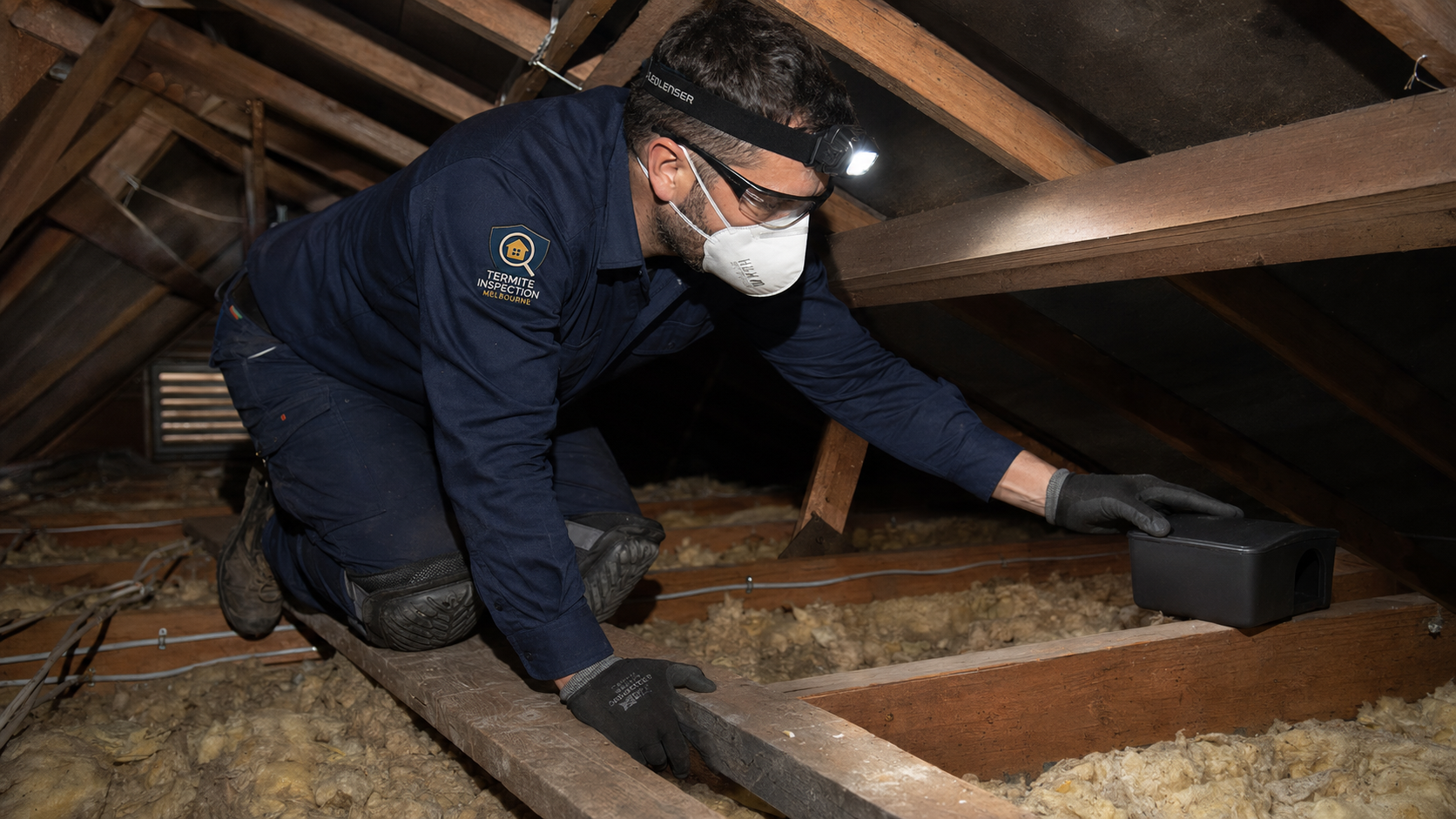
Professional rodent control for roof rats, Norway rats and house mice in Melbourne

Rodent Control Melbourne

Roof Rats (Black Rats)

Excellent climbers, the most common rat species found inside Melbourne homes, nesting in roof voids, ceiling cavities and dense vegetation. Scratching overhead at night and gnaw damage to wiring or insulation are the usual first signs.

Norway Rats

Larger, ground-dwelling burrowers preferring subfloors, drains and garden beds, more commonly found around commercial sites, sheds and properties near waterways.

House Mice

The smallest and fastest-breeding of the three, able to squeeze through gaps as small as 6mm. Usually the first rodent sign shows up in a kitchen, pantry or wall cavity as droppings or gnawed packaging.

Book rodent control
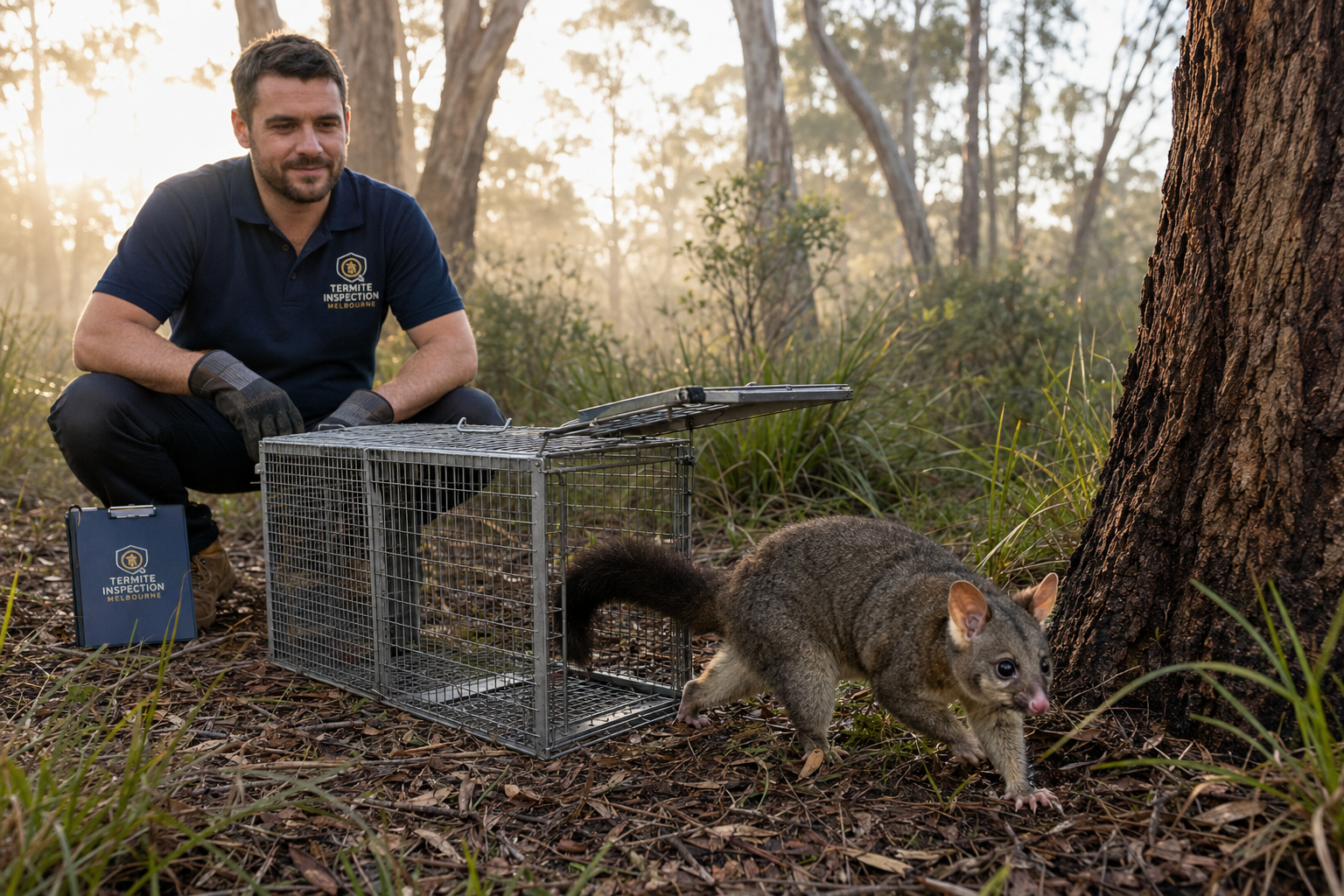
Humane possum removal and one-way exclusion gate installation on a Melbourne roof

Possums — A Wildlife, Not Pest, Matter

Brushtail and ringtail possums are native, protected species in Victoria — they cannot be trapped, harmed or relocated. When a possum takes up residence in a roof void, the compliant approach is a one-way exclusion gate that lets it leave to forage at night while preventing re-entry, followed by permanently sealing the access point once it has vacated.

Scratching or thumping in the ceiling at dusk, droppings in the roof void, and a strong musky odour are the usual signs. Solar panel installations have also created a new entry point on many Melbourne roofs, which is why bird and possum proofing around panel edges has become a common add-on request.

Book humane possum removal

A realistic guide, not a sales pitch

When DIY Is Enough — And When It Isn't

Not every pest sighting needs a professional callout. Being honest about where the line sits helps Melbourne property owners spend their money where it actually matters.

A DIY approach is usually fine for:

  • A single spider or ant seen occasionally, with no trail or nest visible
  • One-off wasp sightings in the garden with no nest located on the property
  • Routine prevention — sealing gaps, clearing gutters, removing standing water
  • Pet-related fleas caught early, treated on the pet and around its bedding immediately

⚠️ Call a professional when:

  • You find a mud tube, hollow-sounding timber, or any suspected termite sign — timing genuinely matters
  • Pest activity is inside a commercial kitchen or food-handling area — this is a compliance issue, not just pest control
  • Rodent droppings, gnaw marks or scratching sounds continue after a DIY trap or bait attempt
  • A possum, bird or other wildlife has entered a roof void — legally and practically a specialist job
  • The same pest keeps returning after repeated DIY treatment — the source hasn't been reached
The general rule: if a pest is visible but isolated and you can see where it's coming from, a DIY response is reasonable. If the source is hidden — inside a wall, under a floor, in a roof void, or behind commercial kitchen equipment — that's exactly the situation professional inspection equipment and species-specific treatment exist for.

Why the provider matters as much as the treatment

Pest Control Providers Compared

Not every pest control option is built for every situation. Here's how the common choices stack up across the criteria that matter most for Melbourne's residential and commercial properties — particularly once a job crosses from a simple household nuisance into structural termite work or a food-safety compliance matter.

Provider Commercial Kitchen Compliance Structural Termite Integration Family-Safe Solutions Warranty Backing
TIM's Professional Pest Eradication ✓ HACCP-documented programs ✓ AS 4349.3 inspection + barrier options ✓ APVMA-approved, label-directed ✓ Written guarantee on qualifying treatments
Supermarket DIY Sprays ✗ No documentation, non-compliant ✗ Surface only — no colony access ⚠️ Varies by product, no professional oversight ✗ None
Basic Local Handymen ✗ Not licensed for pest treatment ✗ Not species-trained ⚠️ Variable, unregulated products ✗ Informal, rarely in writing
Out-of-Town Franchises ⚠️ Compliant, but generic scheduling ⚠️ Available, less local site knowledge ✓ Generally APVMA-approved products ⚠️ Standard corporate terms, less flexible
Our recommendation: Melbourne's pest pressure spans structural termites, HACCP-regulated commercial sites and everyday household nuisances, and each category rewards different expertise. A local, licensed provider with AEPMA-certified technicians, documented compliance reporting and a written guarantee gives you coverage across all four categories in this guide, without juggling multiple providers. Out-of-town franchises can tick most of the same compliance boxes on paper, but a locally based team with direct knowledge of Melbourne's suburb-by-suburb risk profile — covered in the region snapshot below — is generally better placed to prioritise the right category first.

Local conditions, local risk

Why Melbourne's Climate Drives Pest Activity

Melbourne's famously variable weather isn't just a talking point — it's a major driver of which pests are active on a property, and when, which is worth understanding regardless of which of the four pest categories in this guide applies to you.

Wet, Cooler Winters

Consistent rainfall and cooler temperatures push rodents out of gardens and drains and into roof voids and wall cavities seeking warmth and shelter, while damp, insulated subfloors keep subterranean termite colonies active and feeding year-round rather than dormant. This is the season commercial kitchens also see a spike in rodent-related compliance issues as animals seek warmth near ovens, dishwashers and cooking equipment.

Warm, Dry Summers

Ant, spider, wasp and mosquito activity climbs sharply as colonies forage, swarm and breed in the heat. Termite swarms — winged reproductives leaving an established colony to found a new one — are also more commonly reported in the warmer, humid evenings of late spring and early summer, often the first visible sign of nearby termite activity.

Commercial Kitchens: Season-Independent

German cockroach and drain fly populations respond less to outdoor weather and more to warmth, moisture and food residue inside the kitchen itself — meaning commercial pest pressure can spike at any time of year regardless of the season, which is exactly why an ongoing HACCP-documented program outperforms a seasonal or reactive approach.

Spring: The Transition Season to Watch Closely

Spring is where Melbourne's pest pressure genuinely overlaps across categories, and it's often the busiest season for inspection bookings as a result. Rising temperatures and humidity after a wet winter trigger termite swarming, ant colonies expanding out of overwintering nests, and wasp queens beginning new nests from scratch. Rodents that moved indoors for winter warmth are still present and breeding, gardens are growing back into contact with foundations and walls, and possums often relocate or start new litters. If there's one season to prioritise a professional inspection over a DIY check, spring is it — it's the point where an early sign is most likely to be a fresh, still-manageable problem rather than an entrenched one.

The takeaway: there's no single "pest season" in Melbourne — there's a rotating calendar of risk across termites, rodents, insects and commercial pressure points. That's why an annual inspection schedule, rather than a one-off treatment when something is already visible, is what actually keeps a property protected through every season, and why many Melbourne homeowners and hospitality operators eventually move to a scheduled maintenance plan rather than booking reactively each time a new pest shows up.

Local knowledge, not a generic list

Melbourne Region Risk Snapshot

Pest pressure isn't uniform across greater Melbourne. Building age, soil type, garden density and proximity to commercial strips all shift which of the four categories in this guide matters most in a given area.

South-East Growth Corridor

Clyde North, Cranbourne, Berwick, Pakenham

Newer estates with established gardens now reaching maturity, driving heavy seasonal ant and spider activity. New-build termite barriers here need their first periodic inspection as they approach the middle of their service life.

Inner Melbourne & CBD

CBD, inner north, inner south

Dense apartment living and a concentration of restaurants and cafes push commercial kitchen and hospitality pest pressure well above the metro average, with shared walls also making bed bug and cockroach transfer between units a genuine risk.

Eastern & Established Suburbs

Box Hill, Camberwell, Glen Waverley

Older housing stock with mature gardens and established timber structures makes this region one of the highest-risk zones for subterranean termites and wood borers, alongside strong ant and possum activity from decades-old tree cover.

Northern, Western & Peninsula

Northern suburbs, western suburbs, Mornington Peninsula

Larger blocks, acreage and coastal properties bring sheds, outbuildings and dense vegetation that support multiple ant and spider nests, while proximity to waterways on the Peninsula raises Norway rat activity around drains and garden beds.

One provider, every category

Our Approach to Melbourne Pest Management

Whatever pest brought you to this page, the process behind every treatment we deliver follows the same four principles — whether it's a single-visit household job or a multi-site commercial contract with recurring visits.

1

Correct Identification

Every category on this page — from termite species to rodent type — requires a different treatment approach. Our technicians identify the exact pest and its behaviour before any treatment decision is made.

2

Source, Not Symptom

Wherever possible, treatment targets the colony, nest or breeding site rather than just the pests you can see — the difference between a lasting fix and a recurring call-back.

3

Compliant, Documented Work

AS 4349.3 termite reports, HACCP-ready commercial documentation, and APVMA-approved products applied to label directions — every job leaves a paper trail that stands up to scrutiny.

4

Follow-Up & Prevention

Follow-up visits confirm the treatment held, with prevention advice and optional seasonal maintenance tailored to which of the four pest categories affected your property.

Credentials you can verify

Certified Across Every Pest Category

One accredited team, trained across residential, commercial and wildlife pest management — not separate specialists you have to coordinate yourself, and not a subcontractor you have never met turning up unannounced at your door or your kitchen.

TIM's Pest Control accredited team of Melbourne pest control technicians

Fully Licensed & Insured

Current pest-management licence and full public-liability insurance. Certificates available on request before we start.

AEPMA-Certified Technicians

Members of the Australian Environmental Pest Managers Association, trained across residential, commercial and timber pest management.

HACCP-Ready Reporting

Documented commercial kitchen programs built to satisfy council inspectors and HACCP auditors, with a full service history on file.

Police-Checked Local Experts

Every technician is background-checked and Melbourne-based — the same trusted faces at your door or your kitchen, every visit.

Trusted across Melbourne

What Melbourne Homes & Businesses Say

4.9

Rated on Google

from 2,000+ local Melbourne properties

Verified customer reviews

“Termite inspection found early activity in the subfloor before it reached the frame. Same visit covered a small ant problem too. Great to have one provider for everything.”

MV

Maria V.

Cranbourne

“We run a cafe and needed a HACCP-compliant program fast ahead of a health inspection. TIM set it up with full documentation and we passed with no issues.”

DP

Daniel P.

CBD

“Scratching in the roof for weeks turned out to be a possum. They installed a one-way gate, it left within days, and they sealed the entry point properly.”

HJ

Hannah J.

Berwick

“Mice had gotten into the pantry and skirting was chewed up. Bait stations and exclusion work sorted it within a fortnight. Professional and explained everything clearly.”

CW

Chris W.

Frankston

“Bought an older weatherboard home and had a pre-purchase inspection done — found early wood borer activity we would never have spotted ourselves. Glad we knew before settlement.”

AS

Aisha S.

Pakenham

“Restaurant kitchen had a cockroach issue behind the dishwasher. Gel baiting and a documented monitoring schedule fixed it and kept our council inspection on track.”

BT

Ben T.

Clyde North

Answers before you book

Common Melbourne Pests FAQs

What are the most common pests found in Melbourne homes and businesses? +

Melbourne's most common pests fall into four groups: timber pests (subterranean termites and wood borers, the single biggest structural threat to Victorian homes); household invaders (ants, spiders, silverfish, fleas and bed bugs); commercial kitchen and hospitality pests (German cockroaches, mice, rats and drain flies, all governed by strict council and HACCP food-safety standards); and urban wildlife (roof rats, Norway rats, house mice, and brushtail or ringtail possums nesting in roof voids). Which pests are most active on a given property depends heavily on the season, the building age, garden proximity to the foundation, and whether it's a residential home or a commercial kitchen.

How do restaurants and cafes maintain HACCP compliance against German cockroaches? +

HACCP compliance requires a documented, ongoing pest management program, not a one-off spray — councils and food-safety auditors expect records of regular inspections, treatments and monitoring specifically targeting high-risk points like coolroom motors, dishwasher voids, wall cavities behind cooking lines and drainage systems where German cockroaches thrive on warmth, moisture and food residue. Professional commercial pest control combines non-repellent gel baiting, insect growth regulators and monitoring stations placed away from food-contact surfaces, with a written service report after every visit that satisfies council inspectors and HACCP auditors alike.

Why do mice and rats invade Melbourne roof voids during winter? +

As Melbourne's temperature drops through autumn and into winter, rodents move from gardens, drains and neighbouring properties into roof voids and wall cavities seeking warmth, shelter and proximity to a stable food source, often entering through gaps as small as a 10-cent coin around roofline junctions, eaves and pipe penetrations. Once inside, both roof rats and house mice nest in insulation, gnaw on wiring and timber, and breed quickly — a single pair of mice can produce dozens of offspring across a Melbourne winter if the entry points and food access aren't addressed.

Can I treat a severe pest infestation using DIY hardware store products? +

Supermarket sprays and baits can knock down what you can see, but a severe infestation almost always means the source — a termite colony, a rodent nest in the roof void, or a cockroach population breeding inside a wall cavity or kitchen equipment void — is inaccessible to a retail product. Repellent sprays can even worsen some infestations by scattering a colony into new, harder-to-treat areas rather than eliminating it. For anything beyond a handful of visible pests, a professional inspection to locate the actual source, followed by targeted, non-repellent treatment, is what delivers a lasting result rather than a short-term knockdown.

How quickly can TIM's Pest Control dispatch a technician to my Melbourne property? +

Same-day and urgent appointments may be available depending on your suburb, technician route and the pest involved — call 0466 929 533 before 9am for the fastest availability check on the day. Commercial kitchens, restaurants and cafes with an active health inspection or compliance deadline are prioritised where possible, given the food-safety stakes involved. Our service area covers 199+ Melbourne suburbs from our Clyde North base out to the CBD, eastern, northern, western suburbs and the Mornington Peninsula.

What's the difference between roof rats, Norway rats and house mice in Melbourne? +

Roof rats (also called black rats) are excellent climbers that nest in roof voids, ceiling cavities and dense garden vegetation, and are the most common rat species found inside Melbourne homes. Norway rats are larger, heavier-bodied burrowers that prefer ground level, subfloors, drains and garden beds, and are more common around commercial sites, sheds and properties near waterways. House mice are much smaller, breed the fastest of the three, and can squeeze through gaps as small as 6mm — they're typically the first rodent sign in a kitchen, pantry or wall cavity. Correct species identification changes bait placement, station type and the treatment plan.

Are brushtail and ringtail possums a pest control or wildlife removal matter in Victoria? +

Possums are a native protected species in Victoria, so they cannot be trapped, harmed or relocated without following strict regulations — this is a humane wildlife removal and exclusion matter, not a standard pest treatment. The correct approach is a one-way exclusion gate fitted to the roof entry point, allowing the possum to leave and forage at night while preventing it from re-entering, followed by permanently sealing the entry point once the animal has vacated. Attempting to block a possum in, or remove one without following the correct process, can cause unnecessary harm and is not compliant with Victorian wildlife regulations.

How much does general pest control cost compared to termite or commercial treatment in Melbourne? +

Pricing scales with the pest and the property. Standard residential pest treatments for ants, spiders, cockroaches and similar household pests typically start from around $150 + GST for a small property. A full termite inspection with thermal imaging and moisture assessment starts from $270 + GST. Commercial and hospitality sites, including restaurants, cafes and strata buildings, require a custom on-site quote due to the HACCP compliance scope, kitchen equipment access and site size involved. Every quote is confirmed in writing before treatment begins, with no hidden fees.

Do seasonal changes really affect which pests are active on my property? +

Yes, significantly. Melbourne's wet, cooler winters push rodents indoors seeking warmth and drive subterranean termite colonies to remain active in damp, insulated subfloors and wall cavities year-round. Warm, dry summers bring a sharp rise in ant, spider, mosquito and wasp activity as colonies forage and swarm, while German cockroach populations in commercial kitchens can spike whenever warmth and food residue combine, regardless of season. This is why an annual inspection schedule, rather than a single one-off treatment, is what actually keeps a Melbourne property protected across the full pest calendar.

Do you offer combined treatment for multiple pest types in one visit? +

Yes. Many Melbourne properties deal with more than one pest at once — ants and spiders together, or rodents alongside a general pest issue — and our technicians can combine treatments for common household pests in a single appointment where the property and pest combination allow. Termite inspections, commercial kitchen programs and wildlife exclusion work are scoped and quoted separately given their specialised equipment and compliance requirements, but our booking calculator will show you exactly what's included before you confirm.

Does Melbourne's older housing stock carry a higher pest risk than newer builds? +

Generally, yes. Older weatherboard and brick-veneer homes across established Melbourne suburbs often have restricted subfloor ventilation, original single-layer construction, ageing timber in ground contact, and decades of garden growth built up against the foundation — all conditions that favour subterranean termites and wood borers. Newer builds are typically constructed with termite-resistant materials or an installed chemical or physical barrier system, but that barrier has an effective life and still requires periodic inspection to confirm it remains intact. Older or newer, no Melbourne property is risk-free, which is why the recommended annual inspection interval applies across the board.

What should I do if I find a possum trapped inside my roof void? +

Do not attempt to trap, move or remove the possum yourself — as a protected native species, this needs to be handled through the correct wildlife exclusion process. In the short term, if safely accessible, opening a route for the animal to leave (such as an existing vent or gap) can help, but the reliable fix is a professional one-way exclusion gate fitted to the main entry point, which allows the possum to exit and forage at night while physically preventing it from returning, followed by permanently sealing the access point once the roof void is confirmed clear.

Does pest risk differ much between Melbourne suburbs, or is it mostly the same everywhere? +

It differs more than most property owners expect. Established eastern suburbs with mature gardens and older housing stock tend to see the highest subterranean termite and wood borer risk, inner Melbourne and CBD properties carry disproportionate commercial kitchen and hospitality pest pressure given the density of restaurants and cafes, the south-east growth corridor sees heavy seasonal ant and spider activity as newer gardens mature, and northern, western and Peninsula properties with larger blocks or waterway proximity see more Norway rat and multi-nest ant activity. Knowing which risk profile applies to your area is part of why a locally based, experienced provider is worth more than a generic national franchise.

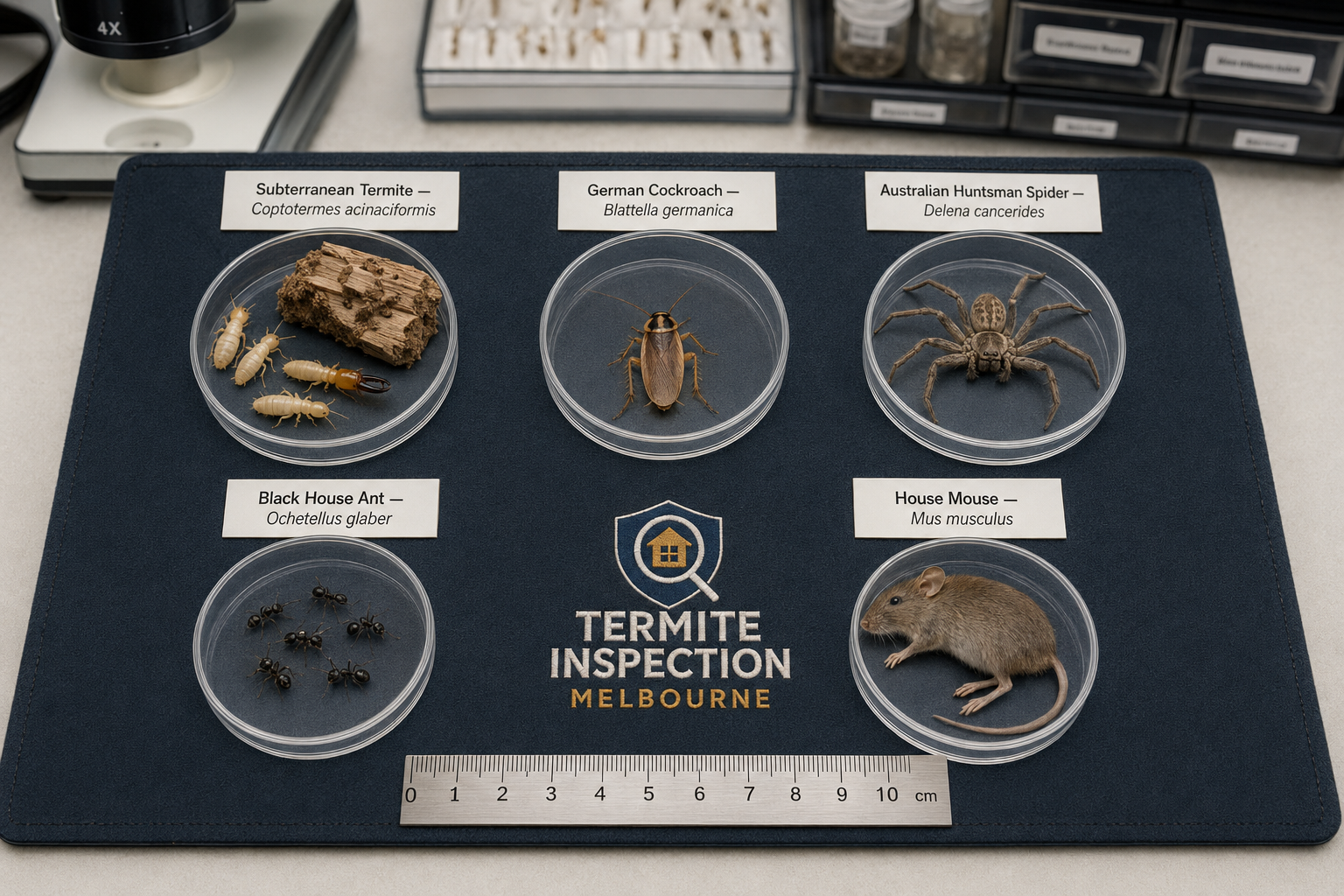
Whatever the Pest, One Call Covers It

From subterranean termites to a commercial kitchen HACCP program, speak directly with our certified Melbourne pest experts and book your professional treatment today — save $250 off complete termite barrier installations plus a free thermal scan ($150 value) when you book this week. Whether you've spotted a single warning sign or you're managing an established compliance program across multiple sites, the same licensed, AEPMA-certified team handles every category covered in this guide.

🎯 Offer ends 15th September 2026 • ✓ Licensed & Insured • ✓ 4.9★ Rated

Service Coverage

199+ Melbourne suburbs. Residential, commercial & hospitality. Clyde North based, rapid-response team.

Contact & Hours

📞 0466 929 533

38 Graziers Crescent, Clyde North VIC 3978
Service area: Melbourne & surrounds

© 2026 Termite Inspection Melbourne — TIM's Pest Control. Licensed & insured. AEPMA-certified. Emergency same-day options subject to availability.

Offer valid until 15th September 2026 • Service area: 199+ Melbourne suburbs