“Manage a 60-lot tower and TIM coordinated access with every resident without us lifting a finger. Report was exactly what our committee needed for the AGM.”
AEPMA-certified strata pest technicians • $20M public liability cover
Strata & Body Corporate Pest Control Services Melbourne
Coordinating multi-unit schedules seamlessly, protecting common property assets from destructive subterranean termites, resolving cross-lot pest disputes fairly, and delivering transparent, AGM-ready reports for Owners Corporation committees — this is strata pest control built specifically around how a body corporate actually operates, not a residential booking process stretched to fit a much larger and more complex job with far more stakeholders involved.
- ✓ Multi-unit access & notice coordination
- ✓ Committee-approved consolidated billing
- ✓ AGM-ready reporting, every visit
- ✓ $20M public liability insurance
Strata & body corporate enquiries
Request a Committee Quote
Multi-unit coordination, committee-approved billing, exact fixed pricing. A commercial account manager will confirm your quote within one business day.
Prefer to build a fixed-price booking instead? Use our full quote calculator.
🏢
Multi-Unit Coordination
Access & notices handled
📋
AGM-Ready Reports
Committee-formatted
🛡️
$20M Public Liability
Certificates on request
⏱️
Priority SLA Response
Same/next business day
📍
199+ Suburbs
Clyde North to CBD
⭐
4.9 Rating
2,000+ reviews
Eight modules, everything a committee needs to know
How Strata Pest Control Melbourne Actually Works
Body corporate pest management Victoria strata managers rely on is a genuinely different discipline to a single residential booking — it involves navigating Owners Corporation regulations, coordinating dozens of individual access points, and producing documentation a committee can act on. This guide breaks the whole process into eight modules covering exactly how we work with Melbourne strata clients, from first inspection through to your next AGM, and what to expect at every stage of the relationship.
⚖️
Module 1
Complex Dynamics & OC Regulations
🏗️
Module 2
Common Property Termite Defense
🗝️
Module 3
Multi-Unit Coordination
🗑️
Module 4
Shared Facility Pest Control
🔬
Module 5
Thermal Imaging & Diagnostics
💲
Module 6
Committee Pricing & Agreements
📄
Module 7
Reporting, Invoicing & Insurance
🤝
Module 8
Why Strata Managers Choose Us
Module 1
The Complex Dynamics of Strata & Body Corporate Pest Control
Before any treatment plan makes sense, everyone involved needs a shared understanding of who is actually responsible for what — this is where most strata pest disputes start, and where a properly documented inspection ends them.
Common Property vs Private Lot Responsibility
Under Victorian Owners Corporations legislation, the Owners Corporation generally holds responsibility for maintaining and repairing common property — shared roof spaces, external walls, car parks, gardens, lobbies, and structural elements not exclusively owned by a single lot. Individual owners are typically responsible for pest issues confined entirely within their own unit. In practice, termites rarely respect that line neatly, which is exactly why a whole-building assessment matters more here than in a standalone home.
Why Termite Colonies Cross Boundaries
A subterranean termite colony travels through soil and then through whatever timber and wall cavity structure connects to it — a shared subfloor, a party wall between two units, a structural column running through several levels. A colony that starts in common property can reach a private lot, or vice versa, without any regard for strata title boundaries, which is why isolated lot-by-lot pest bookings routinely miss the bigger picture.
Resolving Cross-Lot Disputes Fairly
Where a colony has entered through common property before reaching a private lot, our inspection report documents exactly where the entry point was and how far the activity extends — the evidence base your committee and any affected owner need to reach a fair, defensible cost split rather than a drawn-out argument at the next general meeting.
Why This Sets the Foundation for Everything Else
Every module that follows — from the physical inspection methodology to how invoices get split — depends on getting this common-property-versus-private-lot distinction right from the outset. It's the single most important concept in strata pest management, and the one most often skipped by a provider used to residential-only bookings.
Module 2
Common Property Termite Defense & Subfloor Audits
Apartment building termite inspection work is fundamentally different from a house — the shared structures involved are larger, harder to access, and often support far more residents if something goes wrong.
Shared Car Parks & Basement Structures
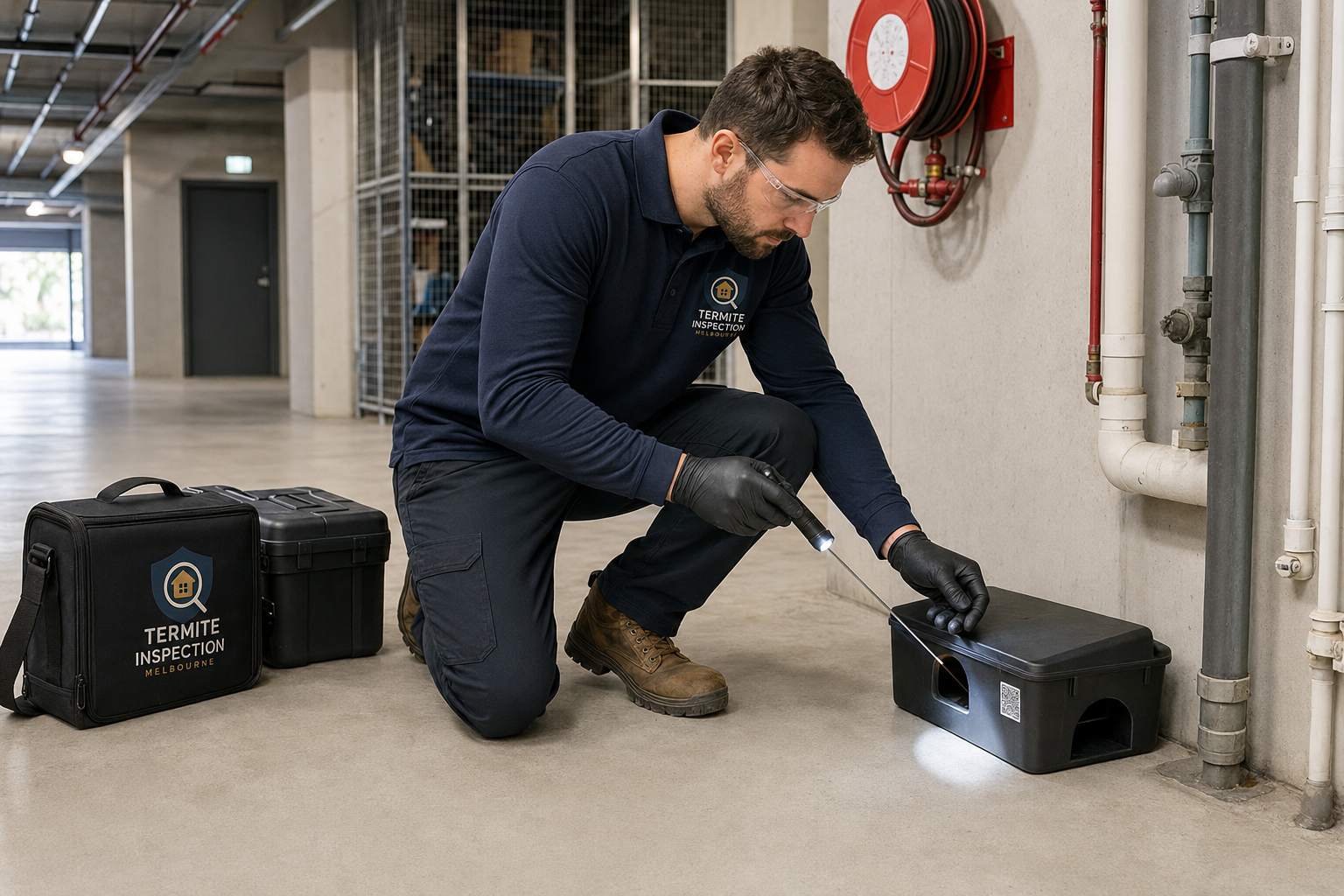
Basement and undercroft car parks sit directly against soil and structural columns that carry the building above — exactly the conditions a subterranean termite colony needs. These areas are assessed for mud tubes along columns and retaining walls, and moisture readings taken where drainage or waterproofing issues may be creating an entry point.
External Wall Cavities
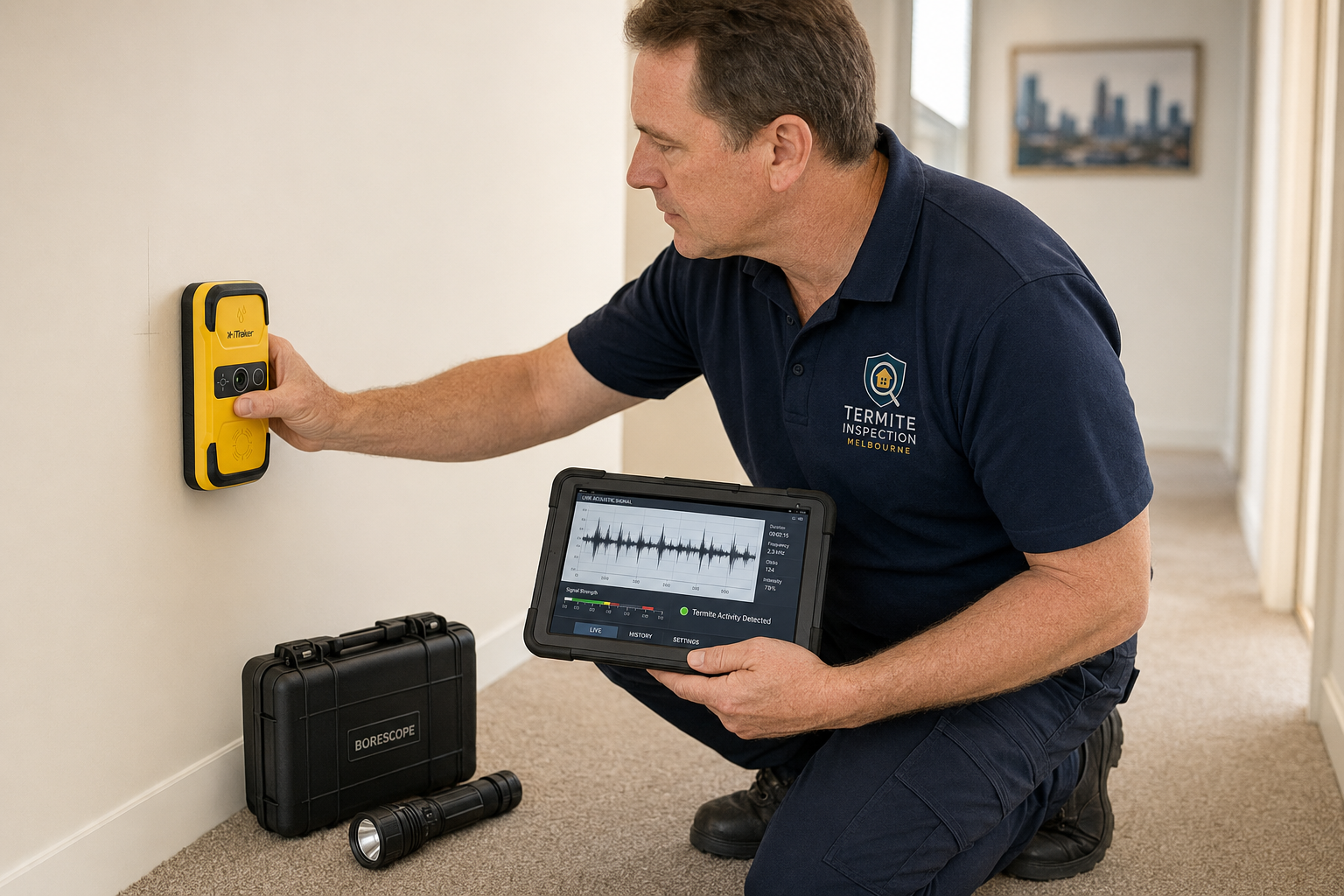
Shared external walls between multiple units are checked using thermal imaging and, where warranted, Termatrac radar, since a colony travelling up an external wall cavity can affect several units on different floors along the same structural line without ever being visible from inside any single apartment.
Common Gardens & Landscaped Areas
Shared garden beds, mulch and landscaping built up against the building foundation are inspected for the same risk factors as a residential property — timber-to-ground contact, poor drainage, and vegetation providing a moisture-retaining bridge to the structure — but across an area that can span an entire building perimeter.
Multi-Unit Foundation Assessment
Where subfloor or foundation access is possible, stumps, bearers and joists supporting multiple units are inspected as a single connected system rather than unit by unit, since damage or activity found under one unit is highly relevant to every neighbouring unit sharing the same structural bay.
Why aggressive species matter more here: Melbourne's dominant subterranean termite genus, Coptotermes, forms large, aggressive colonies capable of significant damage in a relatively short time. In a multi-unit building, that translates to a wider footprint of potential structural risk and a larger number of affected residents than the same colony would ever reach in a standalone home, which is exactly why an annual building-wide audit — rather than a reactive response after a single unit reports an issue — is the standard we recommend for every strata client regardless of building age.
Module 3
Multi-Unit Coordination & Notice Management
Getting access to a single house is simple. Getting compliant, coordinated access to dozens of apartments or townhouses without becoming a full-time administrative burden for a strata manager is a different problem entirely — one this module is built specifically to solve.
Entry Notice Drafting & Review
We can draft or review the entry notices your building needs to distribute to owners and tenants ahead of a common property inspection, matching whatever notice period your Owners Corporation rules or lease terms require.
Tenant & Owner Reminders
Follow-up reminder communications ahead of the scheduled date reduce no-access issues on the day, which otherwise turn a single inspection visit into several partial return trips.
Locksmith & Master-Key Coordination
Where a building manager or concierge holds master-key or fob access, we coordinate directly with them rather than routing every access request back through the strata manager personally.
Building Manager & Concierge Liaison
For buildings with on-site staff, we liaise directly with the building manager or concierge for common-area and car park access, scheduling around building operations rather than around our convenience.
The coordination difference: a strata manager's time is better spent managing the building, not chasing forty individual residents for access windows one by one. Handling this coordination is part of what makes a dedicated strata service meaningfully different from booking a residential provider for a large job.
Module 4
Shared Facility Pest Control (Bin Rooms, Lobbies & Gardens)
Common property pest control services need to cover the everyday shared spaces residents actually use and notice — the areas most likely to generate a resident complaint to the committee if left unmanaged.
Bin Room Rodent Pressure
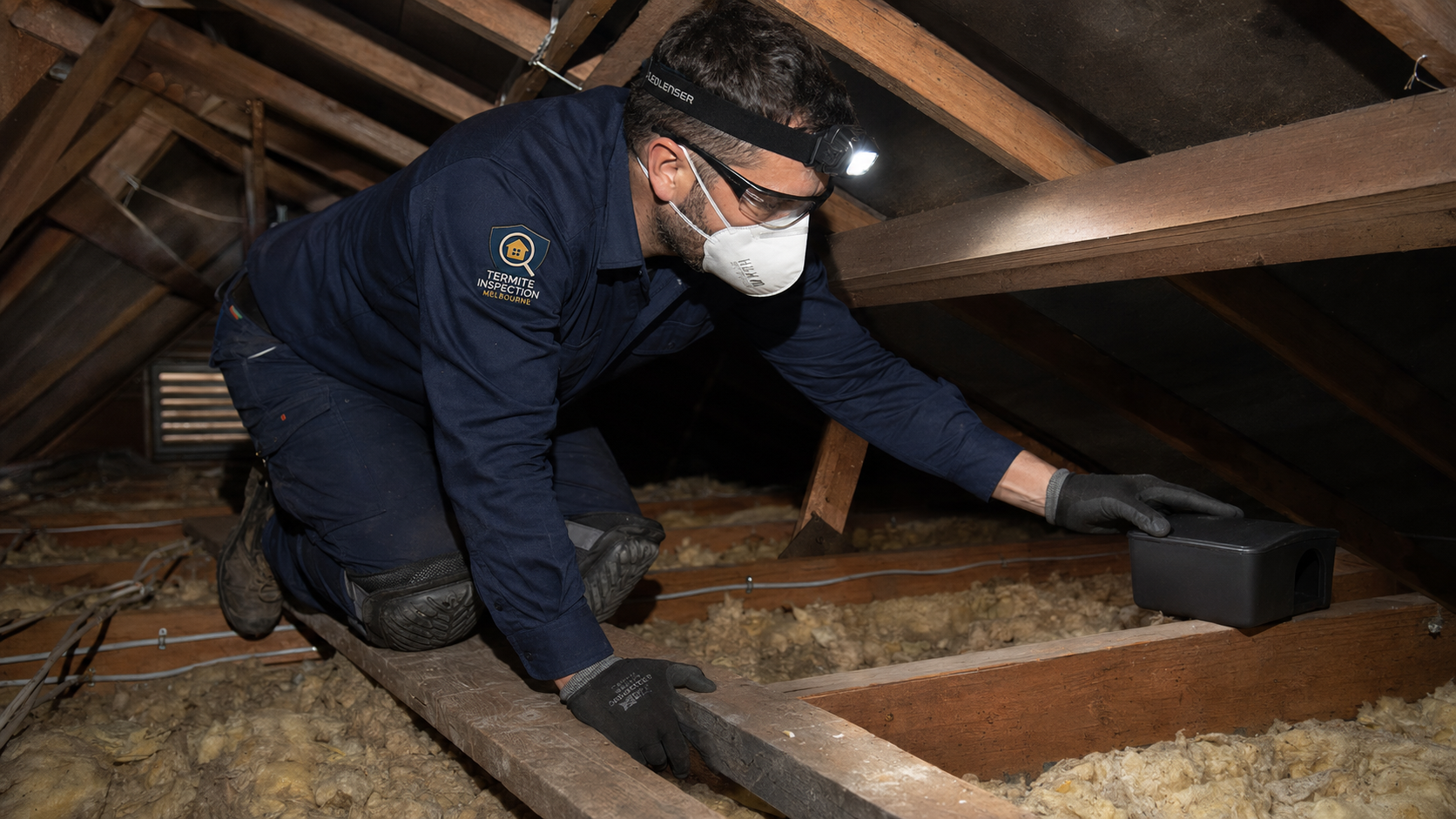
Waste storage areas are one of the highest rodent-pressure zones in any multi-unit building, given the constant food source and shelter opportunities among stored bins and enclosures. Bait station placement and monitoring, combined with exclusion work on any structural gaps, addresses the issue at its source rather than just knocking down visible activity.
Lobby & Common Corridor Treatment
Ant trails, spider webbing and general pest activity in shared lobbies and corridors are treated on a scheduled basis as part of a maintenance agreement, since these are the first spaces visitors and residents see and among the fastest to generate a complaint if left unattended.
Balcony & Solar Panel Bird Proofing
Pigeon and bird activity on shared balconies, ledges and rooftop solar installations creates both a hygiene issue and, on solar panels specifically, a fire and maintenance risk from dropping accumulation. Exclusion netting and spike systems address this without harming the birds.
Common Lawns & Recreational Areas
Shared lawns, BBQ areas and recreational facilities are treated for general pests — ants, wasps, ticks in grassed areas — on the same scheduled basis as the building's other common property, keeping resident-facing amenity spaces genuinely usable year-round.
Module 5
Advanced Thermal Imaging & Non-Destructive Testing
You can't demolish a shared party wall or structural column to check for termites — the diagnostic technology in this module exists specifically to see further than a visual inspection without damaging a structure dozens of residents depend on.
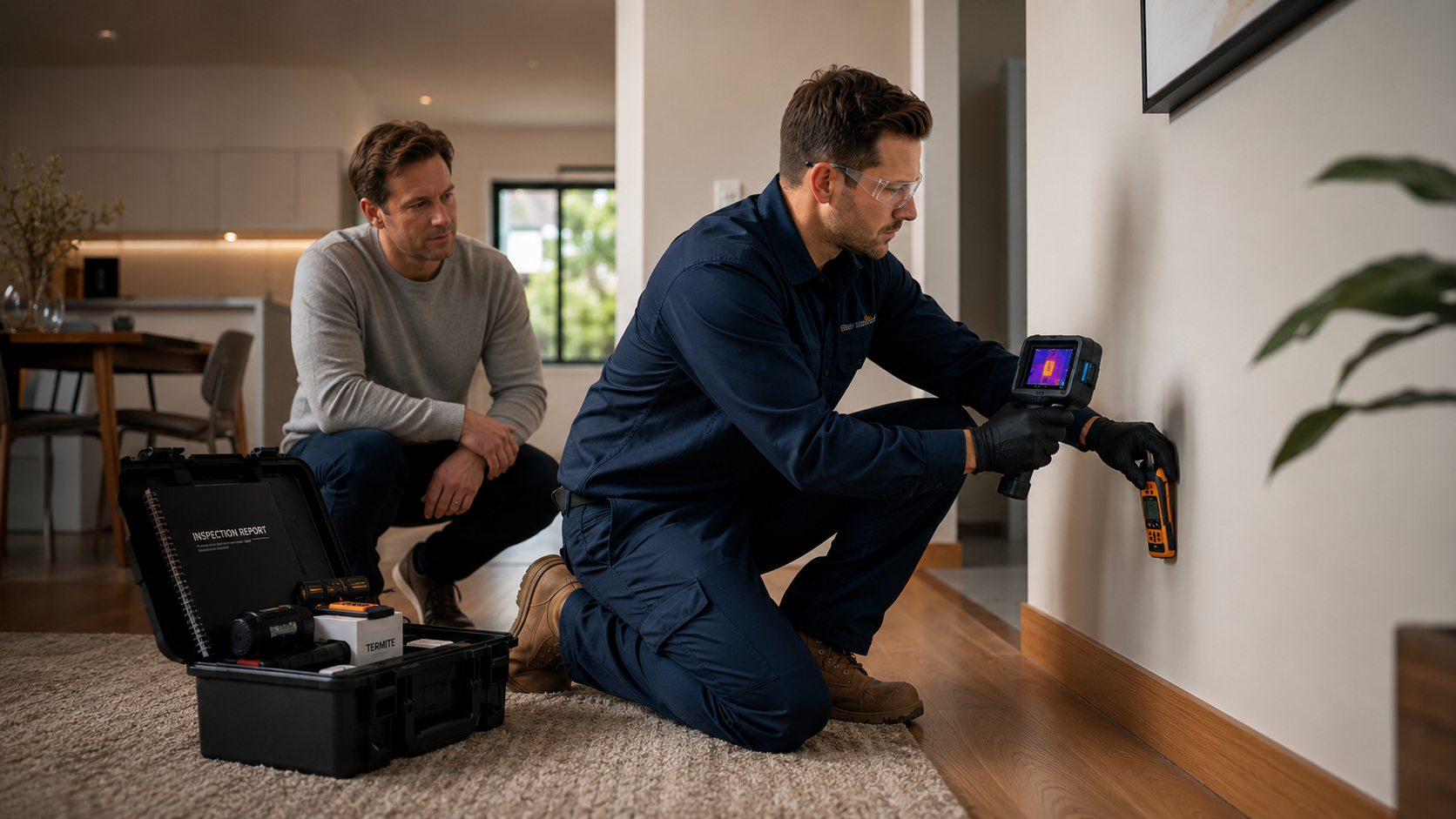
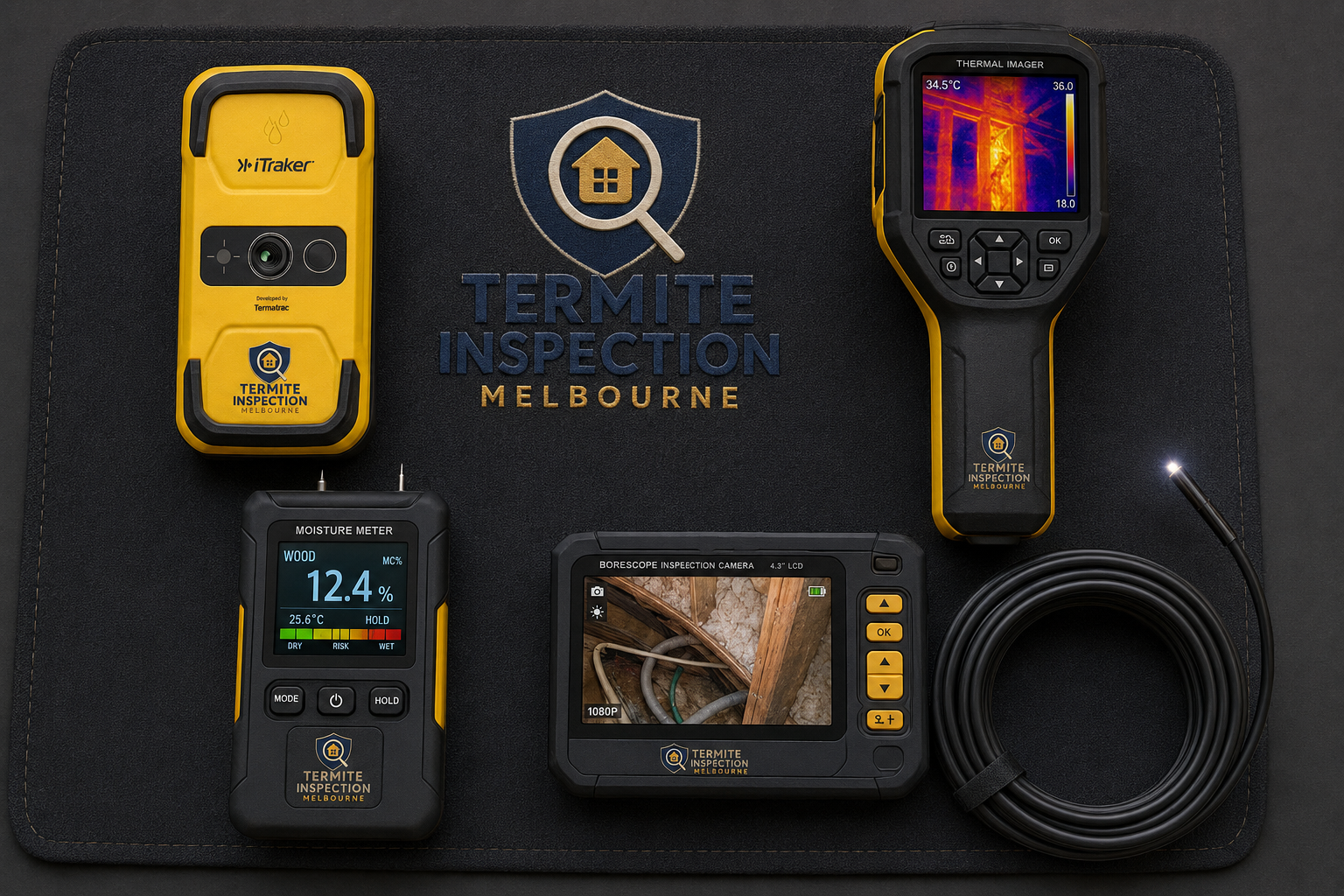
🌡️ FLIR Thermal Imaging on Shared Structures
Thermal cameras scan party walls, structural columns and ceiling cavities for temperature and moisture anomalies consistent with termite activity, directing our technician to the exact spot needing closer investigation across a structure shared by multiple lots.
📡 Termatrac Radar for Structural Columns
Microwave radar detects live termite movement inside structural columns and load-bearing elements without any drilling — critical in a multi-story building where these elements can't simply be replaced or opened up for inspection the way a house stump can.
💧 Moisture Mapping Across Shared Walls
Tramex moisture meters take objective readings across shared walls and common areas, particularly valuable for identifying which side of a party wall a moisture or termite issue originates from before any cost-allocation conversation happens.
Family and pet-safe formulations: with residents living throughout a treated building, lower-toxicity, family and pet-friendly product options are available for common area treatments, and we always confirm re-entry timeframes clearly with your building manager so they can communicate them to affected residents ahead of time rather than after the fact.
Module 6
Transparent Committee Pricing & Maintenance Agreements
A strata management pest quote Melbourne committees can actually approve needs to be structured for how a body corporate budgets and pays, not adapted awkwardly from residential pricing.
Essential Strata Plan
An annual common property termite inspection plus one general pest visit for shared areas each year, suited to smaller, lower-risk complexes wanting baseline compliance coverage.
Most Popular
Standard Strata Plan
Bi-annual termite inspection, quarterly common area treatment, and ongoing rodent monitoring in bin rooms and car parks — the right fit for most established apartment and townhouse complexes.
Premium Strata Plan
Quarterly termite and pest inspection, monthly monitoring, priority SLA response times, and a full AGM-ready reporting package — built for larger or higher-risk buildings and portfolios wanting the fastest response commitment.
Structured Cost Allocations
Where a job spans both common property and a specific lot, or where a cost needs to be split proportionally by lot entitlement, we provide a cost breakdown structured to match however your committee needs to allocate the expense across owners.
Bulk Lot-Count Discounts
Pricing scales sensibly with building size — larger lot counts receive proportionally better per-lot value on a maintenance agreement, recognising the efficiency of servicing many units in a single coordinated visit rather than dozens of separate bookings.
Consolidated invoicing: every maintenance agreement is billed as a single consolidated invoice to the Owners Corporation trust account, not split across dozens of individual lot invoices — exactly the format your committee treasurer and strata management software expect, and one less reconciliation headache heading into your next financial year audit.
Module 7
Compliance Reporting, Invoicing & $20M Insurance
The paperwork behind a strata pest service matters as much as the treatment itself — it's what your committee, your insurer, and your next auditor will actually look at, often long after the technician has left the building.
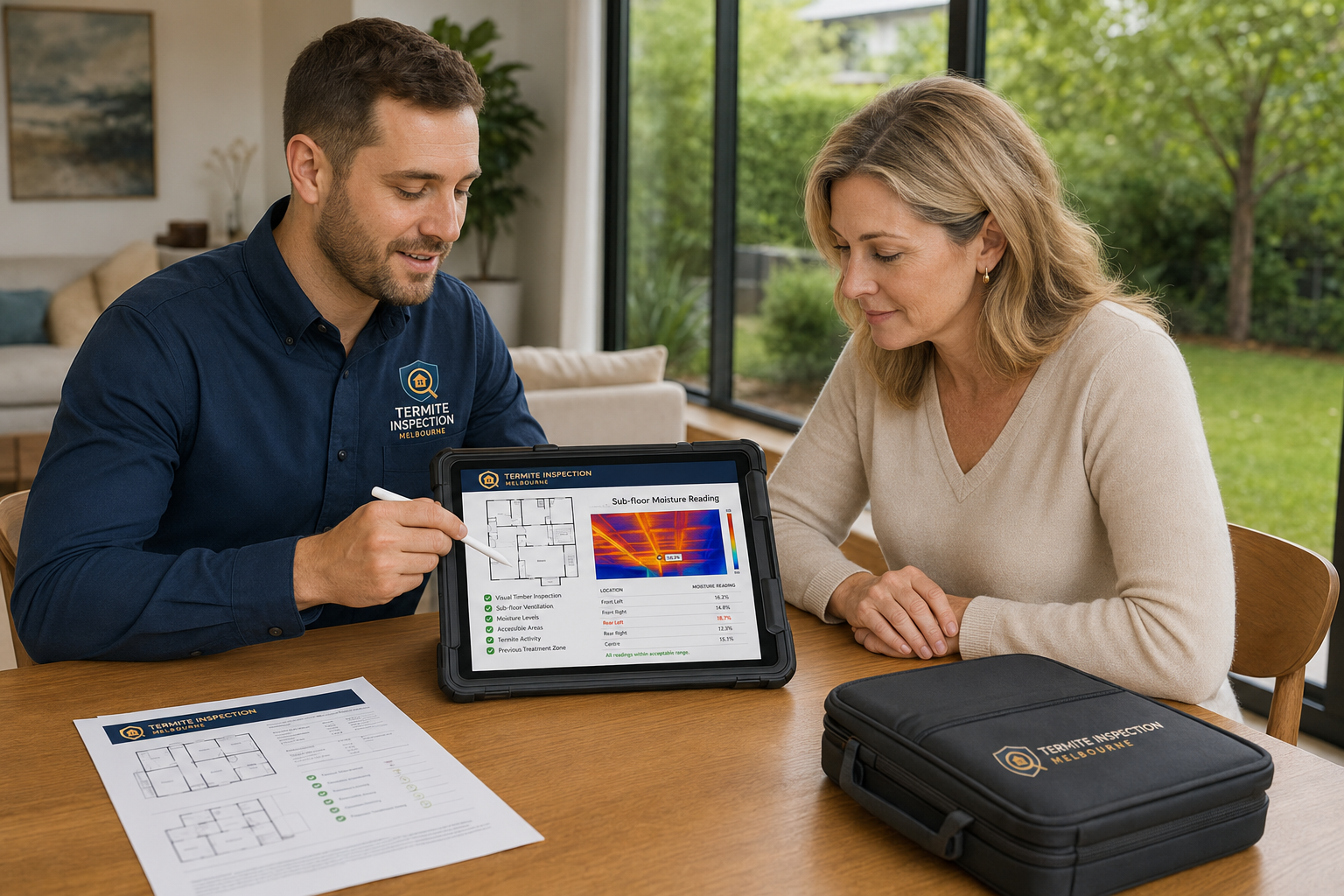
Committee Meeting-Ready Reports
An executive summary suitable for minutes, itemised findings by common property zone, and photographic evidence throughout — built to be read and acted on at a committee meeting, not just filed away.
Tax Invoices for Trust Accounts
Every invoice is formatted correctly for your strata trust account and accounting software, with the detail your treasurer needs for reconciliation without back-and-forth requests.
$20M Public Liability Documentation
Certificates of currency for our $20 million public liability policy are provided as standard and can be sent directly to your strata manager or insurer whenever required, without you needing to chase us.
AGM Presentation Support
We can attend an AGM or committee meeting in person or by phone to answer questions about a report or a proposed maintenance agreement directly, if your committee would find that useful.
Module 8
Why Melbourne Strata Managers Partner Exclusively With TIM's
The reasons a strata management company chooses one pest control provider over another usually come down to a handful of concrete, checkable factors — here's ours, in plain terms rather than marketing language.
Police-Checked Technicians
Every technician entering a residential building is background-checked, which strata managers can confirm and communicate to residents with confidence.
Reliable SLA Response Times
Response time commitments are confirmed in writing as part of your maintenance agreement — no ambiguity about what "urgent" or "priority" actually means for your building.
Deep Portfolio Expertise
Experience across Melbourne metropolitan body corporate portfolios, from small townhouse complexes to large inner-city towers, means we've genuinely seen your building type before.
One Point of Contact
A dedicated commercial account manager for your building or portfolio, rather than a rotating call-centre queue every time you need to make contact.
Why a dedicated strata provider matters
Strata Pest Control Providers Compared
Not every pest control option is built to handle the coordination, documentation and insurance a body corporate genuinely needs — here's how the common choices actually stack up on the criteria that matter to a committee, not just the criteria that sound reassuring in a sales pitch, and the ones your committee will actually be asked about if a dispute ever ends up before VCAT.
| Provider | Multi-Unit Coordination | Owners Corporation Report Formatting | Common Property Warranty | $20M Public Liability |
|---|---|---|---|---|
| TIM's Dedicated Strata Service | ✓ Notices, tenants & locksmith coordinated | ✓ AGM-ready, committee-formatted | ✓ Written warranty on qualifying work | ✓ Certificates provided as standard |
| Standard Residential Pest Bookings | ✗ One property at a time | ✗ Generic residential report | ⚠️ Standard residential terms only | ⚠️ Variable, often lower cover |
| DIY Hardware Store Treatments | ✗ No coordination capability | ✗ None | ✗ None | ✗ None |
| National Corporate Aggregators | ⚠️ Compliant, generic scheduling | ⚠️ Standard template, less building-specific | ✓ Generally covered | ✓ Generally covered |
Our recommendation: a national aggregator can tick the insurance and compliance boxes on paper, but a dedicated local strata provider with direct knowledge of Melbourne's building stock and a genuine coordination process for multi-unit access is what actually makes the day-to-day experience of managing pest control across your portfolio simpler rather than harder, particularly once you factor in how much of that experience depends on responsiveness during an actual pest emergency rather than what's promised in a sales proposal.
Situations we resolve every month
Real Melbourne Strata Scenarios We Resolve
These are the situations strata managers actually call us about — not hypothetical edge cases, but the recurring pest management problems that come with running a multi-unit building week in, week out.
A Lot Owner Reports Termites, But No One Knows Who Pays
A resident notices hollow-sounding skirting in their unit and reports it to the committee, but nobody can say whether the colony originated in their lot or travelled in from common property. We inspect the full connected structure — the reporting unit, neighbouring units where access allows, and the common property structure between them — and document exactly where the activity is concentrated, giving the committee a factual basis for the cost conversation rather than a guessing game.
A New Strata Manager Inherits a Building With No Pest History
Management changeover often means incoming managers have little or no record of the building's pest treatment history, prior termite barriers, or outstanding issues. We can conduct a baseline building-wide assessment to establish exactly where the property stands, giving a new manager a clean, documented starting point rather than inheriting unknown risk.
Residents Are Complaining About Rodents Near the Bin Room
A handful of resident complaints about rodent sightings near waste storage can escalate into a committee agenda item fast if not addressed visibly and quickly. We provide both the treatment and the documentation the committee can point to when responding to resident concerns, showing the issue is being actively managed rather than ignored.
An Insurer or Auditor Requests Pest Management Records
Some building insurance policies and periodic strata audits specifically request evidence of an active pest management program, particularly for termite risk. Because every visit under a maintenance agreement is documented and dated, producing a complete pest management history for an insurer or auditor is a matter of pulling existing records, not scrambling to demonstrate compliance after the fact.
A confident committee decision starts with the right questions
What to Ask Before Signing a Strata Pest Management Contract
Whether you're comparing us against another provider or simply want to brief your committee properly before a vote, these are the questions worth asking any strata pest control provider upfront, and the answers your committee should expect in writing before a contract is signed.
🛡️
What's the public liability cover?
Ask for the exact figure and a current certificate — most Owners Corporations require a minimum level before approving common property work.
🗓️
How is access actually coordinated?
Get specifics on who drafts entry notices, who liaises with the building manager, and what happens if a resident doesn't grant access on the scheduled day.
📄
Can I see a sample committee report?
A genuine strata-focused provider should be able to show a sample report formatted for committee or AGM use, not a generic residential template.
💰
How is invoicing structured?
Confirm whether billing is a single consolidated invoice to the trust account or split across individual lots, and what the payment terms are.
⏱️
What's the actual SLA for urgent issues?
Get a specific, written response-time commitment for urgent common property issues, not a vague "as soon as possible."
🏢
Do they understand our building type?
Ask about experience with buildings of similar age, construction and lot count — the risk profile of a 1970s brick unit block is genuinely different from a new-build tower.
Building stock changes the risk profile
Melbourne Strata Microclimates & Architectural Challenges
From multi-story inner-city apartment towers in Southbank and Docklands to sprawling suburban townhouse complexes in the South East and on the Mornington Peninsula, Melbourne's strata stock presents genuinely different pest challenges building by building.
Inner-City Towers
Southbank, Docklands, CBD
High resident density concentrates bin room and lobby pest pressure, while basement car parks and service risers create structural pathways that need thermal imaging rather than a simple visual walkthrough.
Established Eastern & Northern Unit Blocks
Box Hill, Camberwell, Northcote
Older low-rise brick unit blocks with mature shared gardens and original subfloor construction carry meaningfully higher termite risk than newer buildings, and often have restricted subfloor access needing extra coordination.
South East Townhouse Complexes
Clyde North, Cranbourne, Berwick
Newer, larger complexes with more individual private courtyards and shared driveways mean more access points to coordinate, though generally lower subfloor risk given modern slab construction and installed barriers.
Mornington Peninsula Complexes
Mornington, Frankston, coastal suburbs
Coastal humidity and proximity to bushland increase general pest and wildlife pressure on shared gardens and balconies, alongside standard termite risk factors common across the wider region.
The takeaway for committees: your building's era, construction type and location all shift which module in this guide matters most for your specific complex — which is exactly why a strata maintenance agreement should be scoped to your building, not applied as a generic template across every property in a management company's portfolio.
For strata management companies, not just individual buildings
Portfolio Servicing for Strata Management Companies
If you manage multiple buildings rather than a single complex, a building-by-building approach to pest control quickly becomes an administrative burden of its own — different providers, different invoicing formats, different report styles across your whole portfolio.
One Account Manager, Whole Portfolio
A single dedicated commercial account manager coordinates scheduling and reporting across every building in your portfolio, rather than you managing separate relationships per site.
Consistent Reporting Format
Every building receives the same committee-ready report structure, making it easy to compare pest risk and treatment history across your portfolio at a glance.
Portfolio-Wide Scheduling
Annual and quarterly inspection schedules across multiple buildings can be coordinated together, reducing the scheduling overhead of managing each property's pest control calendar separately.
Volume-Based Portfolio Pricing
Management companies servicing multiple buildings can access portfolio-level pricing that reflects the total relationship, not just each individual building's lot count in isolation.
Worth raising early: if you manage several complexes across Melbourne, mention that when you request a quote — portfolio arrangements are scoped differently to a single-building agreement, and getting that context upfront means the proposal you receive actually reflects how your company operates rather than being reworked later once the full scope becomes clear.
Credentials your committee can verify
Accredited Local Team, Trusted by Melbourne Strata Managers
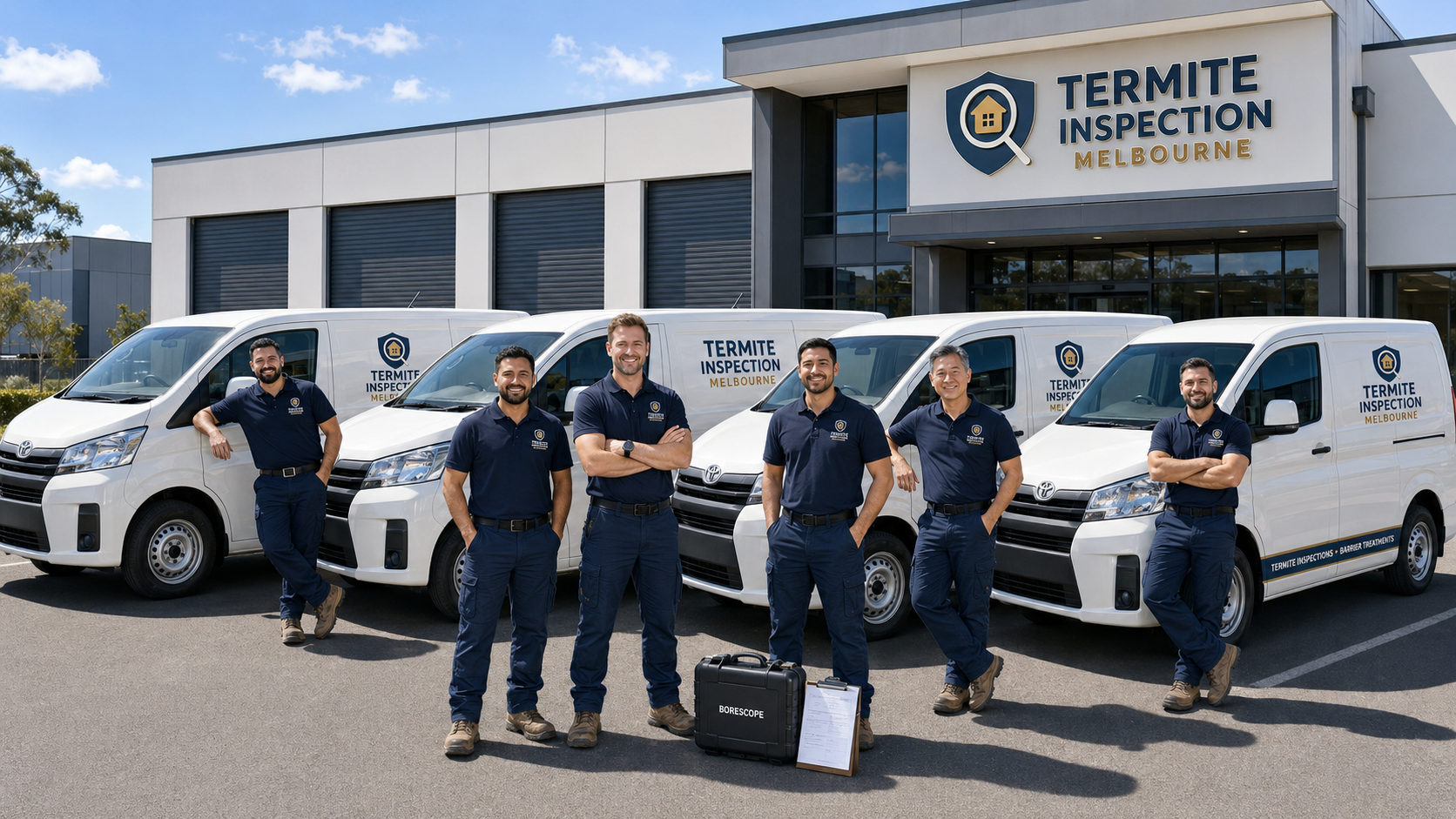
Every technician who enters your building is qualified, background-checked, and trained specifically in the coordination and documentation strata work demands.
$20M Public Liability Insurance
The level most Melbourne strata management companies require before approving common property work. Certificates provided as standard.
AEPMA-Certified Strata Technicians
Members of the Australian Environmental Pest Managers Association, with specific training in multi-unit and common property assessment.
AGM-Ready Reporting, Every Time
Committee-formatted reports and trust-account invoicing, without you needing to reformat or re-explain findings before a meeting.
Police-Checked Local Experts
Every technician is background-checked and Melbourne-based, entering shared residential buildings with the accountability that demands.
Trusted by Melbourne strata managers
What Strata Managers & Committees Say
Trusted across Melbourne for both residential and commercial pest work — here's what strata managers, committees and building managers say about their experience working with us across their portfolios.
4.9
Rated on Google
from 2,000+ local Melbourne properties
Verified customer reviews
“Termite activity found in a shared wall between two units. The report clearly showed where it entered from, which made the cost split conversation with owners so much easier.”
“Bin room rodent issue at our townhouse complex sorted within days. Committee was impressed with how detailed and professional the invoice and report were.”
“We manage a large portfolio and having one consolidated point of contact across multiple buildings has saved us hours every month.”
“Wasp nest in a common stairwell handled same day. Exactly the SLA response our maintenance agreement promised.”
“Have used them for two AGMs now to present termite inspection findings directly to owners. Professional and easy for residents to understand.”
Answers for strata managers and committees
Strata & Body Corporate Pest Control FAQs
How are pest control responsibilities divided between the Owners Corporation and individual lot owners in Melbourne? +
Under Victorian Owners Corporations legislation, the Owners Corporation is generally responsible for maintaining and repairing common property — shared roof spaces, external walls, car parks, gardens, lobbies and any other area not exclusively owned by a single lot. Individual lot owners are typically responsible for pest issues confined entirely within their own unit. Termites complicate this distinction, since a colony often travels through common property (a shared subfloor, an external wall cavity) before reaching a private lot, which is exactly why a coordinated, whole-building termite inspection matters more for strata properties than a lot-by-lot approach ever could.
Can you coordinate access notices and entry with multiple tenants and owners across a large apartment block? +
Yes — this is one of the most common reasons strata managers move away from a standard residential booking process. We work directly with your strata management company to schedule building-wide access, draft or review tenant and owner entry notices in line with your required notice periods, coordinate with your building manager or concierge for common-area and car park access, and arrange locksmith or master-key access where needed, all without you having to personally chase dozens of individual residents.
Do you provide formal reports and quotes formatted for committee meetings and annual general meetings (AGMs)? +
Yes — every inspection and treatment for a strata client is documented in a report structured specifically for committee review and AGM presentation: an executive summary suitable for minutes, itemised findings by common property zone, photographic evidence, and a clear cost breakdown suitable for trust account invoicing. We can also attend an AGM or committee meeting directly, in person or by phone, to answer questions about a report or a proposed maintenance agreement if your committee prefers that.
How do you handle common property termite inspections in multi-story buildings? +
Multi-story buildings present genuinely different access challenges to a standalone home — shared subfloors and car park slabs, external wall cavities running between units, and structural columns that can't be assessed the way a house stump can. Our technicians use FLIR thermal imaging and Termatrac microwave radar to non-destructively assess shared structural elements and party walls, combined with physical access to common property areas like car parks, service ducts, and shared garden beds where a colony is most likely to establish a route into the building.
What is included in your annual strata maintenance agreements? +
Our strata maintenance agreements are tailored to your building's size and risk profile, but typically include a scheduled annual or bi-annual common property termite inspection, general pest treatment for shared areas (lobbies, bin rooms, car parks, gardens), rodent monitoring station servicing, and a documented report after every visit. Pricing is structured with transparent bulk lot-count discounts and a single consolidated invoice for the Owners Corporation, rather than per-lot billing that's harder for a committee to approve and reconcile.
Who is responsible for paying for termite treatment if the colony affects both common property and a private lot? +
This is genuinely one of the most common disputes we help resolve. Where a termite colony has entered through common property (a shared subfloor or external wall) before reaching a private lot, the Owners Corporation is typically responsible for the common property portion of the treatment, while the lot owner may be responsible for any repair work confined entirely within their unit. Our inspection report documents exactly where the colony entered and how far it extends, which is the evidence base your committee and any affected lot owner need to reach a fair, defensible cost split.
Do you carry sufficient public liability insurance for a large strata complex? +
Yes — we carry $20 million in public liability insurance, which is the level most Melbourne strata management companies and Owners Corporations require before approving a contractor for common property work. Certificates of currency are provided as standard with every strata quote and can be supplied directly to your strata manager or committee for their records without you needing to chase us for paperwork.
How quickly can you respond to an urgent pest issue in a shared area like a bin room or lobby? +
Our strata clients receive priority SLA response times, with same-day or next-business-day attendance targeted for urgent common property issues — an active wasp nest in a shared stairwell, a sudden rodent problem in a bin room, or a resident-reported concern that needs fast resolution to avoid it escalating into a committee complaint. Response time commitments are confirmed in writing as part of your maintenance agreement, so there's no ambiguity about what "urgent" actually means for your building.
Can strata managers get a fast quote without a full site visit first? +
For a preliminary indicative quote, yes — our online booking calculator and the dedicated committee quote form on this page both accept building size, lot count and service type to generate a fast estimate for a straightforward job like a common area general spray or an annual termite inspection. Larger or more complex buildings, or anything involving confirmed termite activity, generally still need a brief site walkthrough to confirm final pricing, but we aim to turn that around quickly given how time-sensitive committee budget approvals often are.
Do you work with strata management companies across all of Melbourne, or only specific regions? +
We service strata and body corporate clients across 199+ Melbourne suburbs from our Clyde North base — inner-city apartment towers in Southbank and Docklands, established brick-veneer unit blocks in the eastern and northern suburbs, and townhouse complexes across the South East growth corridor and Mornington Peninsula are all within our regular service area. If you manage a portfolio spanning multiple regions, we can also discuss a consolidated servicing arrangement across your whole portfolio rather than booking each building separately.
Can we switch to TIM's mid-contract if we're unhappy with our current pest control provider? +
Yes — most strata pest service agreements aren't locked in the way some other trade contracts are, and switching providers typically just requires the appropriate committee approval and notice to your outgoing provider under your existing contract terms. We can conduct a baseline assessment as part of onboarding so you have an accurate, documented picture of the building's current pest status from day one, regardless of what records (or lack of records) your previous provider left behind.
How do you handle a building that has multiple owners corporations or a staged development? +
Larger developments with staged construction sometimes have multiple registered Owners Corporations covering different stages or a master Owners Corporation overseeing shared facilities across the whole site. We scope and quote against your building's actual legal structure, coordinating separately with each Owners Corporation where required, or working through a single master committee where that's how your development is set up — either way, invoicing and reporting are structured to match your building's real governance arrangement rather than a one-size-fits-all assumption.
What happens at the end of a maintenance agreement term — does it auto-renew? +
Agreement terms and renewal conditions are set out clearly in writing when you sign, and we'll always reach out ahead of a renewal date to review the past year's service history with your committee rather than relying on a silent auto-renewal. If your building's needs have changed — a lot count change, a new risk factor identified, or simply a desire to adjust the plan tier — that's exactly the point at which we'd recommend revisiting the agreement together.
Managing a Strata Complex? Secure Your Pest Management Program Today
Speak directly with our commercial account managers and secure your complex's pest management program today — save $250 off complete barrier treatments plus a free thermal scan ($150 value) when you book a common property assessment this week.
🎯 Offer ends 31th October 2026 • ✓ $20M Public Liability • ✓ 4.9★ Rated